← Chengdu

Chengdu · 武侯祠

Wuhou Shrine

🎫 Ticket ¥50 (~$7)
🕐 Duration 2–3 hours
🕘 Opening Hours 9:00 AM – 6:00 PM (last entry 5:00 PM)
🚇 Metro Line 3 · Gaoshengqiao
📍 Address 231 Wuhou Ci Street, Wuhou District, Chengdu Map ↗
🎧 10 audio walking guides for Wuhou Shrine — listen on the spot in the YOLO HAPPY app. →

Tips for international visitors

  • Admission is ¥50 per person; students and visitors over 60 pay half price (¥25).
  • Open 9 AM–6 PM with last entry at 5 PM; come on a weekday right at opening to beat the crowds.
  • Walk the Red Wall Passage by Huiling for the shrine’s most photogenic bamboo-shaded corridor.
  • Exit south into Jinli Ancient Street for Sichuan street food and Three Kingdoms souvenirs.

Inside Wuhou Shrine

South Gate & Screen Wall (Chengdu Wuhou Shrine) · 南门与照壁(成都武侯祠)

🎧 In app
South Gate & Screen Wall (Chengdu Wuhou Shrine)

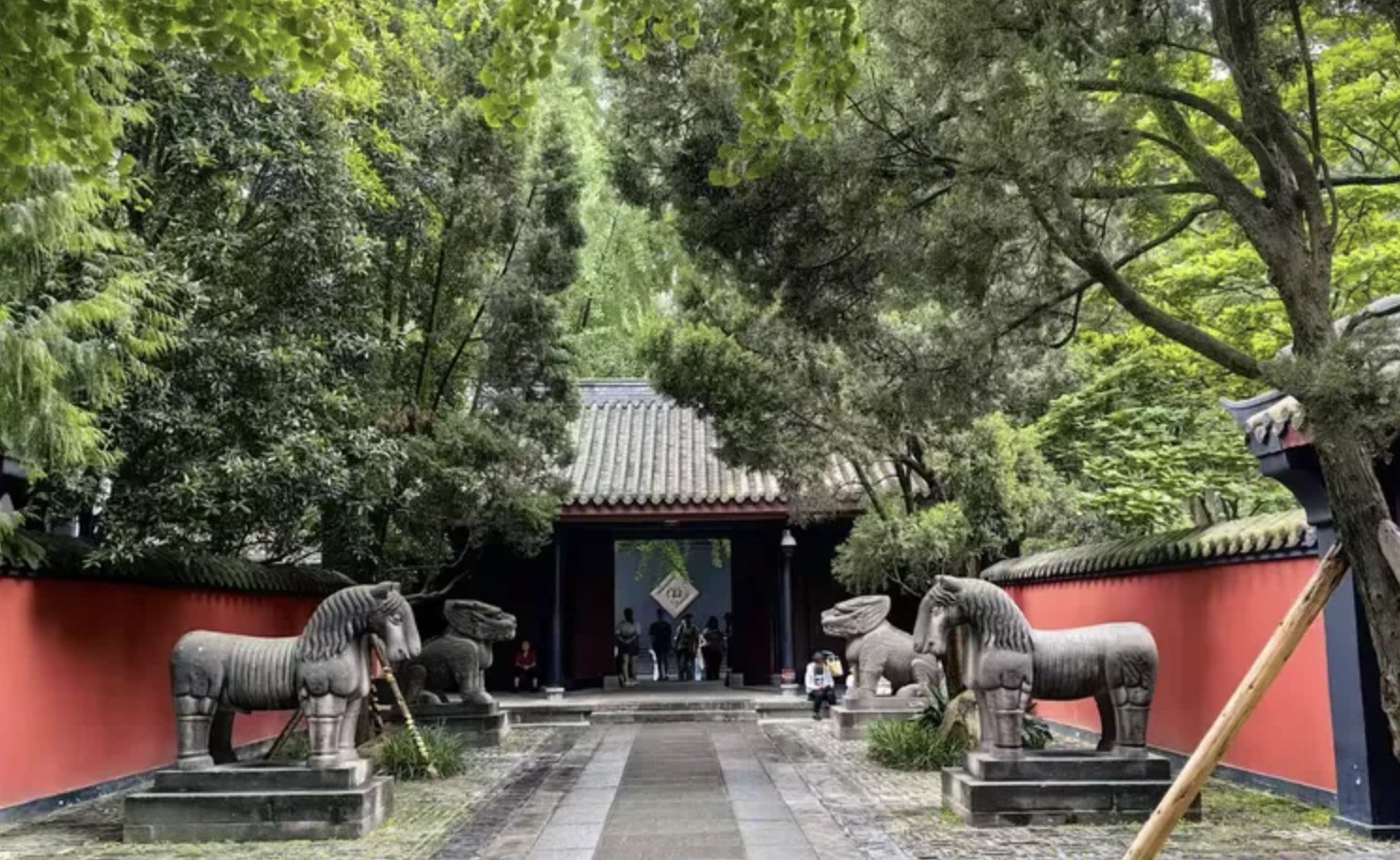
The vermilion screen wall outside the south gate bears the black-and-gold "Han Zhao Lie Miao" plaque—signaling that this is no ordinary Zhuge shrine, but a nationally unique co-enshrinement of sovereign and minister. The wall is ~18m long and ~6m tall, built of grey brick. The south plaza, shaded by green trees, often features Sichuan-opera face-changing performers and bronze statues. The "red wall with bamboo shadow" is one of Chengdu's most photogenic classical backdrops. During Spring Festival, the plaza hosts lantern shows and intangible-heritage markets.
Main Gate — Han Zhao Lie Miao (Chengdu Wuhou Shrine) · 大门——汉昭烈庙(成都武侯祠)

🎧 In app
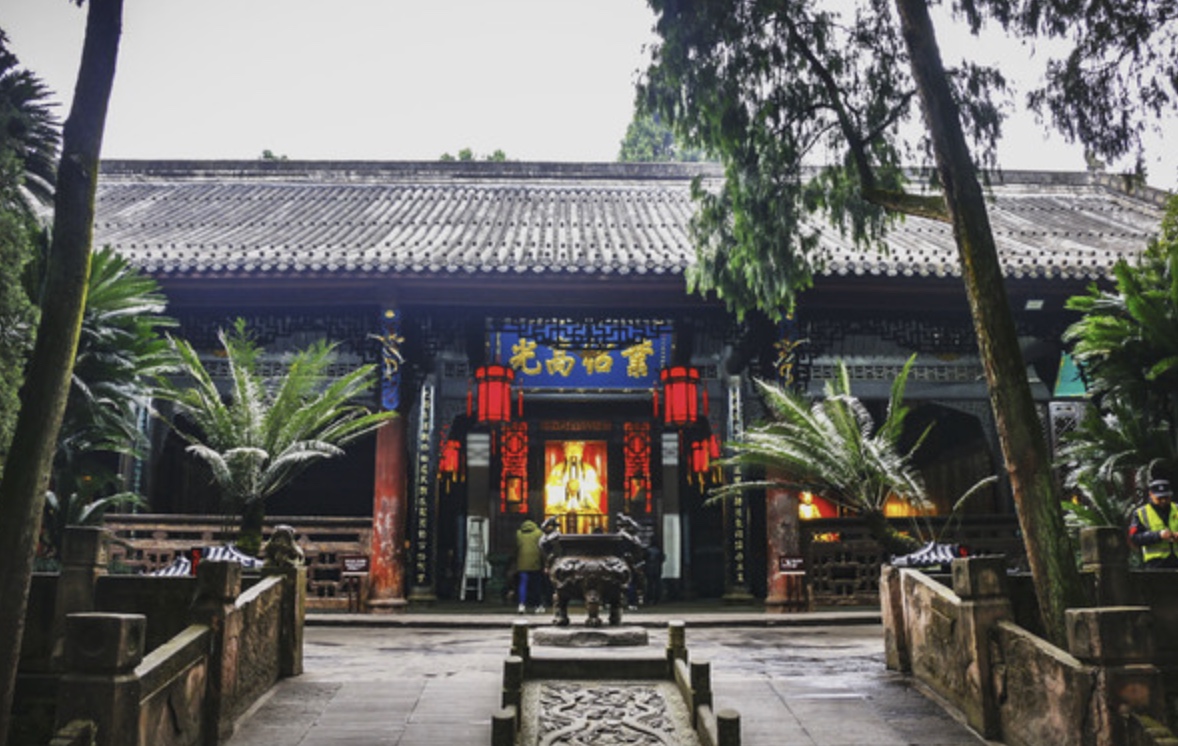
Main Gate — Han Zhao Lie Miao (Chengdu Wuhou Shrine)

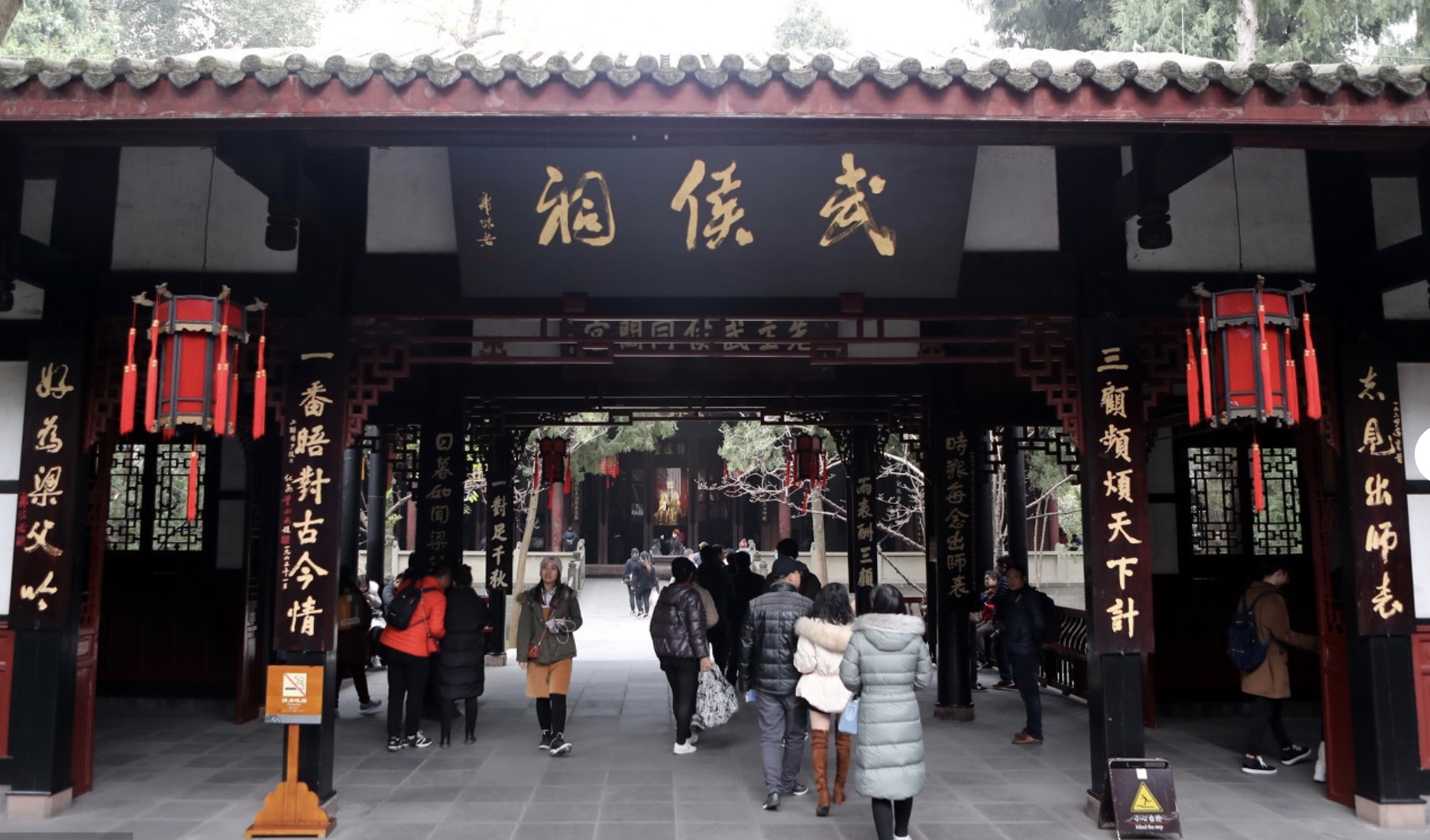
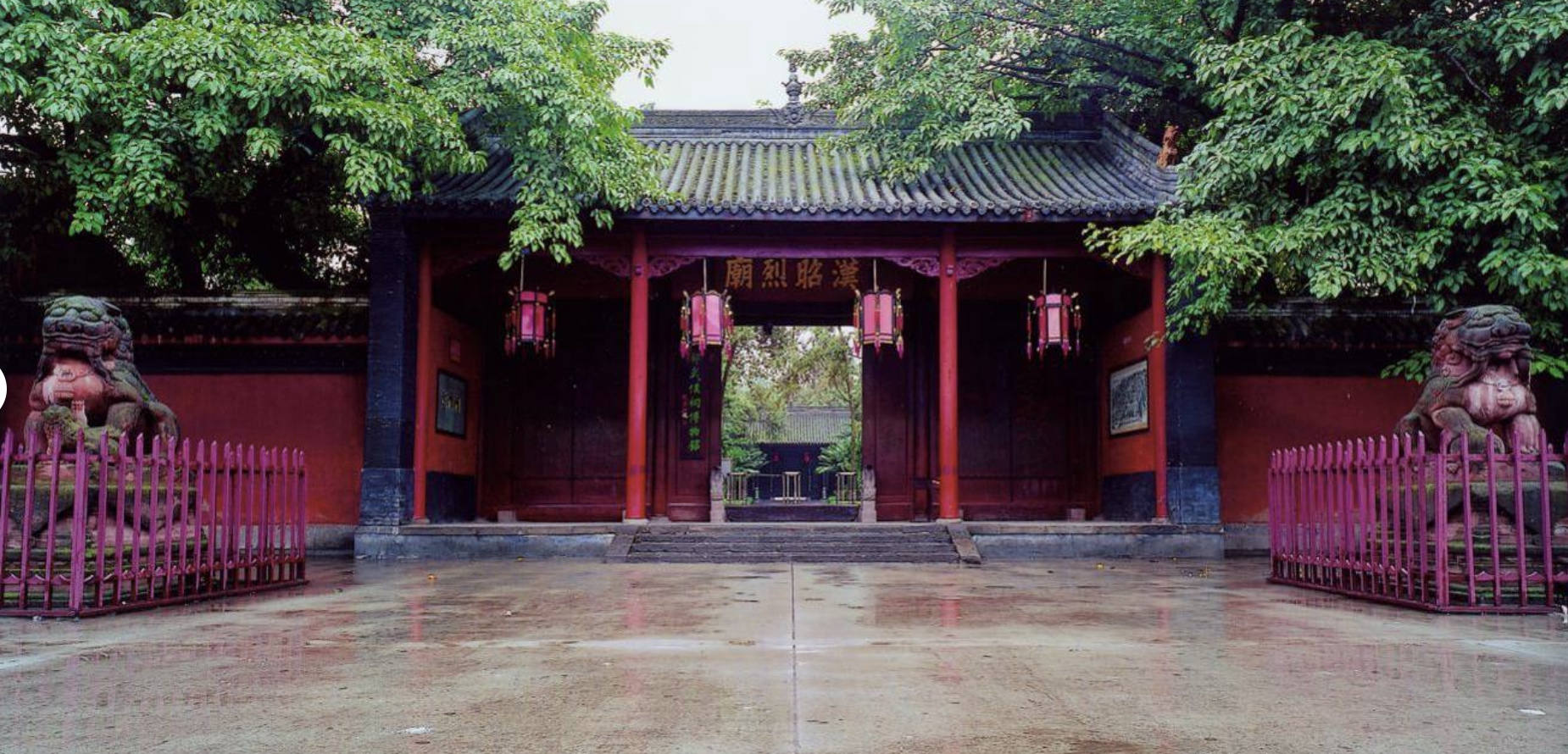
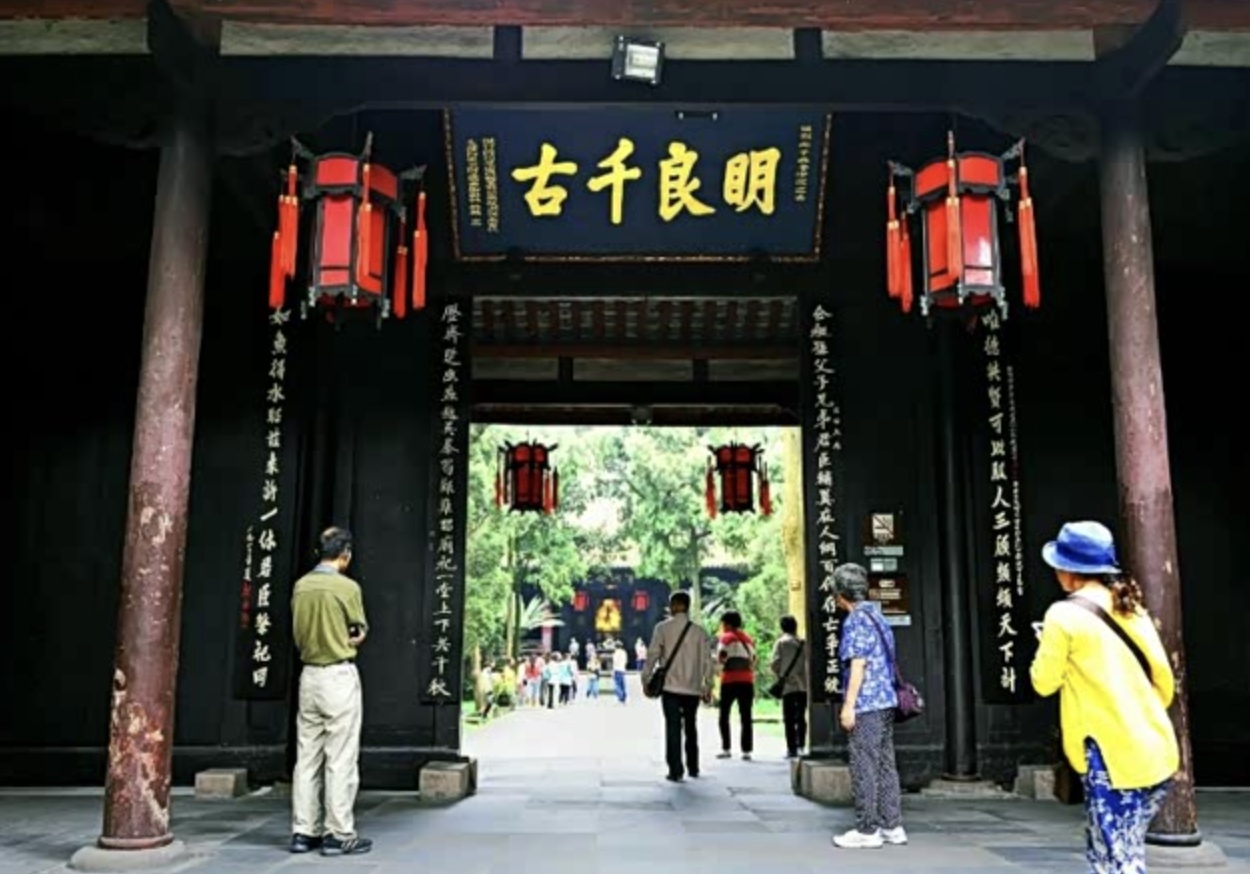
The main gate bears the gold character "Han Zhao Lie Miao," calligraphied by Guo Moruo in 1955. The gate is a single-eave overhanging-gable building, vermilion doors with bronze beast-head knockers, flanked by two stone lions carved in the Kangxi era. The plaque is the key to understanding the shrine's unique layout: as minister, Zhuge Liang's shrine should be in front, but during the early Ming the order was reversed—Emperor Liu Bei's "Han Zhao Lie Miao" stands ahead, Zhuge's behind. The tour officially begins here.

Second Gate & Tang Stele — Three Absolutes Stele (Chengdu Wuhou Shrine) · 二门与唐碑——三绝碑(成都武侯祠)

🎧 In app
Second Gate & Tang Stele — Three Absolutes Stele (Chengdu Wuhou Shrine)

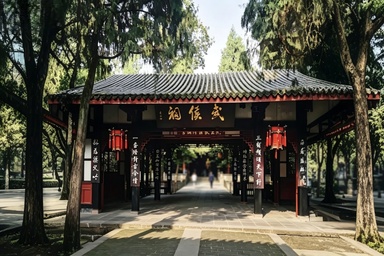
Crossing the main gate, the second gate bears Guo Moruo's 1944 "Wuhou Shrine" plaque, echoing the main gate's "Han Zhao Lie Miao" in the unique sovereign-minister protocol. Inside stands the "Three Absolutes Stele"—3.4m tall, 1.3m wide—composed by Prime Minister Pei Du, calligraphed by Liu Gongchuo, and carved by Lu Jian, 809 AD. The pavilion houses 20+ steles from Han to Qing dynasties, making it a one-stop showcase of 1,200 years of stone inscription. Visitors gain the key view of the central axis: Liu Bei's hall in front, Zhuge's hall behind.

Liu Bei's Hall — Main Hall of Han Zhao Lie Miao (Chengdu Wuhou Shrine) · 刘备殿——汉昭烈庙正殿(成都武侯祠)

🎧 In app
Liu Bei's Hall — Main Hall of Han Zhao Lie Miao (Chengdu Wuhou Shrine)

Liu Bei's Hall is the 3rd bay of the central axis, ~12m high, hung with the plaque "Ye Shao Gao Guang." Centered is the gilded seated statue of Emperor Zhaolie Liu Bei—robed, holding the jade tablet, dignified—the shrine's principal deity. Flanking the emperor are Guan Yu's three generations (Guan Ping, Guan Xing, Zhang Zun) and Zhang Fei's three generations (Zhang Bao, Zhang Zun); the side walls display 14 Shu Han elite statues (Zhuge Liang, Pang Tong, Zhao Yun, Ma Chao, Huang Zhong). The stone balustrade is finely carved, and the hall houses historic plaques including Zhuge Liang's "Collection" plaque and Lu You's poetry stele. Liu Bei's birthday celebration is held on the 26th day of the 6th lunar month.

Connecting Hall — Chu Shi Biao Stone Carving (Chengdu Wuhou Shrine) · 过厅——出师表石刻(成都武侯祠)

🎧 In app
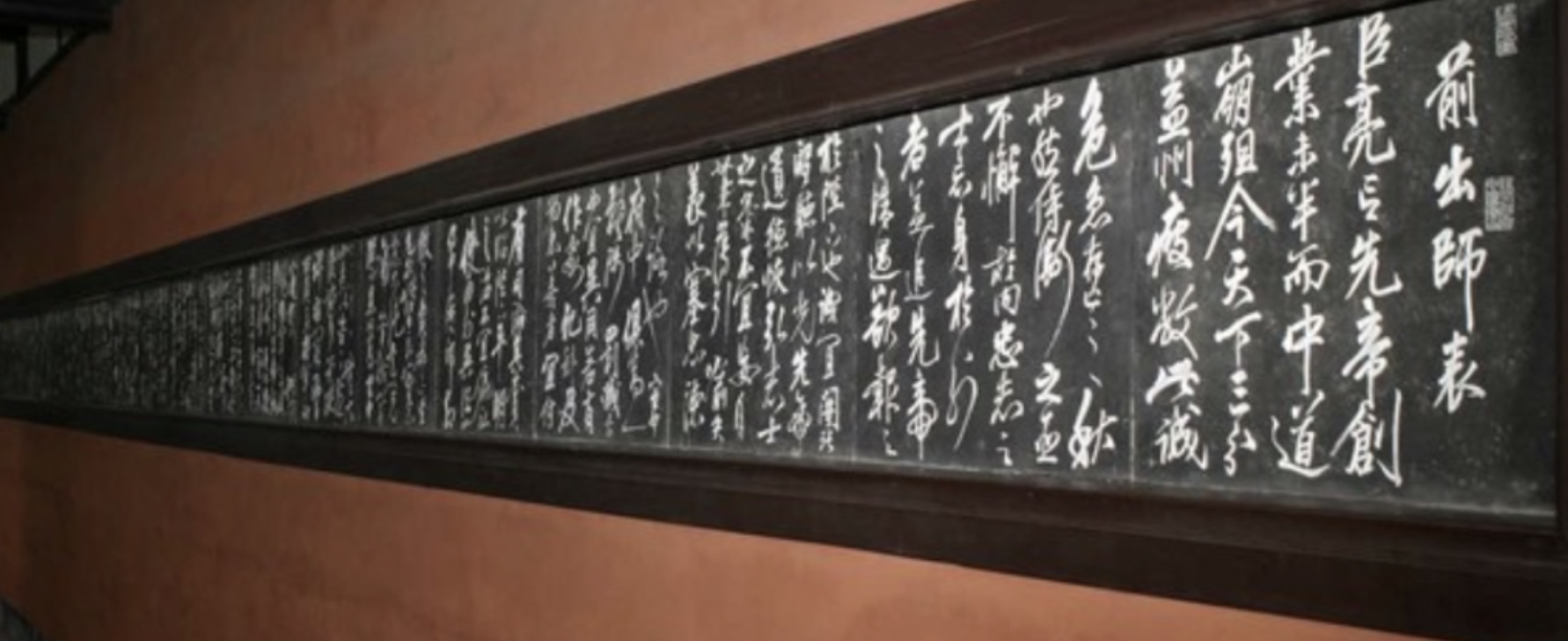
Connecting Hall — Chu Shi Biao Stone Carving (Chengdu Wuhou Shrine)

The connecting hall is the 4th bay on the central axis, functioning as a transition between Liu Bei's and Zhuge Liang's halls. Its south and north walls bear the "Chu Shi Biao" carvings—Yue Fei's calligraphy of the "Former" and "Latter Memorials." Yue Fei's running script is vigorous and powerful, bridging the two loyal figures 700 years apart. The carved plaques were re-engraved in the Guangxu era. The hall bears the "Jingyuan Tang" (Tranquility Hall) plaque, quoting Zhuge Liang's famous injunction: "Without tranquility, one cannot achieve far-reaching goals."

Zhuge Liang's Hall — Jingyuan Tang (Chengdu Wuhou Shrine) · 诸葛亮殿——静远堂(成都武侯祠)

🎧 In app
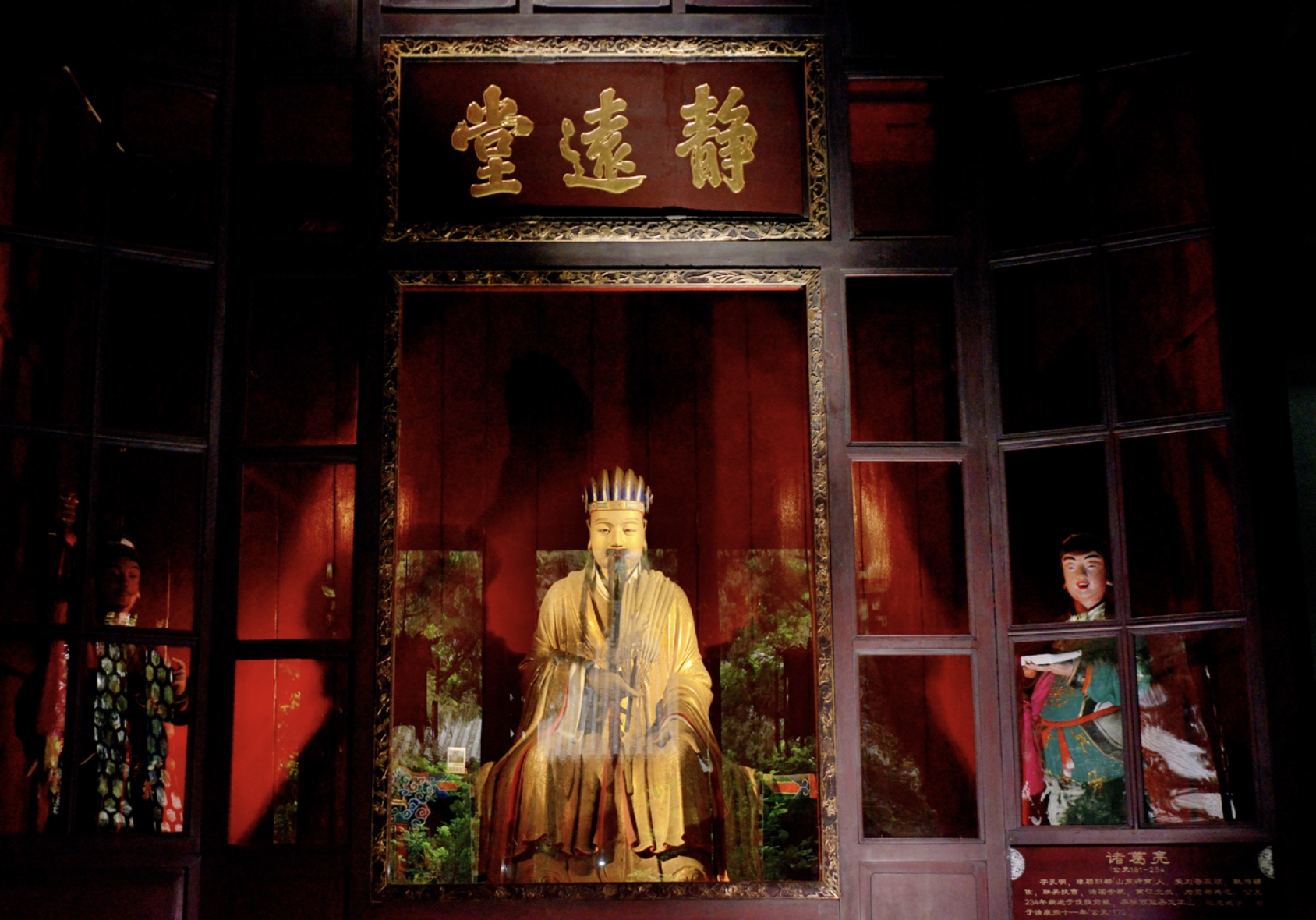
Zhuge Liang's Hall — Jingyuan Tang (Chengdu Wuhou Shrine)

Zhuge Liang's Hall, the 13m-high endpoint of the central axis, bears the Qing prince's "Eternal Fame" plaque. Inside, three generations of the Zhuge family are enshrined as gilded statues. Above Zhuge Liang's image is the "Yi-Zhou Sage" plaque—equating him to the legendary minister Yi Yin. The veranda displays the famous "Gongxin Couplet" by Zhao Fan (late Qing), essential for understanding Sichuan governance philosophy. The hall also houses the "Three Absolutes" original text, a Ming bronze drum, and Qing-era epigraphy exhibits.

Sanyi Temple (Chengdu Wuhou Shrine) · 三义庙(成都武侯祠)

🎧 In app
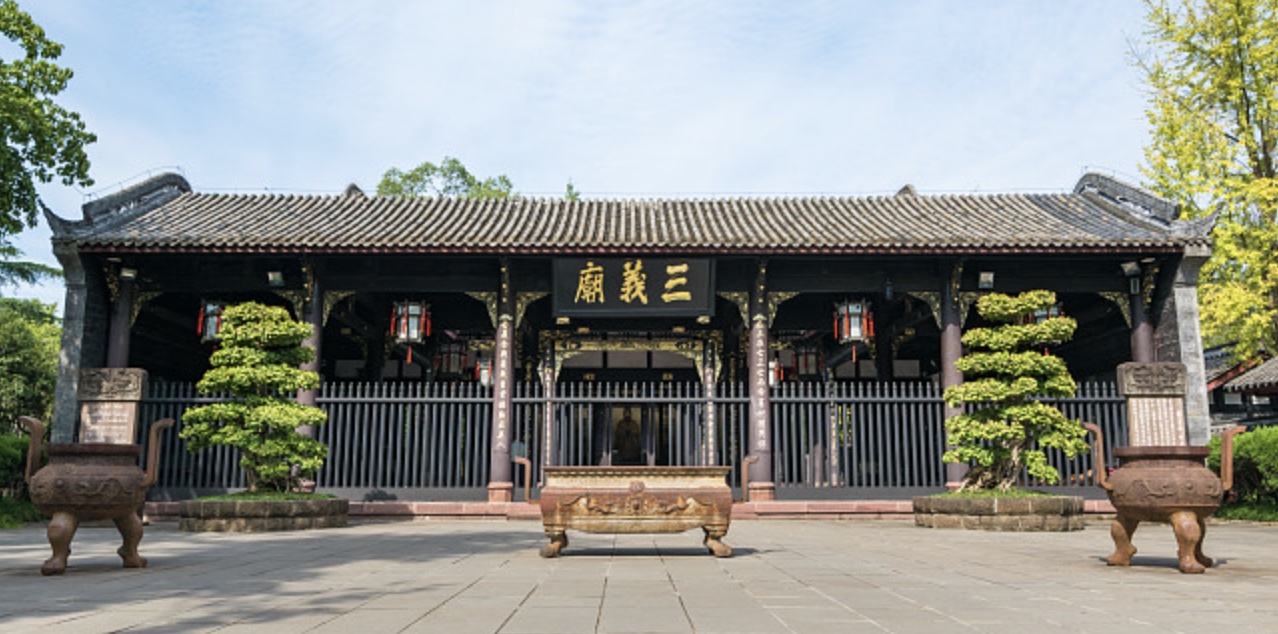
Sanyi Temple (Chengdu Wuhou Shrine)

Sanyi Temple, originally built in 1672 and relocated in 1998, now forms an independent courtyard at the southern end of the heritage zone. It enshrines the three sworn brothers: Liu Bei in the center, Guan Yu left, Zhang Fei right. The east/west wings display woodblock prints of Romance of the Three Kingdoms, replica weapons, and Guan Yu cultural exhibits. The temple complements the central axis's "sovereign-minister" theme with a "brotherly loyalty" focus. Guan Yu's birthday (24th day of 6th lunar month) features ceremonies and Sichuan-opera performances.

Guihe Tower, Qin Pavilion & Garden Area (Chengdu Wuhou Shrine) · 桂荷楼、琴亭与园林区(成都武侯祠)

🎧 In app
Guihe Tower, Qin Pavilion & Garden Area (Chengdu Wuhou Shrine)

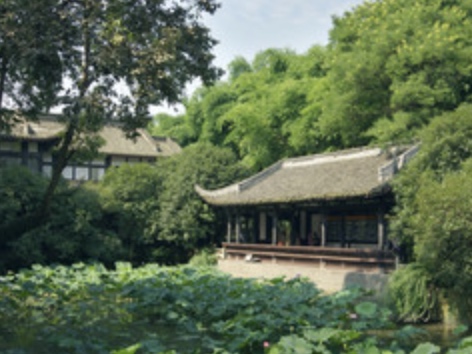
The garden area west of the main axis centers on the Guihe Pond, with the Qing-era civilian-style Guihe Tower, the hexagonal Qin Pavilion (named for Zhuge Liang's "Empty City Strategy"), and several smaller structures—Tingli Pavilion, Bicao Xuan, a boat pavilion, and a bonsai garden. The garden employs the "borrowed scenery" technique, pulling distant views of Zhuge Liang's Hall, Hui Ling Tomb, and the city wall into the pond's reflections. Autumn brings osmanthus and lotus together, while winter features red plum blossoms and stone lanterns. The garden is also home to calligraphy steles of "Chu Shi Biao" and "Jie Zi Shu."

Hui Ling — Joint Burial Tomb of Emperor Zhaolie Liu Bei and Empresses Gan & Wu · 惠陵——蜀汉昭烈帝刘备与甘、吴二皇后合葬陵

🎧 In app
Hui Ling — Joint Burial Tomb of Emperor Zhaolie Liu Bei and Empresses Gan & Wu

Hui Ling is located at the northwest of the heritage zone, distributed in a "reverse pinwheel" layout with Han Zhao Lie Miao and Wuhou Shrine. The burial mound is ~12m high, 180m in circumference, ~3,000 sqm. Liu Bei was entombed here after his death at Baidi City in 223 AD—the tomb has never been looted in 1,780 years, protected by both the people's loyalty and the Ming-Qing tomb guardians. The 1953 excavation of the tomb passage revealed gold, jade, swords, and horse-and-chariot artifacts. The mound, tomb passage, que-fang, and corner towers form a complete imperial-tomb architectural group.

Jinli Folk Street & Waterside Pavilion (Chengdu Wuhou Shrine · Folk Area) · 锦里与水榭(成都武侯祠·民俗区)

🎧 In app
Jinli Folk Street & Waterside Pavilion (Chengdu Wuhou Shrine · Folk Area)

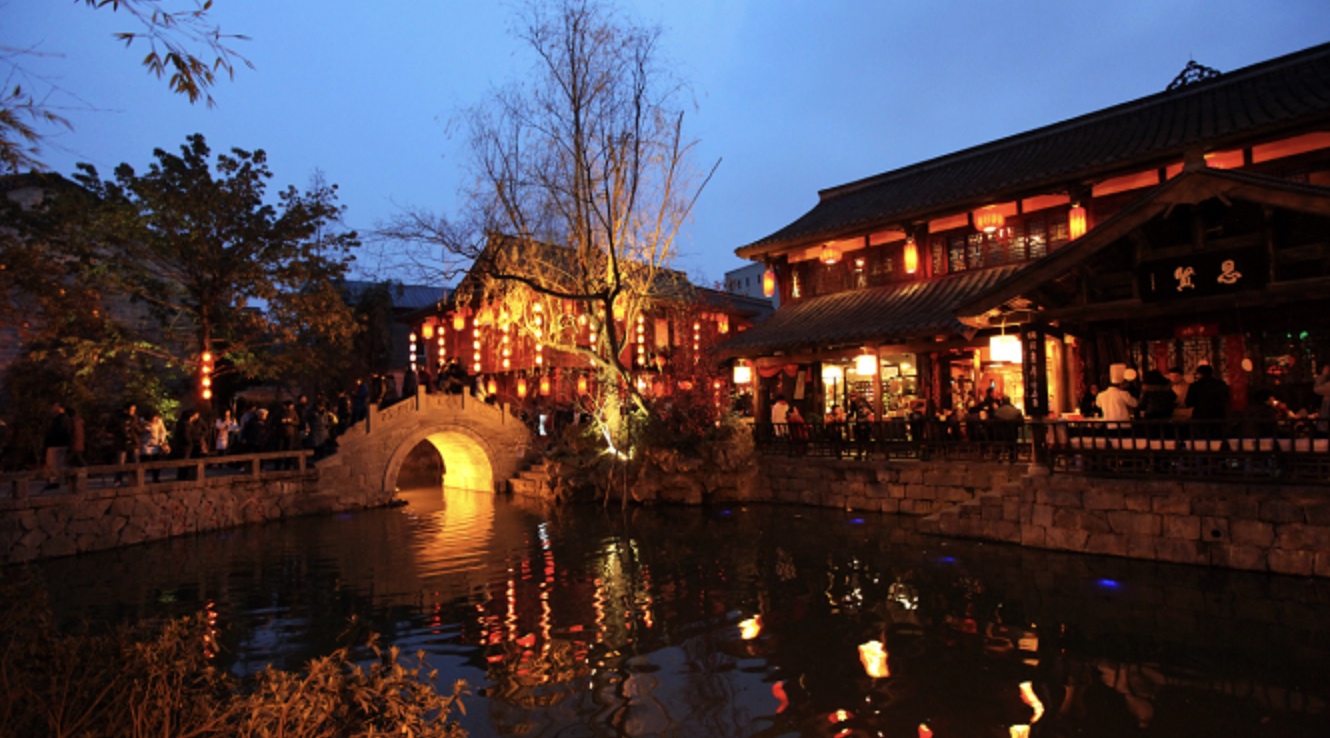
Jinli Folk Area, opened in 2004, is Chengdu's first "Three Kingdoms + western Sichuan folk" themed block, ~550m long, in western Sichuan folk-house style: grey-tile white-wall houses, bluestone paths, wooden archways, and overhanging eaves along the Jinli watercourse. Three highlights: ①Snacks—over 100 Sichuan-style eateries (San Da Pao, Bo Bo Ji, etc.); ②Intangible heritage—12 western Sichuan crafts (Shu embroidery, lacquerware, silver filigree, etc.); ③Performances—three daily Sichuan-opera shows. The waterside pavilion, a riverside teahouse, offers a perfect view of Jinli and the shrine's red wall at night. Year-round red lanterns and Three Kingdoms flags decorate the street, with over 100,000 daily visitors during Spring Festival.

Nearby

  • Jinli Ancient Street · Adjacent (south exit)
  • Sichuan Provincial Library · 10 min walk

Get the app

The tool solved one problem. The app handles the whole trip.

Per-trip visa judgements, audio guides, prep checklists, and a real human concierge — offline-ready, in your language.

Download for iPhoneFree to download · No OTA upsells