← Chengdu

Chengdu · 杜甫草堂

Du Fu Thatched Cottage

🎫 Ticket adult: 50 CNY / kid&student: 25 CNY
🕘 Opening Hours 08:00–18:00
❌ Closed 17:00
🚇 Metro North Gate: Metro Line 4 to Caotang North Road Station, Exit B, about 10 minutes' walk
🚇 Metro South Gate/Main Entrance: Metro Line 4 to Qingyang Palace Station, Exit C, about 8 minutes' walk
📍 Address 37 Qinghua Road, Qingyang District, Chengdu, Sichuan Province (by the Huanhua Stream) Map ↗
🎧 13 audio walking guides for Du Fu Thatched Cottage — listen on the spot in the YOLO HAPPY app. →

Inside Du Fu Thatched Cottage

Cao Tang Screen Wall (Thatched Cottage Screen Wall) · 草堂影壁

🎧 In app
Cao Tang Screen Wall (Thatched Cottage Screen Wall)

The Cao Tang Screen Wall is located at the end of the Flower Path and is one of the most popular iconic landscapes in Du Fu Thatched Cottage. The screen wall, also called the Zhaobi, is an independent wall used to block sight and decorate the facade in traditional Chinese architecture. This screen wall is built of green bricks, with the two characters "Cao Tang" inlaid in the center, each character about 1.5 meters square. The most unique feature is that the two characters "Cao Tang" use the late Qing dynasty blue and white porcelain fragment inlay technique — craftsmen carefully cut and polished hundreds of late Qing dynasty blue and white porcelain fragments, then inlaid them according to the shape of calligraphy strokes, the blue and white porcelain fragments shine in the sun, which is both simple and elegant, and is an outstanding representative of late Qing folk craft. The screen wall has a red wall behind it, facing the Flower Path in front, with green bamboos and cherry blossoms in the background, forming the most poetic picture of the cottage. Every day, a large number of visitors queue up to take photos here, capturing the Chinese-style moment when the four elements of "red wall, green tiles, porcelain shadow and flower path" are integrated, which has become one of the most representative internet-famous check-in landmarks in Chengdu.

Firewood Gate · 柴门

🎧 In app
Firewood Gate

The Firewood Gate is located on the central axis after the Hall of Poetic History and before the Gongbu Shrine, serving as a landmark landscape. In ancient times, "Chai Men" referred to a simple door made of branches and thorns, often used to describe the residence of hermits or impoverished families. Du Fu wrote in his poem "Thatched Cottage" that "The four pines stand at the gate, ten thousand bamboos sparse by the steps", and in "Field House" he also wrote "The firewood gate opens toward the river unevenly", making the Firewood Gate a true reflection of the poet's former residence. The current Firewood Gate is a low wooden gate rebuilt according to Du Fu's poetic imagery and the style of western Sichuan folk houses, with bamboo fences and thatched cottages on both sides, and a plaque with the characters "Chai Men" on the lintel. The "low" design of the gate is intentional — visitors must lower their heads and bend over to enter, symbolizing the poet's noble character of not pursuing power or wealth and maintaining humility. Inside the gate, bamboo shadows dance and pines and cypresses are verdant, creating a reclusive atmosphere of "building a hut in the human world without the noise of carriages and horses".

Hall of Great Affairs (Da Xie) · 大廨

🎧 In app
Hall of Great Affairs (Da Xie)

Da Xie is located behind the Main Gate and in front of the Hall of Poetic History, serving as the first main hall on the central axis. "Xie" refers to an official residence. Du Fu once served as Left Reminder and Vice Minister of Works, hence the name "Da Xie" to highlight his official status. Da Xie was originally the Mahavira Hall of Caotang Temple and was rebuilt as a reception hall and Du Fu life exhibition hall after 1949. In the center of the hall stands a standing bronze statue of Du Fu, depicted in official robes with profound gaze; the side walls display biographical panels of Du Fu, detailing his life from "Study and Travel" to "Struggles in Chang'an" and finally to "Wandering in Southwest China". The door pillars of Da Xie feature a couplet written by Qing dynasty scholar Wanyan Chongshi: "Jin River Spring Wind you claim, Thatched Cottage Renri I return", cleverly incorporating the Chengdu custom of "Visiting Thatched Cottage on Renri" (the seventh day of the first lunar month).

Hall of Great Elegance (Da Ya Tang) · 大雅堂

🎧 In app
Hall of Great Elegance (Da Ya Tang)

The Hall of Great Elegance is located on the east side of the central axis of Du Fu Thatched Cottage, the largest and most artistically valuable exhibition hall in the cottage. The word "Da Ya" comes from "Da Ya" of the "Book of Songs", representing the "righteous and elegant music" of the Western Zhou royal domain, symbolizing the orthodox poetics and cultural peak. The plaque "Da Ya Tang" in front of the hall is composed of characters from the famous Tang dynasty calligrapher Yan Zhenqing, full of momentum. The Hall of Great Elegance was originally the Mahavira Hall of Caotang Temple, and was officially converted into an art exhibition hall and opened to the public in 2002. The most famous art treasure in the hall is the large-scale colored glaze inlaid lacquer mural "Poets Walking and Chanting", the largest of its kind in China to date, with Du Fu's life journey as the clue, bringing Li Bai, Wang Wei, Meng Haoran, Gao Shi, Cen Shen and other Tang dynasty poets together in one painting, with a grand picture and brilliant colors. The hall also displays 12 sculptures of famous poets of all dynasties, including Qu Yuan, Tao Yuanming, Xie Lingyun, Li Bai, Du Fu, Bai Juyi, Su Shi, Lu You, Li Qingzhao, Xin Qiji and other peak poets in the history of Chinese literature, allowing visitors to feel the long history of Chinese poetics in every step.

Gongbu Shrine (Ministry of Works Shrine) · 工部祠

🎧 In app
Gongbu Shrine (Ministry of Works Shrine)

The Gongbu Shrine is located behind the Firewood Gate and east of the Shaoling Thatched Cottage Stele Pavilion, the most solemn sacrificial building at the deepest part of the central axis. Du Fu once served as Vice Minister of Works (Jianxiao Gongbu Yuanwailang), commonly known as "Du Gongbu", hence the name "Gongbu Shrine". The shrine is a traditional ceremonial hall with green tiles and white walls, housing statues of Du Fu, Huang Tingjian and Lu You, commonly known as the "Hall of Three Sages". Huang Tingjian was the founder of the "Jiangxi Poetry School" of the Northern Song Dynasty, and Lu You was a patriotic poet of the Southern Song Dynasty, both of whom admired Du Fu's poetic art. The Gongbu Shrine enshrines them on both sides of Du Fu, showing the poetic lineage of the three. The shrine is full of plaques and couplets, among which the couplet by Qing dynasty scholar Qian Baotang "Building a hut by the desolate river, you live forever; Different eras ascending the hall, these two sages" is a famous masterpiece. In front of the shrine there are incense burners and incense tables, with constant incense throughout the year, making it the core place for visitors to mourn the poet saint and express their respect.

Flower Path · 花径

🎧 In app
Flower Path

The Flower Path is located on the east side of the central axis of Du Fu Thatched Cottage, a small red wall path connecting the Hall of Poetic History and the Firewood Gate. The name "Flower Path" comes from Du Fu's poem "The flower path has never been swept for guests, the pine door is now opened for you" ("Guest Arrival"), originally referring to the small path in front of Du Fu's residence leading to the Firewood Gate. The current Flower Path has been renovated many times and has become the most popular internet-famous check-in point in the cottage: red walls lining the path, green bamboos shading, cherry blossoms and crabapples blooming alternately in four seasons; at the end, a screen wall is inlaid with the two characters "Cao Tang" with Qing dynasty blue and white porcelain fragments, with exquisite craftsmanship and strong classical charm. Walking slowly along the Flower Path, visitors can feel the poetic imagery of "The flower path has never been swept for guests" — from Tang to Qing, this small path has welcomed countless literati and dignitaries. In spring and summer, cherry blossoms are like snow and crabapples are like rosy clouds, making it one of the most popular Chinese-style photo spots in Chengdu; in autumn and winter, red leaves dot and wintersweet is fragrant, showing another kind of quiet beauty. It is recommended to visit in the morning or evening when the light is soft, to take the most artistic red wall flower shadow photos.

Thatched Cottage Former Residence · 茅屋故居

🎧 In app
Thatched Cottage Former Residence

The Thatched Cottage Former Residence is located west of the Shaoling Thatched Cottage Stele Pavilion, a landmark attraction rebuilt in 1997 based on Du Fu's poetic imagery and the style of western Sichuan folk houses, covering an area of about 5 mu. The overall building uses traditional western Sichuan farmhouse craftsmanship of bamboo-woven mud walls and wooden windows with paper seams, the roof is covered with thatch, and the front of the door has vegetable fields enclosed by fences, connected to a pond and Huanhua Stream. The interior of the cottage is simply furnished: a thatched bed, a writing desk, brushes and inkstones, poetry manuscripts, and medicine jars are restored according to Tang dynasty life style, recreating Du Fu's impoverished life of "No dry place at the head of the bed or under the eaves, the rain drops like hemp without ceasing". A stone statue of Du Fu stands in front of the cottage, leaning on a staff with a solemn expression, as if still worrying about the country and the people here. The cottage is surrounded by green bamboos, plum trees and peach trees, with different scenery in four seasons — peach blossoms in spring, green shade in summer, yellow chrysanthemums in autumn, plum blossoms in snow in winter. Visitors can feel the great mind of "How can I get a vast mansion of a million rooms to shelter all the poor scholars of the world with joy" here, which is the core place to experience the life scene of the poet saint.

South Gate · 南门

🎧 In app
South Gate

The South Gate is located on the south side of the Chengdu Du Fu Thatched Cottage Museum and is one of the secondary entrances of the cottage, mainly serving visitors entering the park from the direction of Huanhua Stream Park. The South Gate tower is in an antique architectural style, with green bricks, gray tiles and upturned eaves, echoing the main gate but more elegant and restrained. In front of the gate is close to the Huanhua Stream, with the stream water gurgling; inside the gate, bamboo shadows are dancing and the green is lush. Entering through the South Gate, visitors can directly reach the garden landscape belt connecting the south area of the cottage with Huanhua Stream Park. Compared with the main gate, the South Gate has fewer visitors and a quieter environment, making it the best entrance for visitors who want to avoid the crowds and deeply experience the quiet beauty of the cottage. Entering the park from the South Gate in the morning or evening, visitors can listen to the sound of the Huanhua Stream, watch the green bamboos swaying, and feel the poetic imagery of "The water of Huanhua Stream is at the west end, the host divined that the forest pond is quiet" (Du Fu's "Divining Residence"). After entering from the South Gate, visitors can follow the signs northward to visit the Thatched Cottage Former Residence, Shaoling Thatched Cottage Stele Pavilion, Firewood Gate, Hall of Poetic History, and finally reach Da Xie and the main gate, taking about 2 hours in total.

Thousand Poetry Stele Corridor · 千诗碑廊

🎧 In app
Thousand Poetry Stele Corridor

The Thousand Poetry Stele Corridor is located on the east side of the central axis of Du Fu Thatched Cottage, close to the south side of the Hall of Great Elegance, and is a corridor-style building about 100 meters long. The stele corridor is composed of green bricks, green tiles and carved wooden windows, and on both sides of the corridor are inlaid with bluestone steles, on which more than 1,450 of Du Fu's surviving poems are engraved in the form of calligraphy, which is a cultural landmark of the perfect combination of Chinese classical literature and calligraphy art. The stele calligraphy collects calligraphy works of Du Fu's poems by calligraphy masters of all dynasties such as Su Shi, Huang Tingjian and Mi Fu of the Song Dynasty, Zhao Mengfu of the Yuan Dynasty, Dong Qichang and Wen Zhengming of the Ming Dynasty, He Shaoji and Zhao Zhiqian of the Qing Dynasty, and Yu Youren, Guo Moruo, Qi Gong, Sha Menghai of modern times, with all five scripts of seal, clerical, regular, running and cursive, making it a "small museum of Chinese calligraphy art". Walking slowly along the corridor, visitors feel as if they are strolling in the long river of history: on the left are the immortal poems of the poet saint, on the right are the brush and ink style of calligraphers, and in the middle is the sculpture group of poets in the Hall of Great Elegance. Visitors are advised to stop and appreciate in the stele corridor, each stele is a piece of history, and each calligraphy work is a kind of style.

Shaoling Thatched Cottage Stele Pavilion · 少陵草堂碑亭

🎧 In app
Shaoling Thatched Cottage Stele Pavilion

The Shaoling Thatched Cottage Stele Pavilion is located east of the Gongbu Shrine and serves as the core landmark of the Du Fu Thatched Cottage park. "Shaoling" is the abbreviation of Du Fu's self-styled name "Shaoling Yelao" (Old Man of Shaoling). There was a Shaoling Plateau in Chang'an in the Han Dynasty, and Du Fu's ancestor Du Yu of the Xiangyang Du family was a Jinzhao Du, so he called himself "Old Man of Shaoling". The stele pavilion is a wooden hexagonal pavilion with a thatched roof, supported by 6 wooden pillars, with a gourd-shaped finial, surrounded by beauty-rest chairs, and the base is built of bluestone in a hexagonal shape. In the center of the pavilion stands a huge stone tablet, on which are engraved the four majestic characters "Shaoling Cao Tang", signed by Qing Yongzheng Emperor's brother Prince Guo Aisin Gioro Yunli. According to legend, Yunli passed through Chengdu on his way to Tibet on imperial order, made a special pilgrimage to the cottage and wrote the inscription. The inscription is in regular script with strict structure and strong bones, making it a masterpiece among inscriptions of all dynasties. Surrounded by towering ancient trees and verdant bamboo, the pavilion is the core landscape that visitors must take photos with.

Hall of Poetic History · 诗史堂

🎧 In app
Hall of Poetic History

The Hall of Poetic History is located behind Da Xie and serves as the core main hall on the central axis. Du Fu's poems truly record the historical transformation of the Tang Dynasty from prosperity to decline around the An Lushan Rebellion, and are honored as "Poetic History" by later generations, hence the name "Hall of Poetic History". The plaque "Shi Shi Tang" in front of the hall was inscribed by the famous philosopher and former Peking University President Feng Youlan in 1980. In the center of the hall is a bronze bust of Du Fu created by the famous sculptor Liu Kaiqu, with a lean face and solemn expression, embodying the spirit of caring for the country and the people. The walls on both sides of the hall are inlaid with calligraphy works of Du Fu's representative works such as "Five Hundred Words on the Way from Chang'an to Fengxian County", "The Thatched Cottage Broken by Autumn Wind", "Climbing High", "Spring View", "Three Officials" and "Three Farewells", which is a must-see for visitors to understand the essence of Du Fu's poetry. At the back wall of the hall is a 1:1 scale restoration of a Tang dynasty poet Du Fu walking and chanting statue.

Tang Dynasty Site · 唐代遗址

🎧 In app
Tang Dynasty Site

The Tang Dynasty Site is located at the westernmost end of the central axis of Du Fu Thatched Cottage, a Tang dynasty living site area excavated archaeologically and protected in situ. Since the 1980s, archaeologists have conducted multiple excavations within the cottage area, successively unearthing Tang dynasty house foundations, wells, porcelain, bronze ware, pottery and a large number of daily necessities, among which the location of some Tang dynasty house sites is highly consistent with the location of Du Fu's former residence recorded in literature, providing indisputable physical evidence for the "Thatched Cottage". The site area adopts a protective display method: Tang dynasty stratigraphic sections are completely preserved and protected with glass covers, so that visitors can clearly see the original appearance of Tang dynasty architectural foundations, drainage ditches, stoves, wells and other relics. Next to the site is a small exhibition hall, which systematically displays the real life scene of Du Fu in the Chengdu Thatched Cottage through excavated artifacts, archaeological photos and literature. Here, visitors can touch the historical pulse of 1,200 years ago, making it an important place for parent-child study and in-depth understanding of Tang dynasty culture.

Main Gate · 正门

🎧 In app
Main Gate

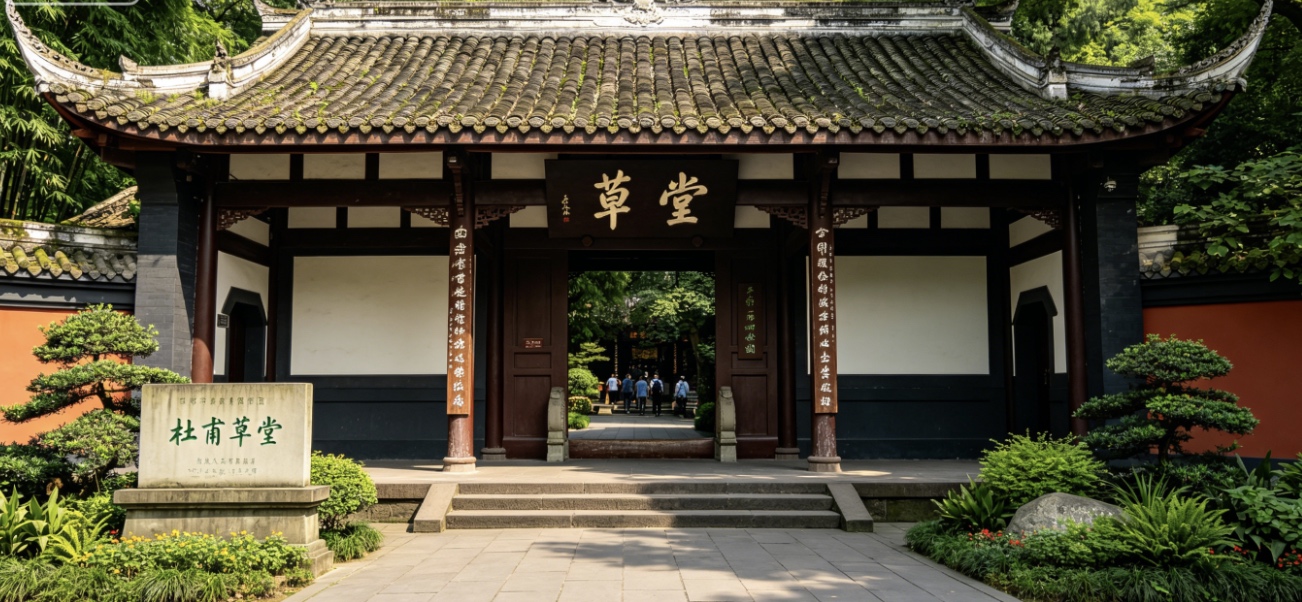
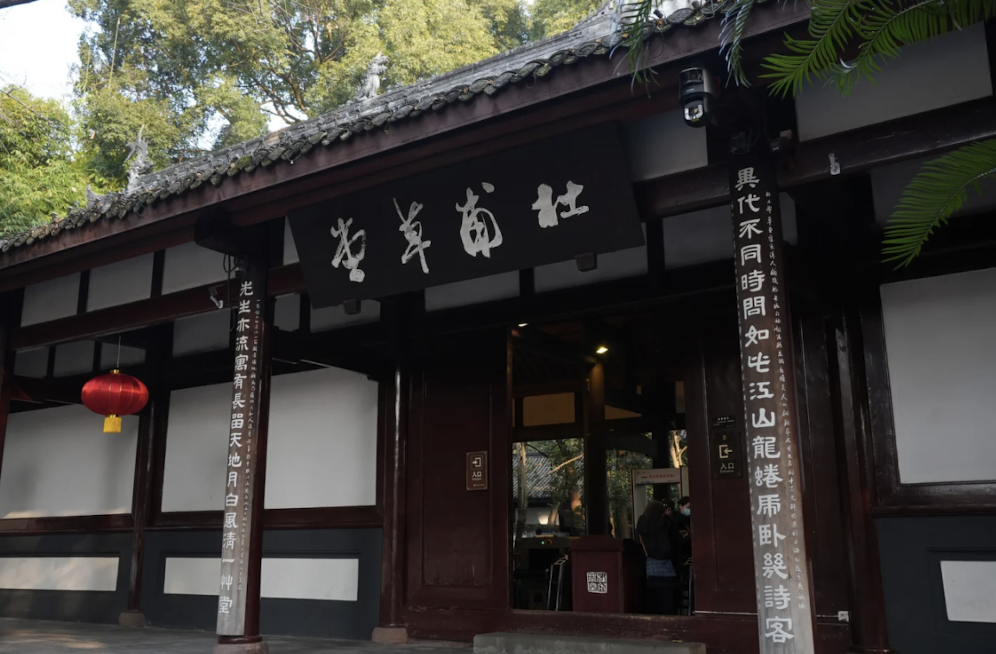
The Main Gate is the main entrance of the Chengdu Du Fu Thatched Cottage Museum, located at the southern end of Qinghua Road and serves as the first stop for visitors. The gate tower is built in a five-pillar, three-bay Tang-style architecture with upturned eaves and grand momentum. The four golden characters "Du Fu Cao Tang" inscribed on the lintel were written by the famous writer and poet Guo Moruo in 1958, with powerful and vigorous brushstrokes, making it the most recognizable landmark of the cottage. A couplet on both sides reads: "Wanli Bridge West Residence, Baihua Pool North Villa", indicating the geographical location of the cottage. Entering the main gate, visitors can tour the Hall of Great Affairs, Hall of Poetic History, Firewood Gate, Gongbu Shrine, Shaoling Thatched Cottage Stele Pavilion, Thatched Cottage Former Residence and other attractions in turn.

Nearby

  • Huanhuaxi Park · 1 mile

Get the app

The tool solved one problem. The app handles the whole trip.

Per-trip visa judgements, audio guides, prep checklists, and a real human concierge — offline-ready, in your language.

Download for iPhoneFree to download · No OTA upsells