← Chengdu

Chengdu · 文殊院

Chengdu Wenshu Monastery

🕐 Duration 08:00–17:00
🚇 Metro Metro Line 1, Wenshu Monastery Station, Exit K
🎫 Ticket Free
🕘 Opening Hours 08:00
❌ Closed 17:00
📍 Address 66 Wenshuyuan Street, Qingyang District, Chengdu Map ↗
🎧 10 audio walking guides for Chengdu Wenshu Monastery — listen on the spot in the YOLO HAPPY app. →

Tips for international visitors

  • Dress respectfully, Pagoda circumambulation & temple etiquette,Incense

Inside Chengdu Wenshu Monastery

Sutra Repository (Chen Scripture Hall) · 藏经楼(宸经楼)

🎧 In app
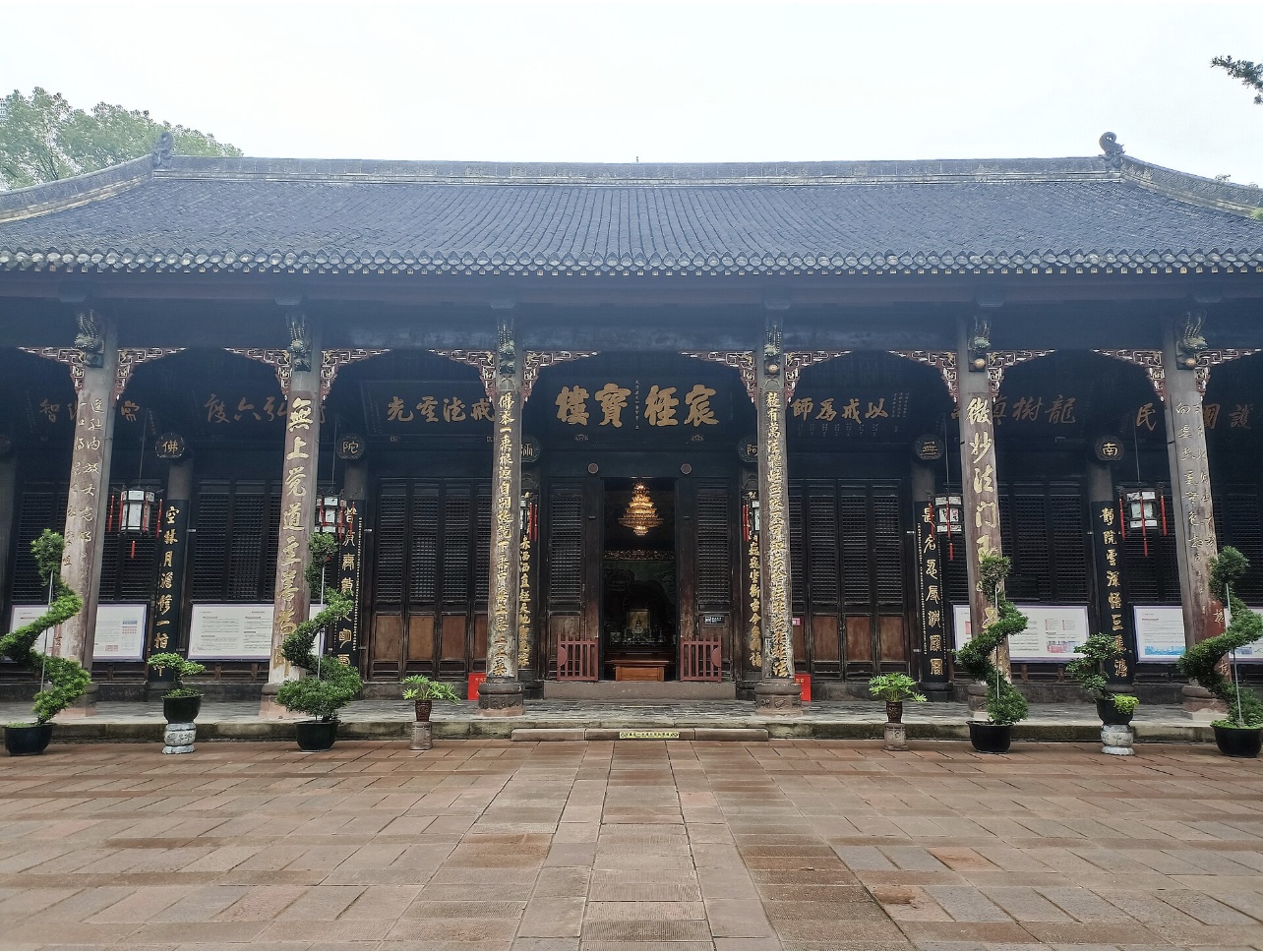
Sutra Repository (Chen Scripture Hall)

The Canon Library, also called "Chenjing Lou," is the fifth hall on the central axis—originally built by Chan Master Cidu and rebuilt by Abbot Benyuan in 1824. Standing 15.84 m tall in two stories, it is the monastery's central repository for sutras and treasures. The name "Chenjing" comes from Kangxi's imperial calligraphy. Beyond the Ming and Qing Buddhist canons (Long, Pingqia, Taisho, Qianlong Da Zangjing and continuations), the library preserves Kangxi's "Konglin" hand and his Mi Fu-style "Hai Yue" calligraphy, Song dragon ink paintings, late-Ming and Qing calligraphy by Poshan and Zhangxue, paintings by Biyan and Zhuchan, and works by He Shaoji, Zheng Banqiao, Zhang Daqian, and Feng Zikai. To the left rests a portion of the cranial relic of Master Xuanzang, transferred from Nanjing in the 1940s—the monk was ordained in Chengdu and lived here for five years; to the right rests a Buddha Śarīra brought from Bodh Gaya by the monk Nenghai in the 1920s. The "Tian Yi Xuan Cai" qipao embroidered with 248 Buddha figures by Ming consort Tian, the Qing hair-embroidered Water-Moon Guanyin, four blood-written sutras, and the Diamond Sutra pagoda painting—all part of the "Eight Views of Konglin"—are also housed here.
Tea Garden and Vegetarian Hall · 茶园与香斋堂

🎧 In app
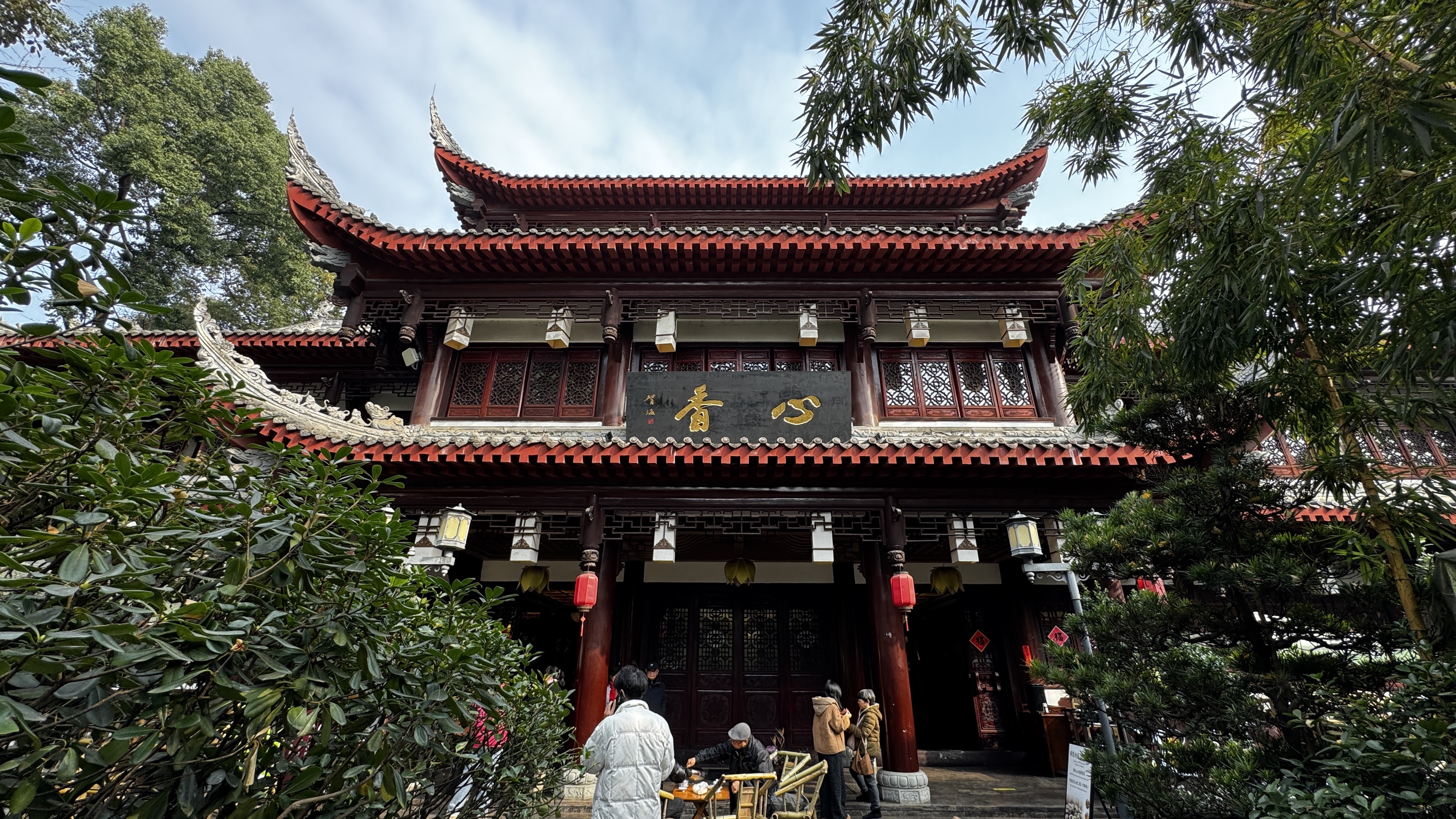
Tea Garden and Vegetarian Hall

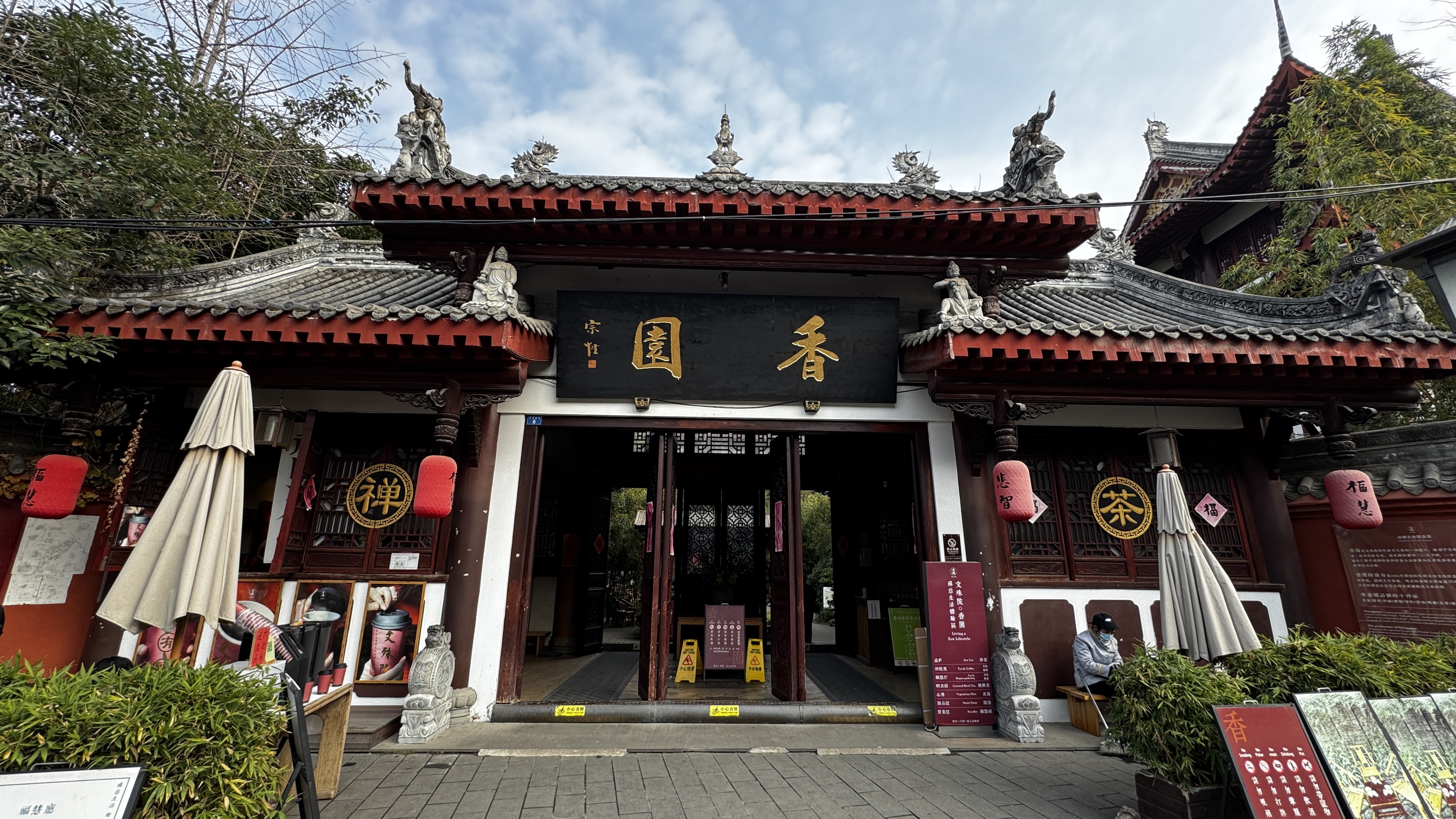
The Tea Garden sits inside the monastery's east garden, opened in 1988 alongside the Thousand-Buddha Peace Pagoda, and operates as a "Chan-monastery teahouse" in old-Chengdu style. Bamboo roofs, blue-brick paving, square tables, covered-bowl tea, and long-spouted copper kettles recreate a classic "bada cha" open-air teahouse serving Bi Tan Piao Xue, Zhu Ye Qing, Mao Feng, Tie Guan Yin, and Pu'er teas at around RMB 10–30 per person, with free hot-water refills and outside snacks allowed. The Xiangzhai Hall vegetarian restaurant sits next to the Tea Garden and is separate from the monks' Wuguan Hall. The menu emphasizes Sichuan-style vegetarian cuisine: vegetarian Mapo tofu, vegetarian twice-cooked pork, sweet rice cake, monastery pickles, and full vegetarian set meals at RMB 20–60 per person, plus luohan noodles and mushroom wonton. Together they create a "worship, tea, dine" loop, expressing the monastery's "humanistic Buddhism" approach. Just outside the gate, Wenshu Yuan Street hosts Chengdu classics such as Long Chaoshou (Wenshu Yuan main branch), Yan Taipo Guokui, and Zhong Sui Jiao, making the visit a combined temple-and-old-streets experience.

Mahavira Hall · 大雄宝殿

🎧 In app
Mahavira Hall

The Mahavira Hall is the third hall on the central axis, originally built by Chan Master Cidu and rebuilt by Abbot Zhangbai. Standing 10.56 m tall in single-eaved Xieshan style, it is the largest and highest-ranked hall in the monastery. The central glass shrine houses a bronze Sakyamuni Buddha cast in 1829, flanked by bronze Kasyapa and Ananda figures—the most important Qing-dynasty bronze trio in the monastery and part of the "Eight Views of Konglin." Two Burmese jade Buddhas brought back in 1923 and 1938 by monks Xinglin and Dengyun sit in the shrine ("Burmese Jade in the Shrine"). Two ancient fir trees, each 15 m tall, stand behind the hall: descendants of the firs that flanked the old gate and under which Master Cidu took shelter ("Twin Firs Auspicious"). Free incense is provided—one stick per person, taken with both hands.

Thousand Buddhas Peace Pagoda and Stele Corridor · 千佛和平塔与碑廊

🎧 In app
Thousand Buddhas Peace Pagoda and Stele Corridor

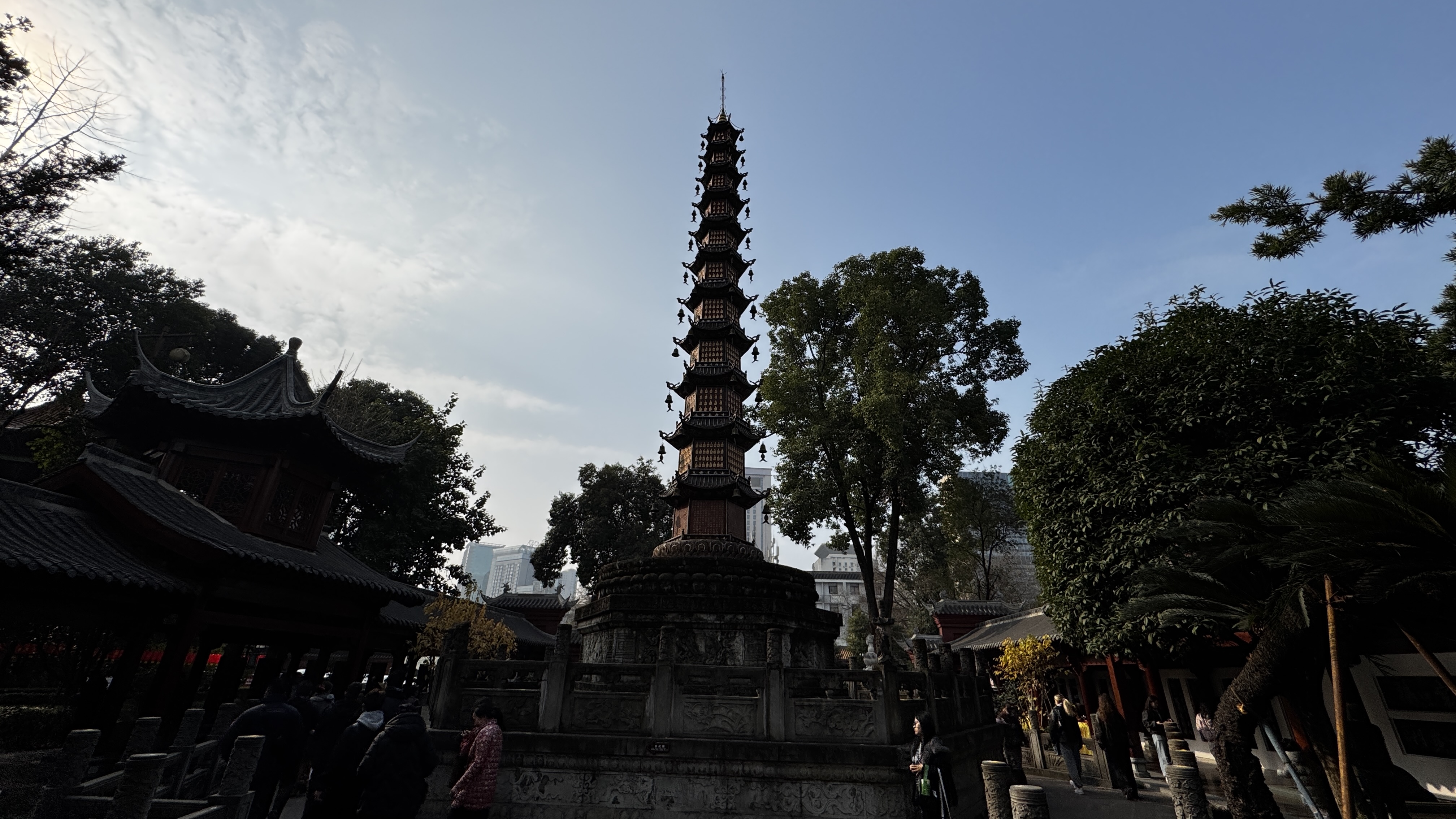
The Thousand-Buddha Peace Pagoda stands in the eastern courtyard between the Canon Library and Wenshu Pavilion. Built in 1988, it was inscribed and coupleted by Zhao Puchu, then president of the Buddhist Association of China. The six-sided, eleven-story iron pagoda rises 21 meters and bears 1,000 cast Buddha images. Six dragons crown the spire with bells that ring in the wind. The east, west, and north sides are lined with stele corridors displaying dozens of stone tablets—Qing imperial and official inscriptions, poems by the monastery's abbots Cidu, Benyuan, Xuanlin, Nenghai, Biannen, and Weixian, and Buddhist maxims. The two-tiered surrounding walls are decorated with four-season floral motifs and bas-reliefs of the Journey to the West, symbolizing the two-way transmission of dharma along the Silk Road. Ginkgo, camphor, plum, and magnolia trees frame the pagoda, making it the monastery's most contemplative garden.

Hall of Three Great Beings (Guanyin Hall) · 三大士殿(观音殿)

🎧 In app
Hall of Three Great Beings (Guanyin Hall)

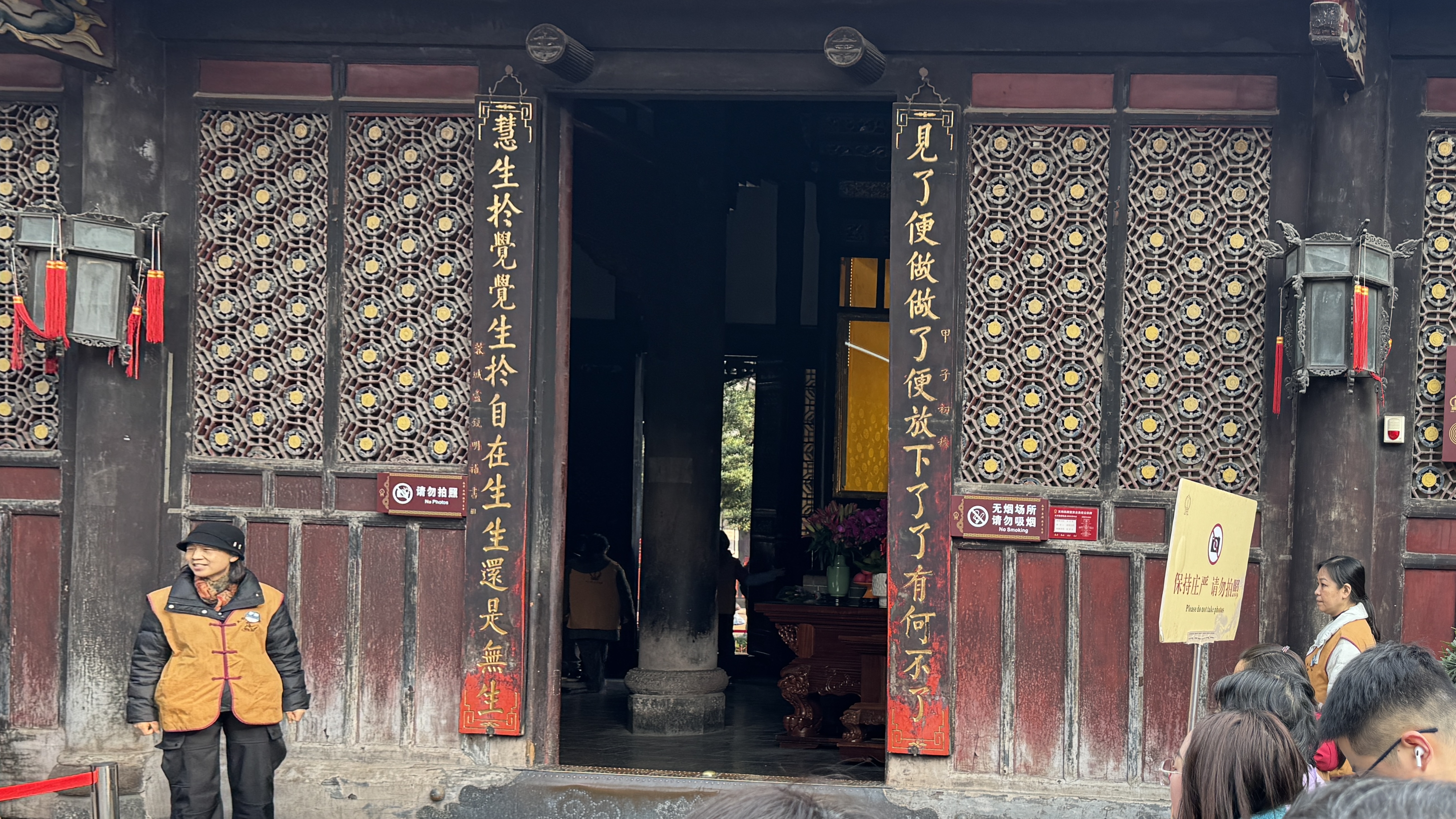
The Hall of the Three Great Beings, also called the Hall of Guanyin, is the second hall on the central axis and the only one of the six that retains its original 1697 Kangxi-period structure. Three principal statues stand on a central platform: Manjushri on a blue lion (wisdom), Guanyin holding a willow branch and pure-water vase (compassion), and Samantabhadra on a white elephant (vow and action). Side bays house Wenchang Dijun and Saintly Lord Guan, reflecting the late-imperial Sichuanese fusion of Buddhist, Daoist, and Confucian popular devotion. Behind the hall stands the bronze Weituo guardian, cast by Abbot Benyuan in 1829. The lintel couplet by late-Qing Chengdu literatus Fang Hezhai—"What is done let be done, what is let go let be let go, what ends, ends; wisdom is born of awakening, awakening is born of ease, what arises, arises and yet does not arise"—expresses the Chan spirit of resolving the matter at hand.

Mountain Gate (Hall of Heavenly Kings) · 山门(天王殿)

🎧 In app
Mountain Gate (Hall of Heavenly Kings)

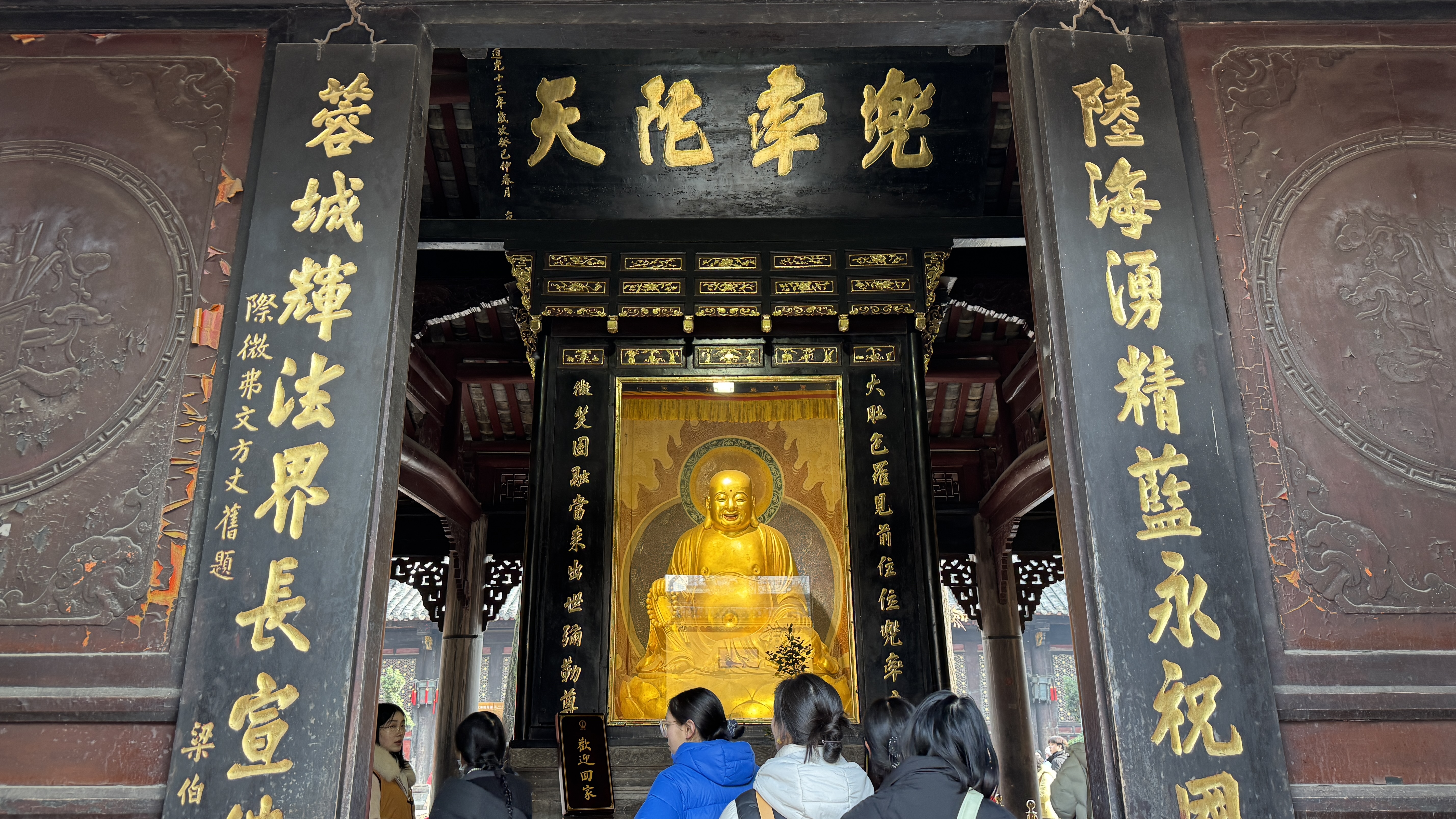
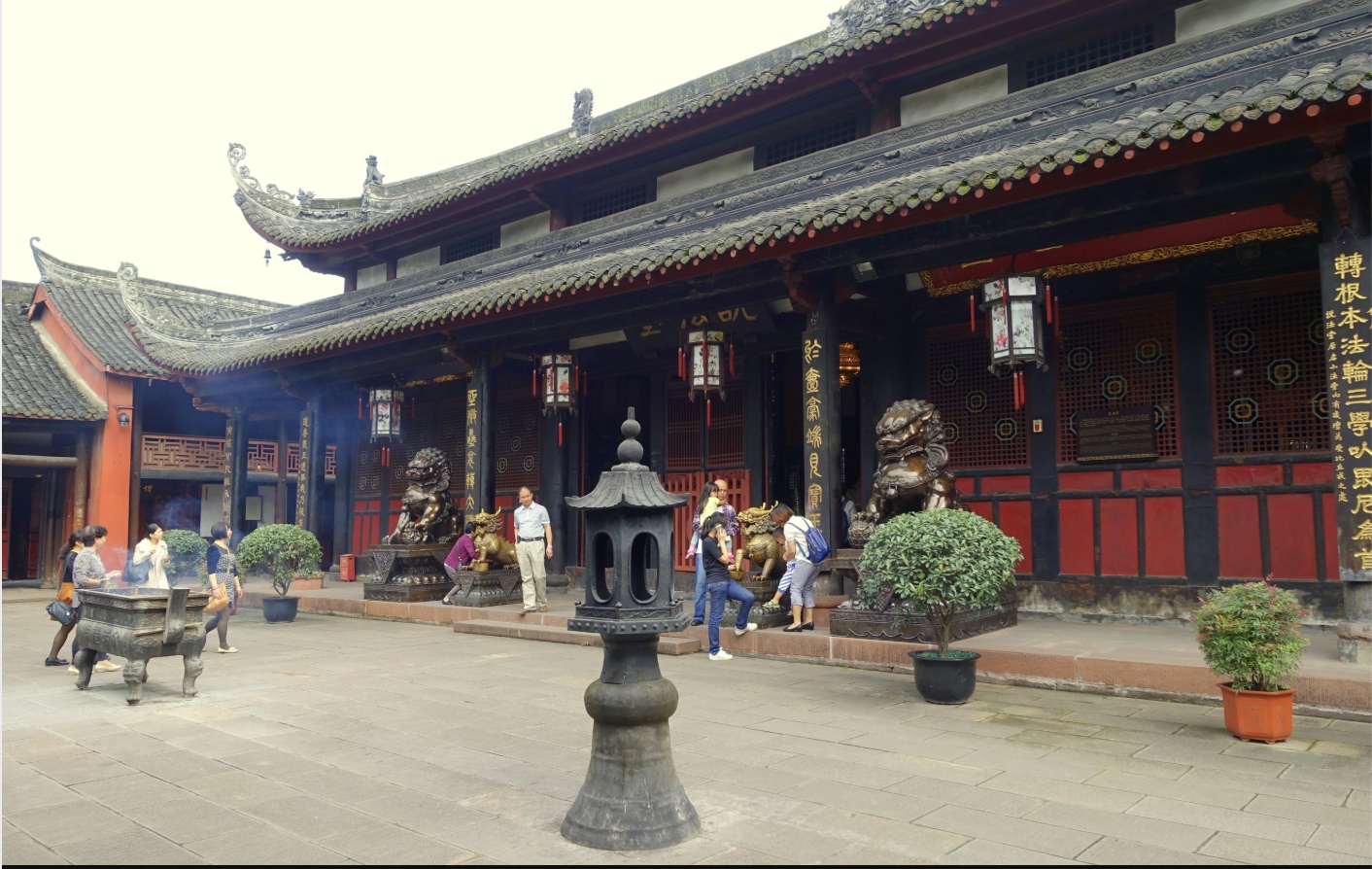
The Main Gate / Hall of Heavenly Kings is the first hall on the central axis, originally built by Chan Master Cidu and rebuilt by Abbot Benyuan, facing south with a five-bay facade in classic Kangxi–Daoguang Sichuanese style. The gate and hall are combined: the two Heng-Ha guardians stand at the door, Maitreya is enshrined at the center (with Weituo behind), and the Four Heavenly Kings—Dhṛtarāṣṭra, Virūḍhaka, Virūpākṣa, and Vaiśravaṇa—flank the hall, each holding a sword, pipa, parasol, or serpent/dragon to symbolize favorable weather. The pillars bear the couplet by Qing abbot Fu Wenjiwei. In front, the three-story Drum and Bell towers face each other: the bell tower houses a 4,500+ kg Qing-dynasty bronze bell, the drum tower its great drum. Their morning bell and evening drum mark the monastic schedule and ritual calendar.

Dharma Hall (Medicine Buddha Hall) · 说法堂(药师殿)

🎧 In app
Dharma Hall (Medicine Buddha Hall)

The Dharma Hall, also called the Hall of Bhaisajyaguru, is the fourth hall on the central axis and is said to occupy the site of the original Tang-era Xinxiang Monastery. A double-eaved Xieshan Qing-dynasty building, it contains a brick ordination platform used for precepts ceremonies, lay refuge, and sutra lectures. At center, beneath a jeweled canopy, sits Bhaisajyaguru, the Medicine Buddha of the eastern Lapis Lazuli world, flanked by the twelve yakṣa generals—each guarding one of the twelve traditional double-hours and zodiac animals. The back wall bears the Kangxi Emperor's 1702 inscription "Konglin" (Empty Forest)—the calligraphic origin of the monastery's alternate name "Konglin Tang" and the first of the "Eight Views of Konglin." The Sichuanese-style Buddhist chanting preserved here was inscribed on Chengdu's seventh intangible cultural heritage list in 2021.

Manjushri Pavilion · 文殊阁

🎧 In app
Manjushri Pavilion

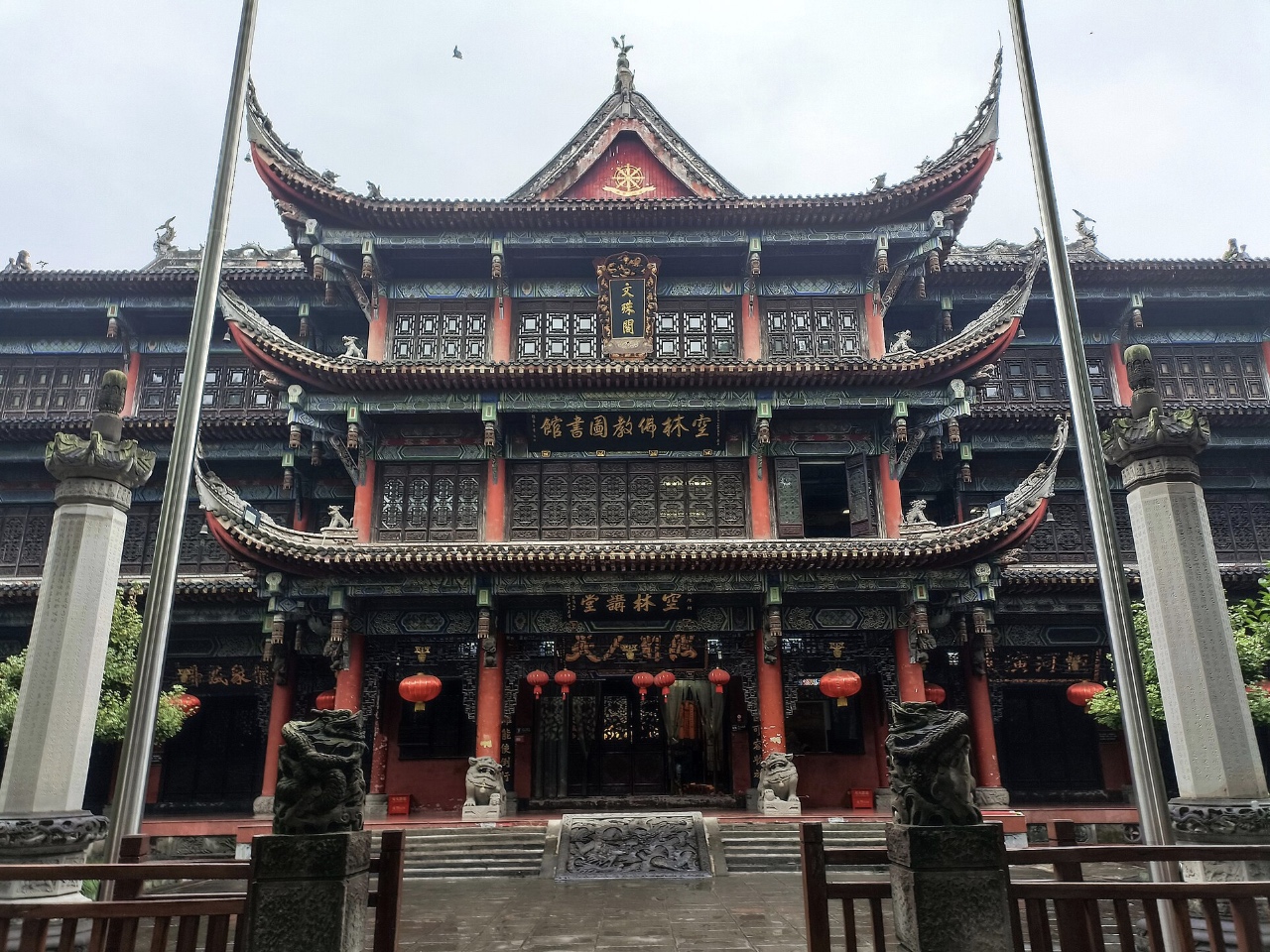
Wenshu Pavilion stands at the northernmost end of the central axis. Built in 1997 under the 17th abbot Xuanlin, it occupies about 1,000 square meters in a three-story Qing-style double-eave structure. The first floor, the "Konglin Lecture Hall," seats several hundred for dharma talks, meditation, and Chan practice. The second floor houses the "Konglin Buddhist Library," with sutras, modern Buddhist scholarship, and journals for both laypeople and researchers. The third floor, the "Ten-Thousand-Buddha Hall," enshrines the central principal Buddha surrounded by a thousand Buddhas on the four walls, creating the monastery's most contemplative space. The pavilion closes the central axis and complements the five earlier historic halls, forming a "front-court, rear-market" plan that joins devotional and cultural functions.

Garden and Life-Release Pond · 园林与放生池

🎧 In app
Garden and Life-Release Pond

The Wenshu Monastery gardens center on the east and west gardens flanking the central axis and the Release Pond—landscaped together with the Thousand-Buddha Pagoda in 1988. The Release Pond sits between the Hall of Heavenly Kings and the Mahavira Hall in an irregular L shape, home to koi, goldfish, and turtles, with water lilies, calamus, and willows along the banks; a Qing-era "Release Pond" stele stands on the north bank in Manchu and Chinese. The Tingsong Waterside Pavilion on the west bank responds visually to the Bell and Drum towers. The east garden ("Hearing and Reflecting") and west garden ("Cultivating and Realizing") flank the central axis, with Taihu rocks, ginkgo, camphor, plum, magnolia, crepe myrtle, and paths of bamboo. Covered corridors tie the halls, gardens, and the Peace Pagoda into a single meandering composition. The two ancient firs at the rear of the Mahavira Hall, said to mark Master Cidu's hermitage, are the "Twin Firs Auspicious" of the "Eight Views of Konglin."

Main Gate (Screen Wall) · 正门(照壁)

🎧 In app
Main Gate (Screen Wall)

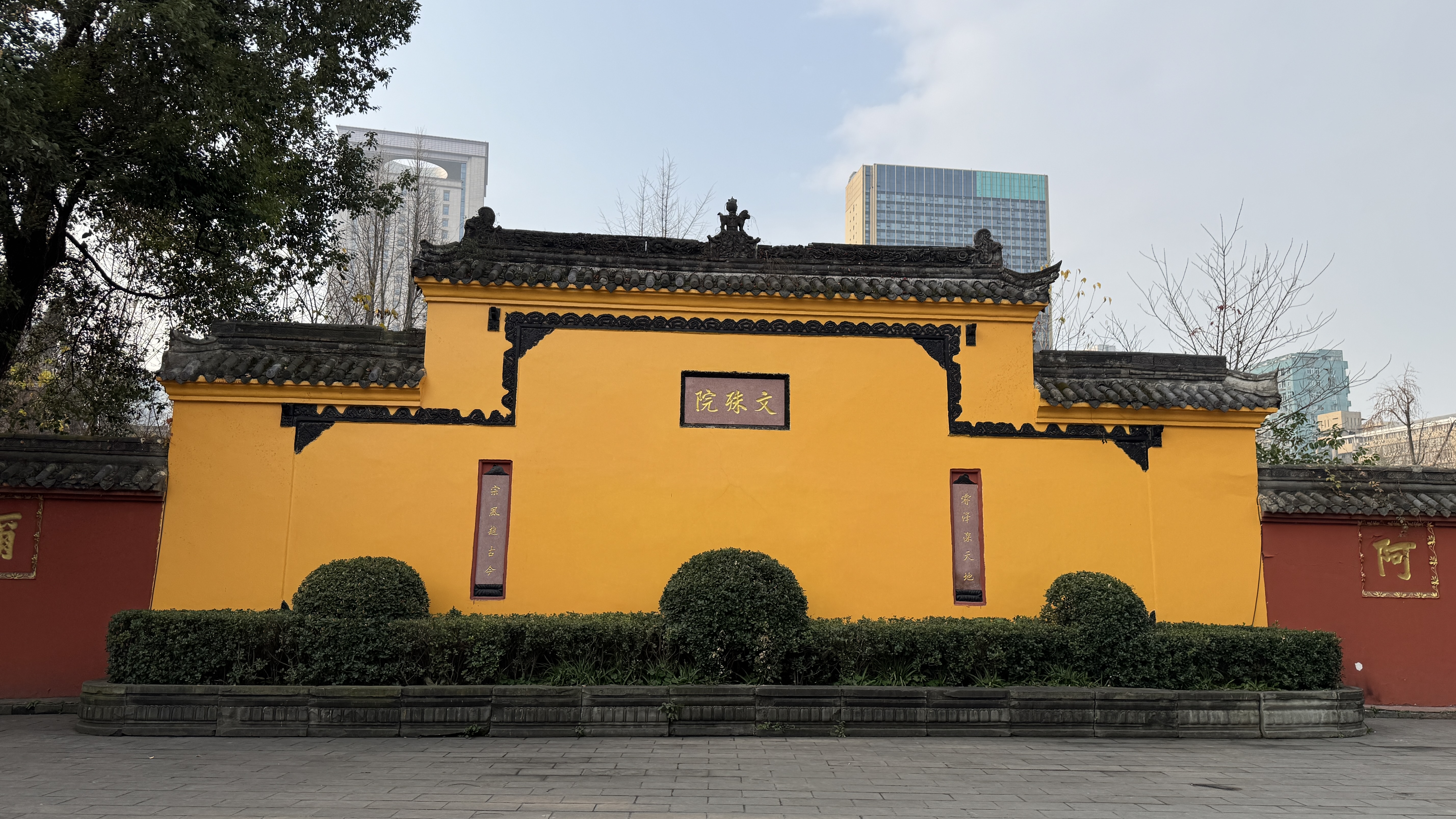
The front gate and spirit wall stand at the south end of the Wenshu Monastery central axis, the first visual anchor before visitors reach the main gate. About 8 metres high and shaped like the Chinese character for "pin" in brick and stone, the wall bears the monastery name and a couplet meaning "wisdom deep as heaven and earth, lineage surpassing past and present," said to be in the hand of Chan Master Cidu of the Kangxi reign. The wall faces the city street on one side and the temple gate on the other—a classic Chinese monastic gesture of modesty and containment. Two side gates flank the central entrance, and the temple itself is open and free, with public transit and the city road reaching right up to the wall.

Get the app

The tool solved one problem. The app handles the whole trip.

Per-trip visa judgements, audio guides, prep checklists, and a real human concierge — offline-ready, in your language.

Download for iPhoneFree to download · No OTA upsells