← Chongqing

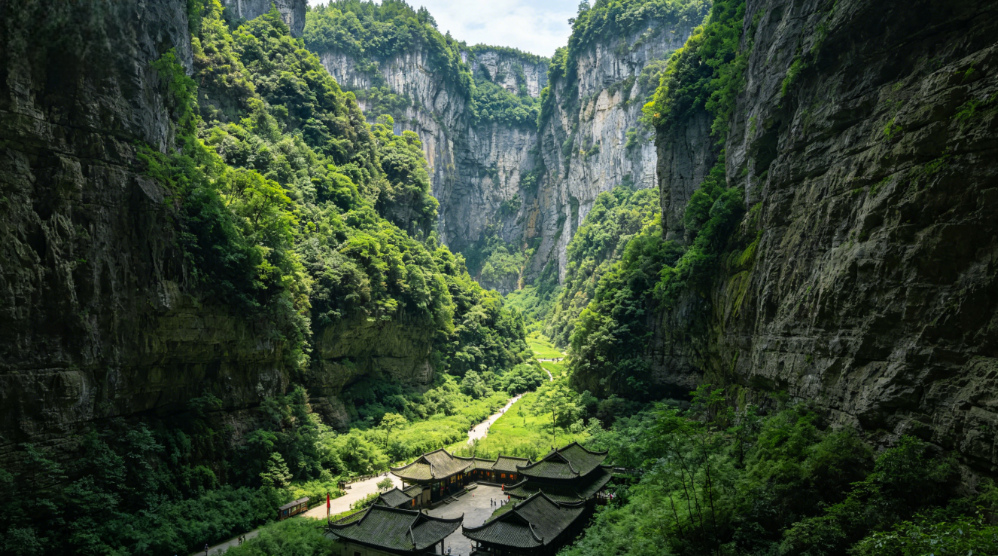
Chongqing · 武隆喀斯特旅游区

Wulong Karst Tourist Area

🎫 Ticket (charged per attraction)Three Natural Bridges: Peak season (May–August) 70 RMB; off-season (September–April) 40 RMB (including shuttle bus)
🎫 Ticket Longshuixia Fissure: Peak season 55 RMB; off-season 50 RMB (including shuttle bus)
🎫 Ticket Fairy Mountain: 50 RMB year-round
🎫 Ticket Furong Cave: Peak season 80 RMB; off-season 65 RMB
🕘 Opening Hours - Tiankeng Three Bridges: 08:00-17:30 (last entry at 16:30) - Longshuixia Ground Fissure: 08:00-17:00 (last entry at 15:30) - Furong Cave: 08:30-17:00 (last entry at 16:00) - Note: Wulong Karst Tourist Area covers a vast area; it is recommended to allow 2 days for visiting; if time is limited, Tiankeng Three Bridges is the top recommendation
📍 Address Xiannushan Street, Wulong District, Chongqing (Tiankeng Three Bridges/Longshuixia Ground Fissure); Jiangkou Town, Wulong District, Chongqing (Furong Cave) Map ↗
🎧 11 audio walking guides for Wulong Karst Tourist Area — listen on the spot in the YOLO HAPPY app. →

Inside Wulong Karst Tourist Area

Tianlong Bridge (Heavenly Dragon Bridge) · 天龙桥

🎧 In app
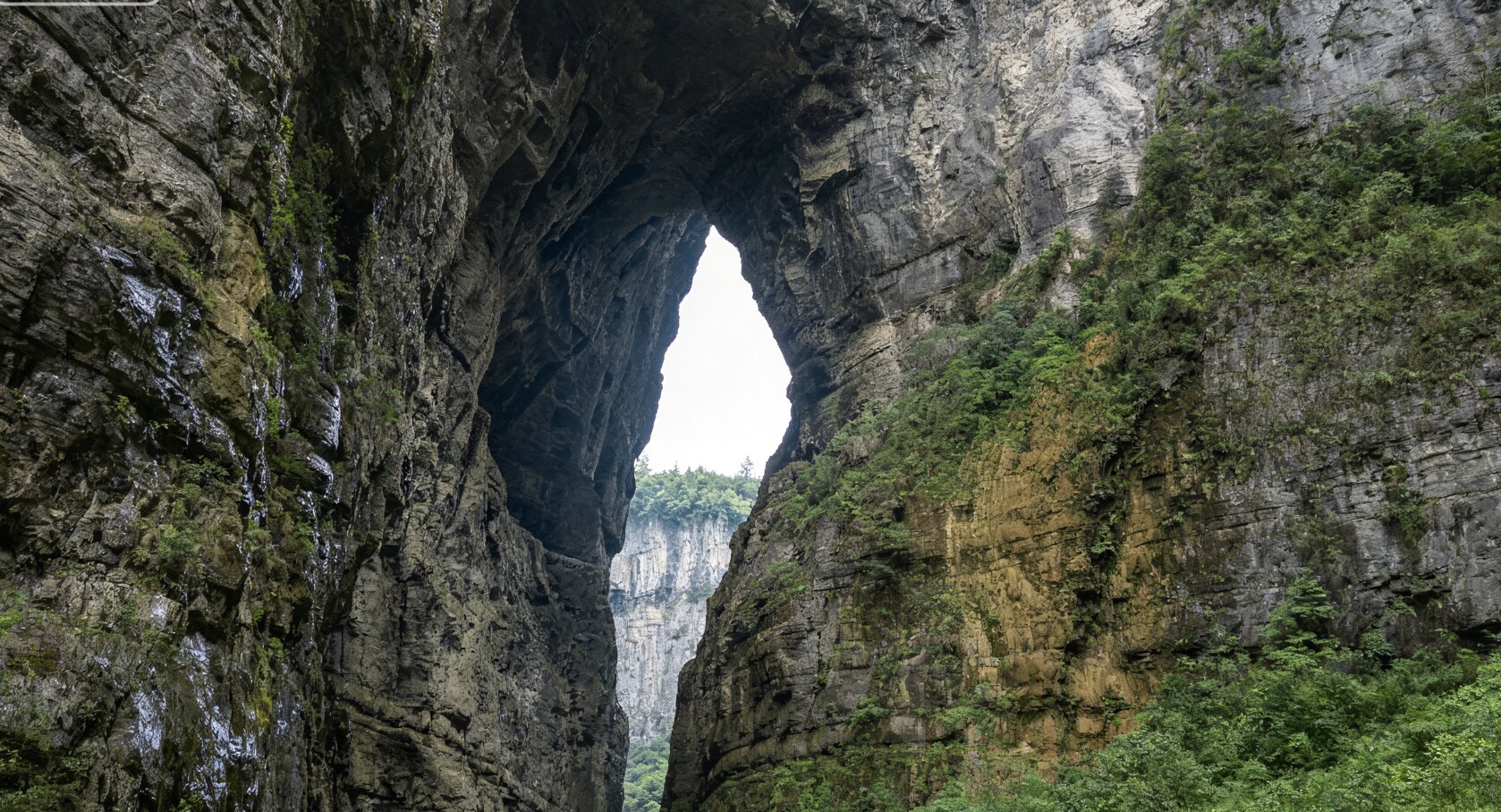
Tianlong Bridge (Heavenly Dragon Bridge)

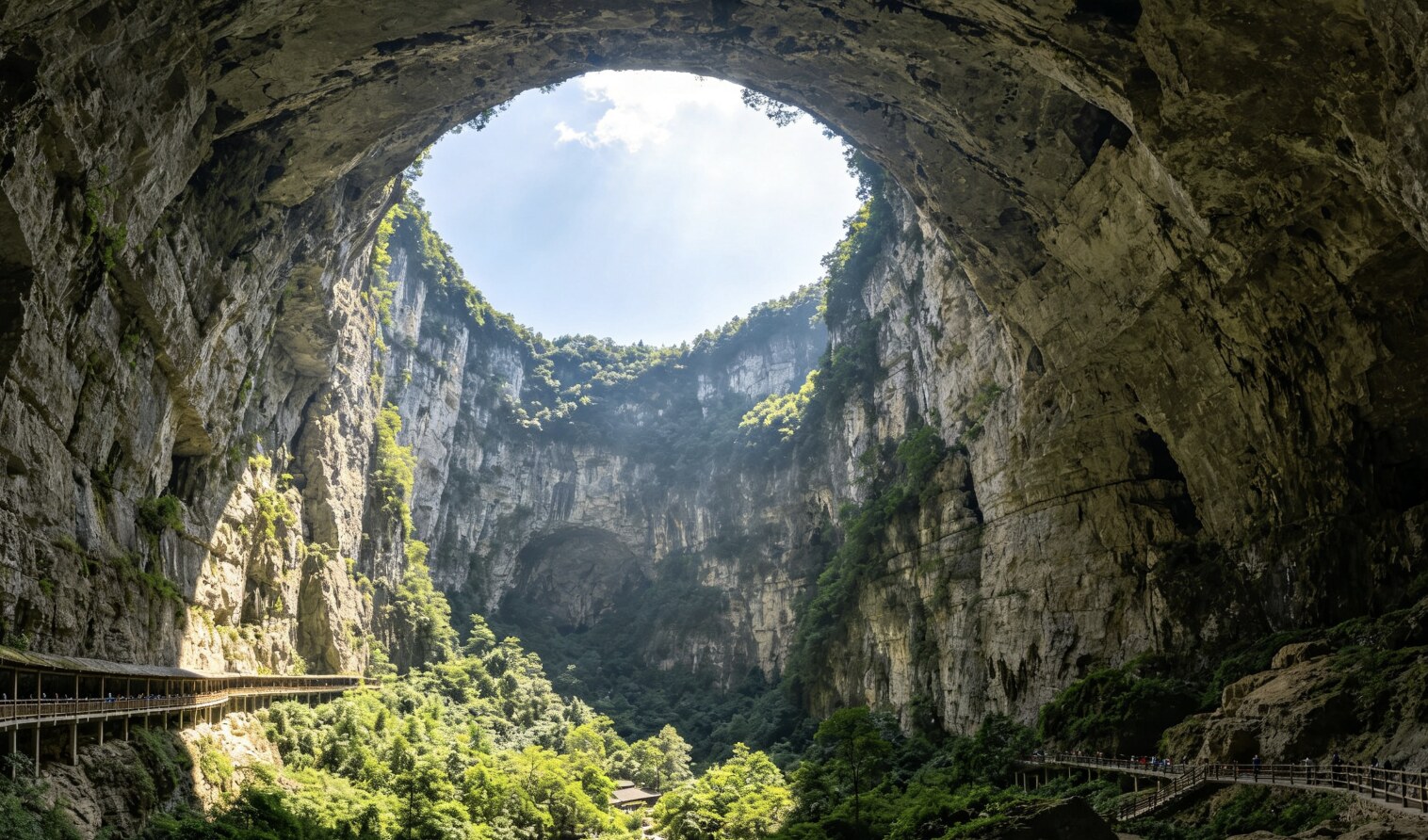
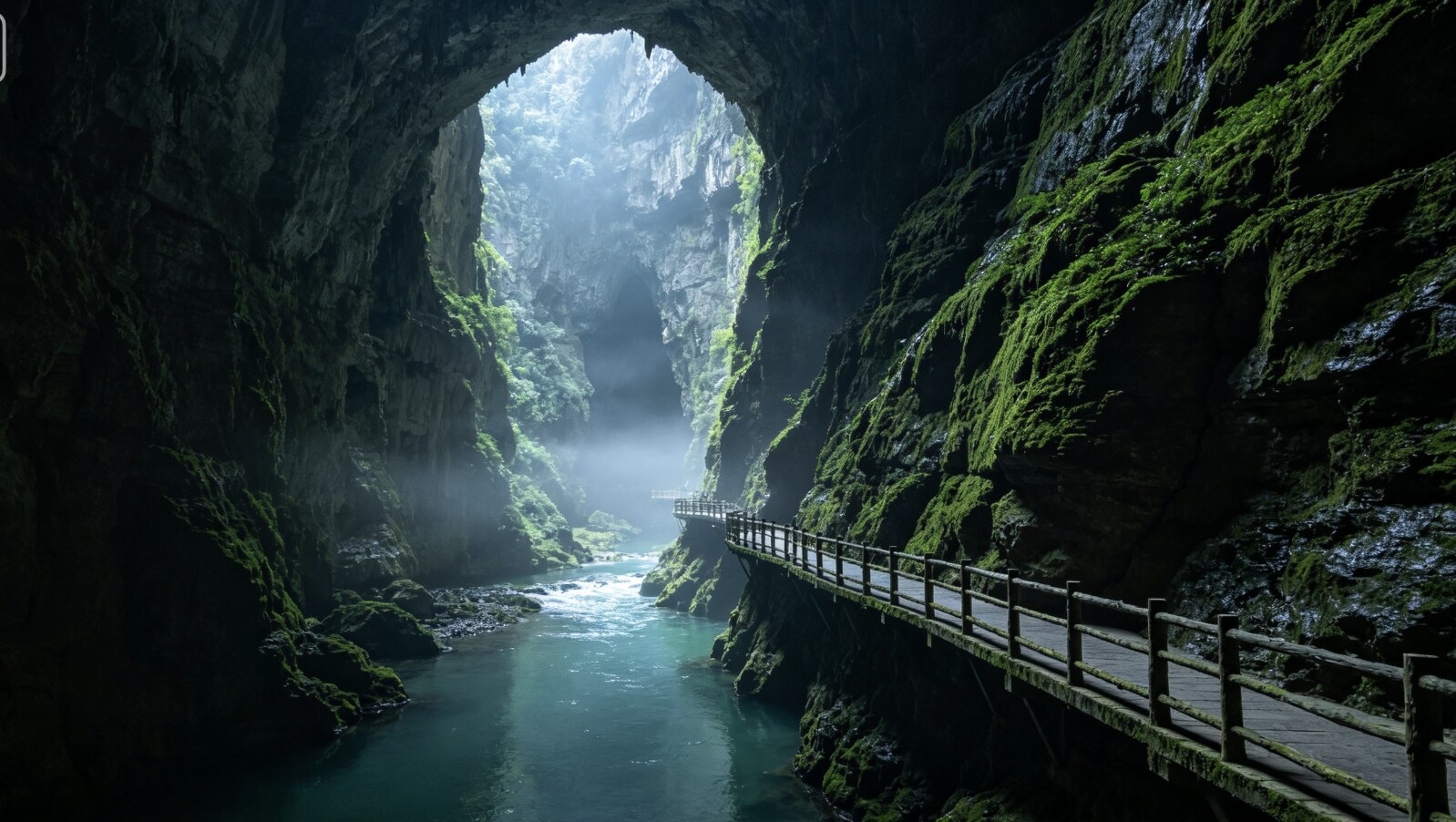
Tianlong Bridge is the first natural stone arch bridge in Wulong's Three Natural Bridges scenic area and the most imposing of the three. The bridge was formed from limestone deposited on an ancient seabed hundreds of millions of years ago, subsequently uplifted by tectonic movement and sculpted by water erosion and collapse. The arch stands approximately 235 meters high, with a bridge deck about 150 meters thick, 147 meters wide, and a span of about 34 meters—like a colossal stone rainbow spanning two cliff faces. The irregularly shaped arch opening allows sunlight to pour through from above, casting dappled light and shadow across the valley floor in a magnificent, dreamlike display. A winding stone-paved trail passes beneath the bridge, with ferns and vines clinging to the rock walls and moss-covered rubble scattered about, as if entering an ancient secret realm. The most famous feature is an eagle-shaped natural rock formation at the top of the arch and the "Thread Spring" trickling from beneath the vault. The hidden courier station from Zhang Yimou's film "Curse of the Golden Flower" was filmed beneath Tianlong Bridge, and the replica structure remains as a must-visit photo spot. Walking beneath the bridge and looking up at the enormous vault overhead, one feels the overwhelming majesty of nature and the smallness of humanity.
Tianguan Cifu (Heavenly Official's Blessing) · 天官赐福

🎧 In app
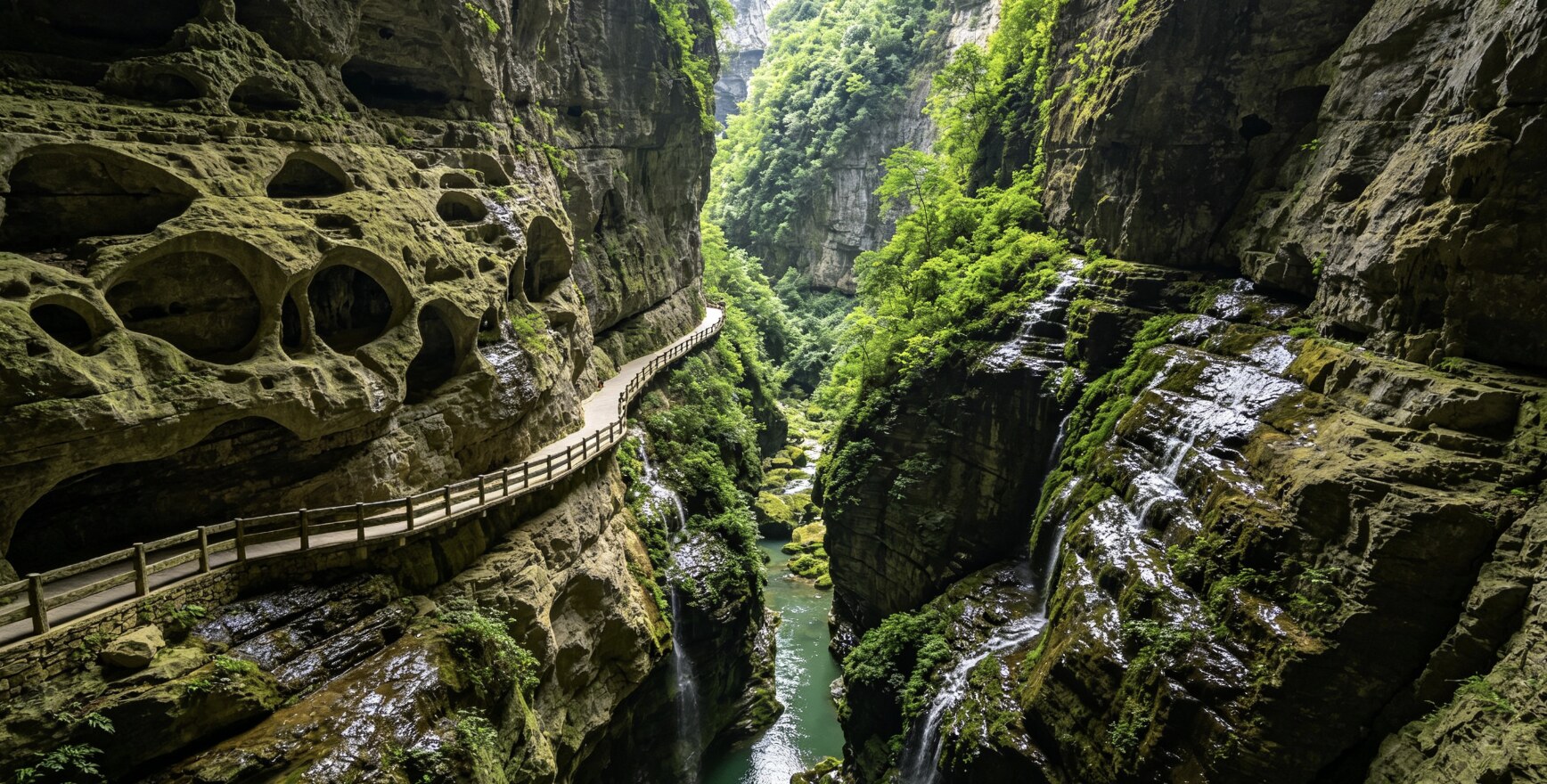
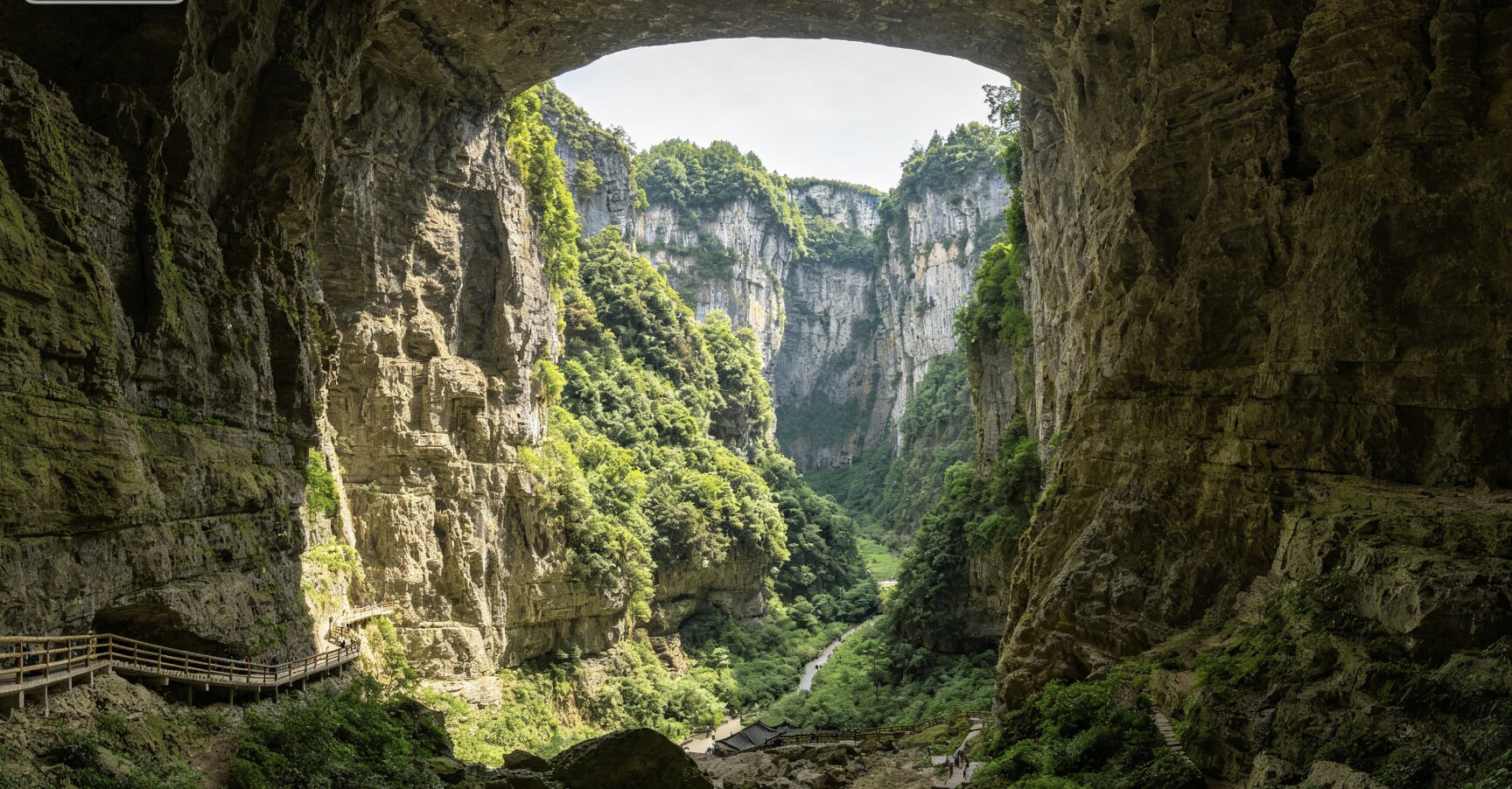
Tianguan Cifu (Heavenly Official's Blessing)

Tianguan Cifu is a unique natural cliff-face feature beneath Tianlong Bridge in the Three Natural Bridges scenic area. On the inner wall of the northern arch of Tianlong Bridge, a pattern of stone veins—formed over hundreds of millions of years through water erosion and mineral staining—strikingly resembles the four Chinese characters (Heavenly Official's Blessing). The strokes appear vigorous and well-structured, as if an immortal had used a finger as a brush to write on the cliff face. This coincidence has circulated in folklore for generations; local people regard it as an auspicious mark bestowed by a heavenly official descending to earth. During New Year and major celebrations, nearby villagers come to burn incense and pray for favorable weather and household peace. The surrounding cliff also bears natural patterns resembling auspicious clouds, bats, and ruyi motifs, further reinforcing the auspicious symbolism of fortune, prosperity, longevity, and happiness. The scenic area has installed a viewing platform, information plaque, and soft lighting so visitors can appreciate this natural wonder under various conditions. Geologically, the pattern results from differential weathering of varying mineral compositions in the limestone and iron oxide staining—a natural formation that, due to its striking resemblance to Chinese characters, has become one of the most culturally significant geological wonders of the Wulong Karst.

Qinglong Bridge (Azure Dragon Bridge) · 青龙桥

🎧 In app
Qinglong Bridge (Azure Dragon Bridge)

Qinglong Bridge is the second natural stone arch bridge in the Three Natural Bridges scenic area and the tallest of the three, with an arch height of approximately 281 meters, a deck thickness of about 168 meters, a width of about 124 meters, and a span of about 31 meters—ranking among the tallest natural stone arch bridges in the world. The bridge spans a near-vertical karst canyon, resembling a colossal stone archway standing between heaven and earth. The name comes from a beautiful natural phenomenon: at sunrise, sunlight slants through the arch opening, and the light refracts through mist and water vapor to form a blue-green beam crossing the canyon—like an azure dragon soaring through the bridge. A stream flows along the valley floor, with stalactites hanging from the rock walls in various forms—some like swords piercing the ground, others like lotus buds about to bloom. The arch ceiling has developed alcoves and natural stone eaves through weathering. During the rainy season, water cascades from these eaves like a bead curtain, with rainbows appearing in the sunlight—a dreamlike scene. A viewing platform beneath Qinglong Bridge offers one of the best vantage points for photographing the "soaring azure dragon" sunrise spectacle and classic panoramic views of the Three Natural Bridges.

Shenying Tiankeng (Divine Eagle Doline) · 神鹰天坑

🎧 In app
Shenying Tiankeng (Divine Eagle Doline)

Shenying Tiankeng is a large karst collapse doline situated between Tianlong Bridge and Qinglong Bridge in the Three Natural Bridges scenic area. The doline has an elliptical plan with a rim diameter of about 200–300 meters and a depth of approximately 195 meters, with a total volume of several million cubic meters—a world-class karst collapse feature. The doline is enclosed by nearly vertical limestone cliffs whose surfaces, through differential weathering, have formed numerous lifelike rock formations. The most striking is a protruding boulder on the eastern rim that, from certain angles, resembles a soaring eagle with head held high, wings spread, and piercing gaze overlooking the doline floor—giving the feature its name "Divine Eagle." The doline floor is relatively flat, covered with thick collapse deposits and subsequently grown dense vegetation, forming a relatively isolated "hanging garden" ecosystem. Wildflowers carpet sunlit areas while ferns thrive in shady corners, and birds occasionally circle above. Visitors descend along a cliff-hugging boardwalk, appreciating the doline's grandeur and the Eagle Rock from different heights and angles. Standing at the bottom looking up, the surrounding walls form a natural shaft with the sky cut into an irregular ellipse where clouds drift overhead—an extraordinary sense of isolation from the world.

Heilong Bridge (Black Dragon Bridge) · 黑龙桥

🎧 In app
Heilong Bridge (Black Dragon Bridge)

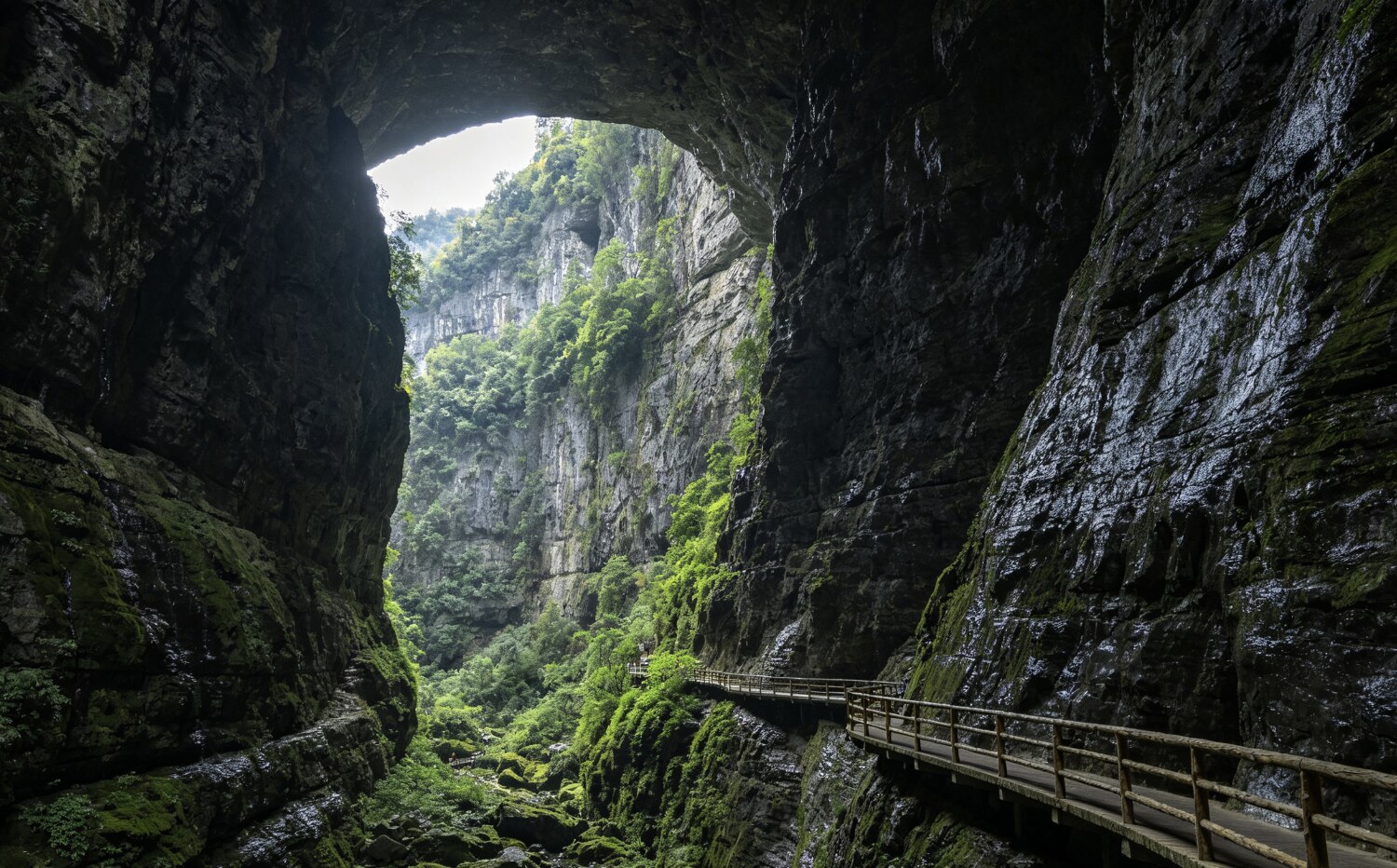
Heilong Bridge is the third and final natural stone arch bridge in the Three Natural Bridges scenic area, with an arch height of approximately 223 meters, a deck thickness of about 137 meters, a width of about 193 meters, and a span of about 28 meters. Unlike Tianlong Bridge's grandeur and Qinglong Bridge's height, Heilong Bridge is renowned for its depth, darkness, and unpredictability. The long, curving arch opening admits little sunlight, leaving the interior perpetually dim with cool breezes and the sound of flowing water—walking through feels like traversing a black dragon's belly, hence the name "Black Dragon." The most famous feature is the natural perforation in the arch ceiling through which sunlight enters, creating a bright spot on the dark wall that slowly moves over time like a searchlight scanning the cave—dubbed the "Shadow Clock." Multiple remarkable micro-karst formations exist beneath: a stalactite platform resembling Guanyin seated on a lotus, rock strata sections as clean-cut as by knife, and miniature stalagmite clusters formed by perennial dripping. Near the exit, a narrow passage called "Dragon Gate" has walls nearly touching, admitting only one person sideways—after squeezing through, the space suddenly opens into a hidden paradise. Summer temperatures beneath Heilong Bridge are only about 18°C, making it a natural cooling refuge and the most adventure-filled of the three bridges.

Longquan Cave (Dragon Spring Cave) · 龙泉洞

🎧 In app
Longquan Cave (Dragon Spring Cave)

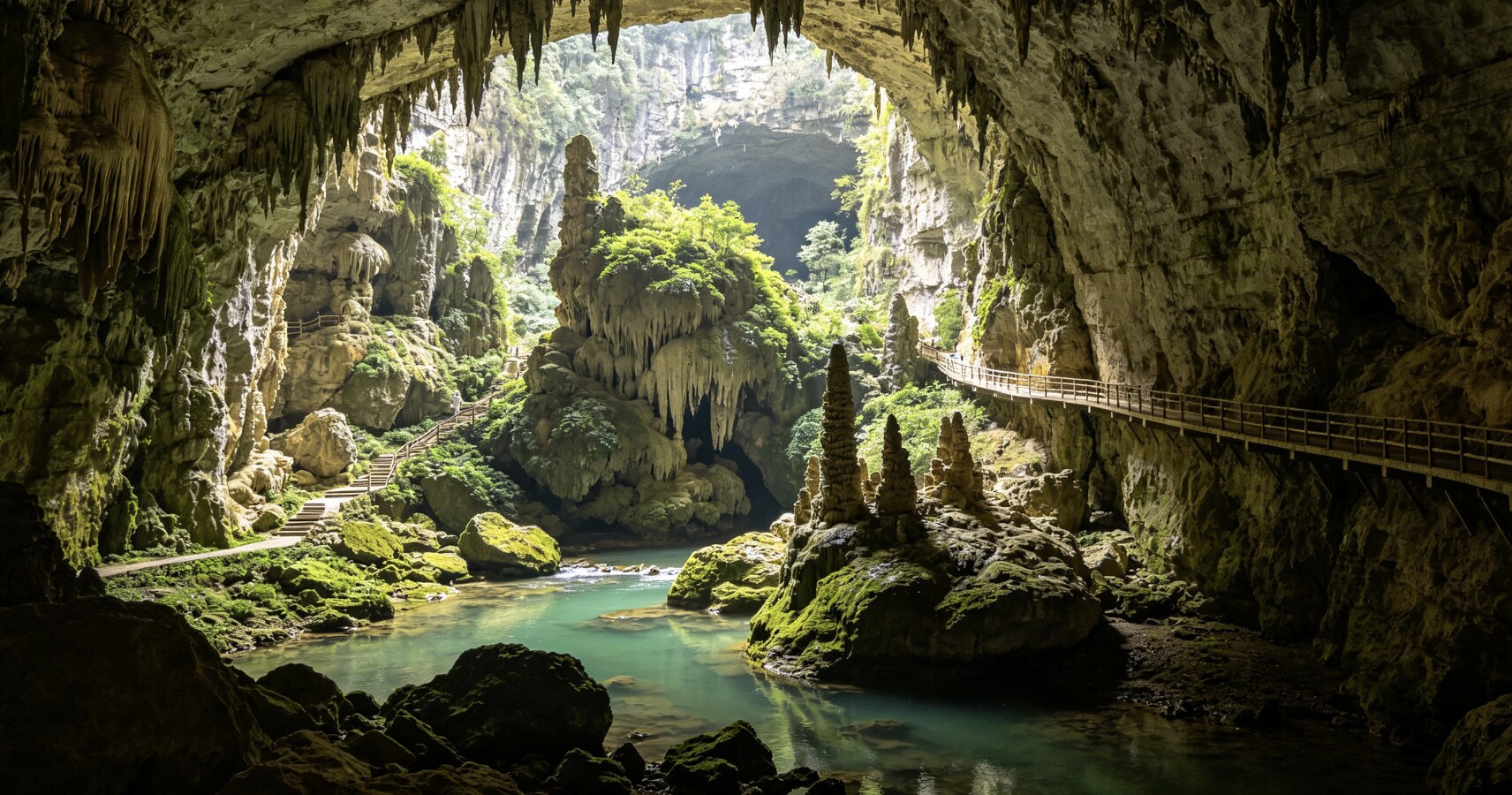
Longquan Cave is hidden within a limestone cliff face near Heilong Bridge in the Three Natural Bridges scenic area—one of the most mysterious cave features in the park. The entrance is concealed beneath a moss-covered cliff, where a clear mountain spring gushes from within, cascading along the rock face into a thin stream that drops to the valley floor. The perpetual flow and the low, dragon-like rumble of the water give it the name "Dragon Spring." The explored length extends several hundred meters, divided into front and rear chambers. The front chamber is spacious with a vault about 15 meters high, walls covered in diverse stalactites and stone curtains—some like inverted lotus flowers, others like terraced fields or hanging silk drapes—gleaming under lighting. The rear chamber is deeper and narrower, requiring visitors to stoop; the ceiling is dense with soda straw stalactites like a volley of arrows, while several stalagmites and columns rise from the floor. The tallest stalagmite, about 3 meters high, resembles a miniature pagoda, formed over tens of thousands of years of drip deposition. The cave maintains a constant temperature of about 16°C year-round—refreshingly cool in summer and misty in winter. Ancient marine fossils are visible on the cave walls, silently recounting the epic geological journey from ocean floor to mountain peak over hundreds of millions of years. Though smaller than Wulong's Furong Cave, Longquan Cave's exquisite delicacy and seamless integration with the Three Natural Bridges make it an unmissable hidden gem.

Longshuixia Difeng (Dragon Water Gorge Fissure) · 龙水峡地缝

🎧 In app
Longshuixia Difeng (Dragon Water Gorge Fissure)

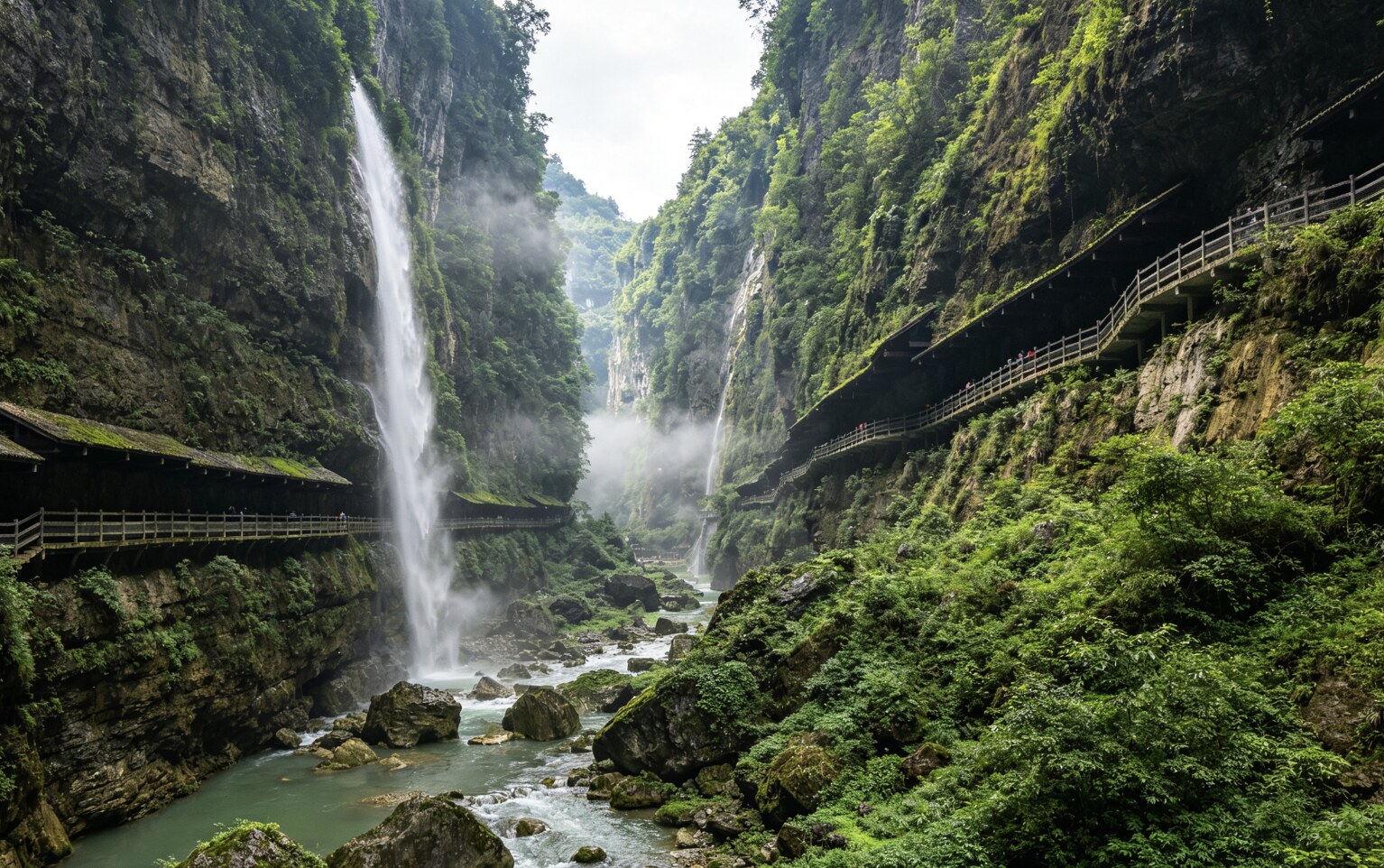
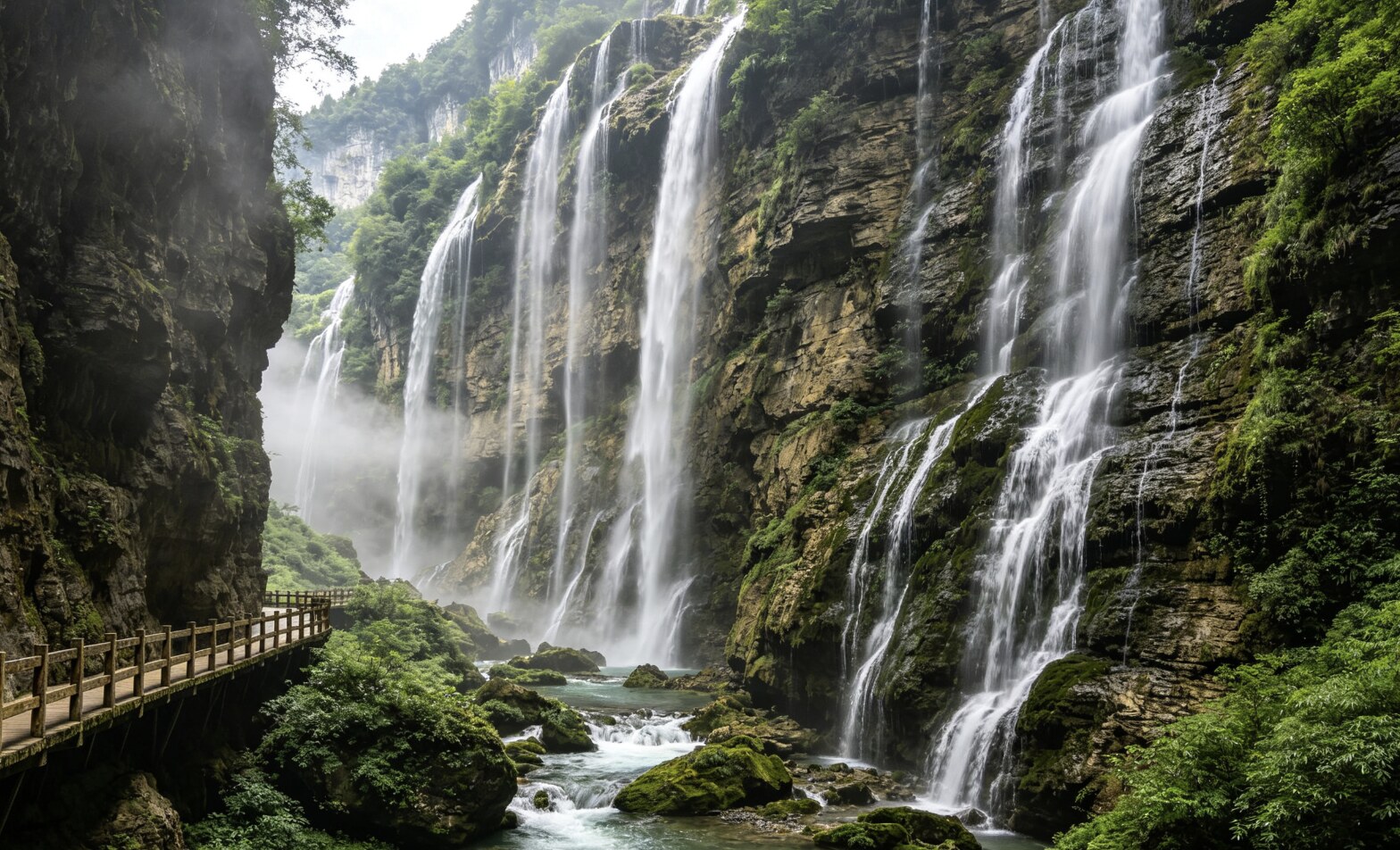
Longshuixia Difeng is an important component of the Wulong Karst World Natural Heritage. It belongs to the same geological system as the Three Natural Bridges but presents a dramatically different landscape. The fissure extends about 5 km total with a developed tourist section of about 2 km—a deep gorge-type karst landform formed by the collapse of an underground river's ceiling. At its narrowest, the gorge is only 1–2 meters wide, with near-vertical cliff walls 200–300 meters high. From the valley floor, the sky appears as a single thread—hence the names "Earth Fissure" and "Thread of Sky." A crystal-clear stream runs the length of the valley floor, jade-green in color, with water-polished boulders scattered throughout. Cliff-hugging boardwalks and suspended bridges wind through the gorge—visitors stroll along the streambank one moment and climb to mid-cliff aerial walkways the next, with only a sliver of sky overhead and rushing water below. Stalactites hang from the walls, thick with moss and ferns, as if entering a green tunnel toward the earth's core. The microclimate is cool and humid, with air fragrant with plants and water mist; summer temperatures are about 10°C lower than outside. Multiple small waterfalls cascade from cliff crevices along the way, with mist and occasional rainbows. The most spectacular, Yinhe Waterfall, drops dozens of meters—the iconic feature of the fissure.

Yinhe Waterfall (Milky Way Cascade) · 银河飞瀑

🎧 In app
Yinhe Waterfall (Milky Way Cascade)

Yinhe Waterfall is the largest and most awe-inspiring waterfall in the Longshuixia Difeng scenic area. Located at the mid-section of the gorge fissure, an abundant underground river source gushes from a natural crevice high on the cliff face, cascading down a near-vertical rock wall with a drop of several dozen meters. At full flow, the curtain spans 3–5 meters wide, roaring like thunder with mist filling the narrow gorge—an overwhelming spectacle. The great height and force shatter the water into countless fine droplets that refract sunlight into brilliant sparkles, like the Milky Way descending from heaven—hence the name "Milky Way Cascade." At its base, the waterfall collects into a deep emerald pool, clear to the bottom yet unfathomably deep, surrounded by mirror-smooth boulders polished by the current. From the viewing platform at the pool's edge, mist washes over visitors—refreshingly cool in summer, while in winter it freezes into icicles and frost flowers adorning the cliffs, offering distinct beauty in every season. A natural alcove in the cliff behind the waterfall allows adventurous visitors to circle via a side boardwalk into the cave and look outward through the cascading curtain—a magical "Water Curtain Cave" experience. Yinhe Waterfall is the climactic section of the Longshuixia Difeng tour and one of the most memorable water features in the entire Wulong Karst tourist area.

Jiaolong Hangu (Flood Dragon Cold Cave) · 蛟龙寒窟

🎧 In app
Jiaolong Hangu (Flood Dragon Cold Cave)

Jiaolong Hangu is located beneath a cliff deep within the Longshuixia Difeng scenic area—a natural large stone cavern formed by the combined action of karst dissolution and rock layer collapse. The entrance is low and concealed, half-hidden by dense ferns and moss, requiring visitors to duck to enter. The interior space covers several dozen square meters with a vault about 3–5 meters high. The walls are covered with grooves and dissolution pits formed by perennial water erosion, their surfaces wet and smooth, gleaming with a cold sheen under lighting. The cavern's most notable feature is its exceptionally low temperature—about 12–14°C year-round. Even in midsummer, the chill upon entering is biting and bone-penetrating, with a temperature difference of more than 15°C from outside. A shallow cold pool occupies the cavern floor, crystal-clear and icy, inhabited by tiny blind fish and transparent shrimp—cave-dwelling species evolved for perpetual darkness, their bodies pale or colorless. Behind the pool, a narrow underground river channel extends deeper into the earth, its water echoing faintly, with even searchlights unable to reach the end—shrouding the cavern in mystery. Local folklore holds that a flood dragon once lurked here, its dragon breath becoming the perpetual cold mist, hence the name "Flood Dragon Cold Cave." Though modest in size, the extreme chill and mysterious underground ecosystem make this one of the most memorable exploration stops in the Longshuixia Difeng tour.

Fairy Mountain National Park – Mutizi Station · 仙女山国家公园-木梯子站

🎧 In app
Fairy Mountain National Park – Mutizi Station

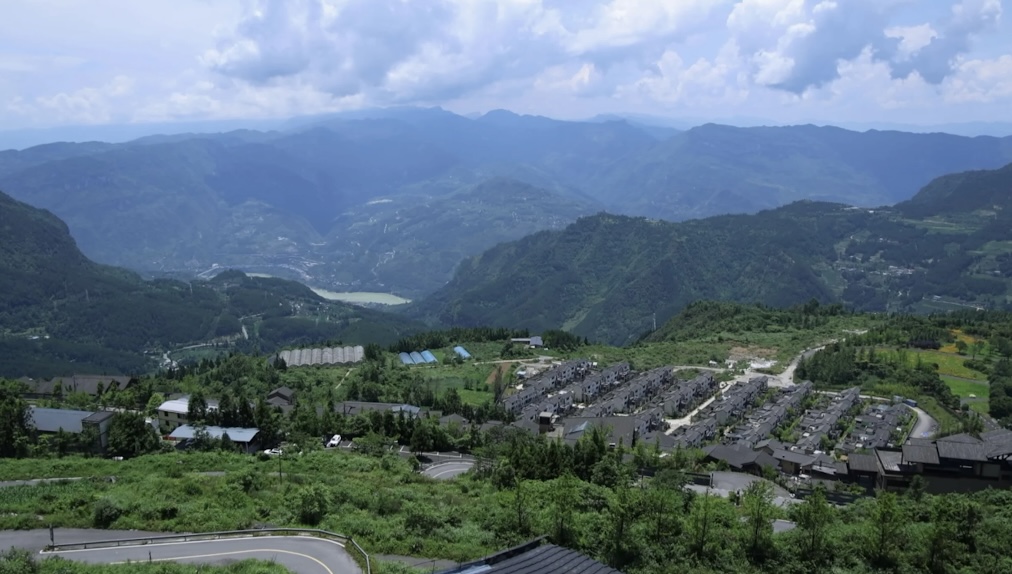
Mutizi Station is the starting station of the sightseeing train within Fairy Mountain National Park, located near the main park road entrance at an elevation of about 1,900 meters—the first stop for visitors entering the core scenic area. The name "Mutizi" (Wooden Ladder) originates from local history: a steep mountain path once paved with wooden stairs here was the main route for early mountain dwellers to gather herbs and graze livestock. After the road was built, the stairs fell into disuse, but the name endured. The station building features wooden construction with grey tiles in Ba-Yu mountain vernacular style, harmonizing with the surrounding pine forest and alpine meadows. The plaza in front includes a large visitor distribution area, ticket windows, a resting corridor, and park maps. After purchasing tickets, visitors board a vintage sightseeing train that runs along a circular railway through the park. The 12-kilometer route passes through dense Cryptomeria and cypress forests and alpine meadows with seasonal variation: lush green grass and wildflowers in spring and summer, layered autumn colors, and a silvery snowscape in winter resembling northern landscapes. Mutizi Station also houses a transfer center and ecological parking lot where self-driving visitors park before taking the train into the core scenic area. An open lawn beside the station is equipped with telescopes for viewing Fairy Mountain's main peak and the rolling Wuling range—an ideal spot for warm-up photos before departure.

Fairy Mountain National Park – Mutizi Station · 仙女山国家公园-木梯子站

🎧 In app
Fairy Mountain National Park – Mutizi Station

Get the app

The tool solved one problem. The app handles the whole trip.

Per-trip visa judgements, audio guides, prep checklists, and a real human concierge — offline-ready, in your language.

Download for iPhoneFree to download · No OTA upsells