🎫 Ticket the street/pedestrian area is free and open all day; individual inner attractions charge separately
🚇 Metro Metro Line 1, Sanshan Street Station
🕘 Opening Hours - **Public areas of the scenic area:** Open 24 hours a day
- **Opening hours of internal attractions (reference, subject to on-site announcements):**
- Confucius Temple Dacheng Hall: 9:00—21:00
- Nanjing China Imperial Examination Museum: 9:00—21:00
- Former Residence of Li Xiangjun Exhibition Hall: 9:00—22:00
- Former Residence of the Wang and Xie Families: 9:00—22:00
- Former Residence of Qin Dashi: 9:30—17:30
- Zhonghuamen Wengcheng (Gate Tower): April to October 8:30—22:00; November to March 8:30—21:00
- Zhanyuan Garden: 8:00—17:00
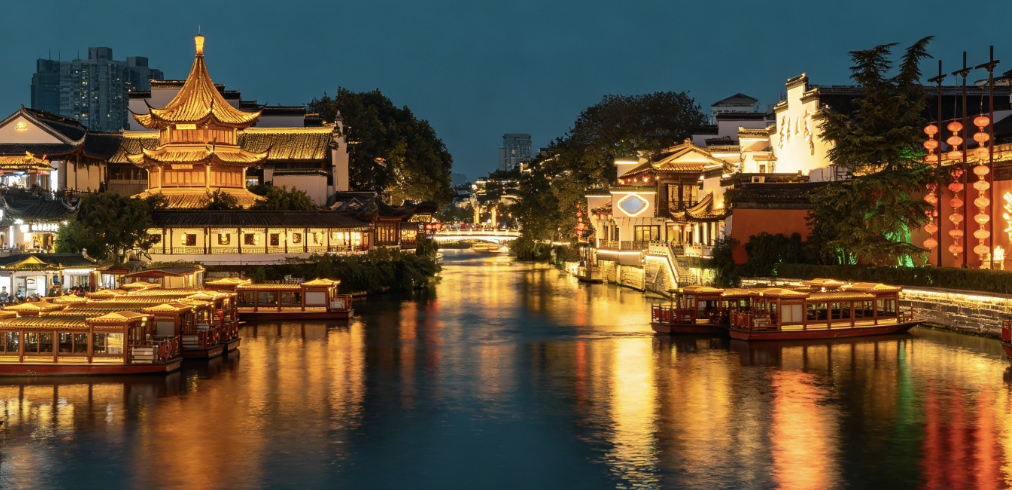
- **Qinhuai River painted boat cruise:** Day and night shifts are available. Night cruise is about 18:00—22:00
- **Recommended visiting time:** Half a day to a full day; it is recommended to visit from evening to night, so you can enjoy both daytime scenery and night lighting
🕘 Opening Hours Dacheng Hall / Imperial Examination Museum: 09:00–22:00, last admission at 21:30
🚇 Metro Metro Lines 3/5, Fuzimiao Station, Exit 2
📍 Address Gongyuan Street, Qinhuai District, Nanjing, Jiangsu Province (Confucius Temple Central Scenic Area) Map ↗ ⚠️ BookingAdvance reservation required
Inside Nanjing Confucius Temple - Qinhuai River Scenic Area
Ancient Qinhuai Archway (Entrance Plaza) · 古秦淮牌坊(入口广场)
🎧 In app 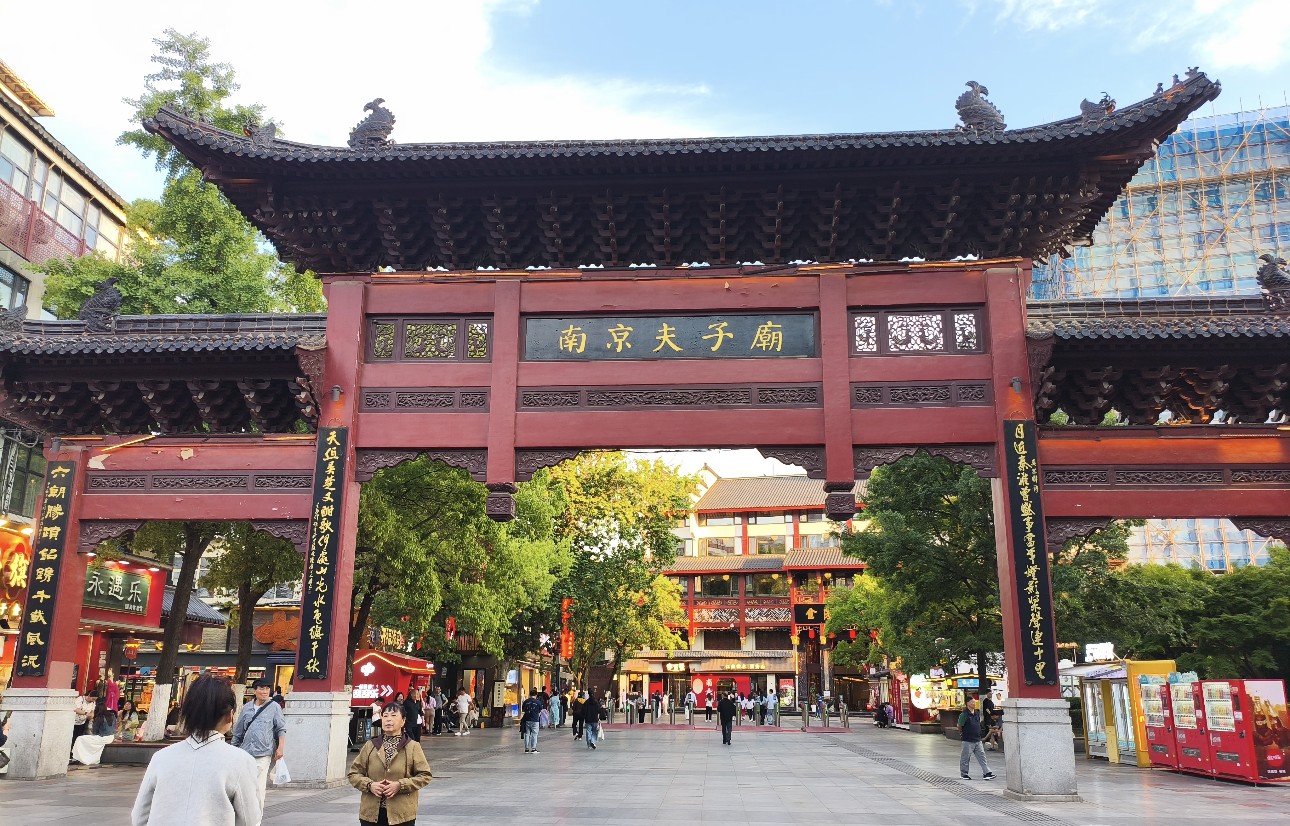
The Ancient Qinhuai Archway stands at the southern entrance of the Fuzimiao scenic area, serving as the first landmark when entering the Qinhuai riverfront district. It is a four-column, three-bay soaring stone archway constructed of bluestone and white marble. The front lintel bears the gilded characters "Gu Qinhuai" (Ancient Qinhuai), while the reverse reads "Fuzimiao" (Confucius Temple), both in vigorous calligraphy. Stone lions guard either side, lending the structure a commanding presence. The entrance plaza before the archway is broad and flat, serving as a primary gathering and photo spot. During holidays, the plaza teems with visitors, and the archway glows brilliantly under illumination. Looking northward from here, one takes in the full panorama of the bustling riverside streets and historic architecture, marking the formal start of a Fuzimiao visit.
Screen Wall and Pan Pool · 照壁与泮池
🎧 In app 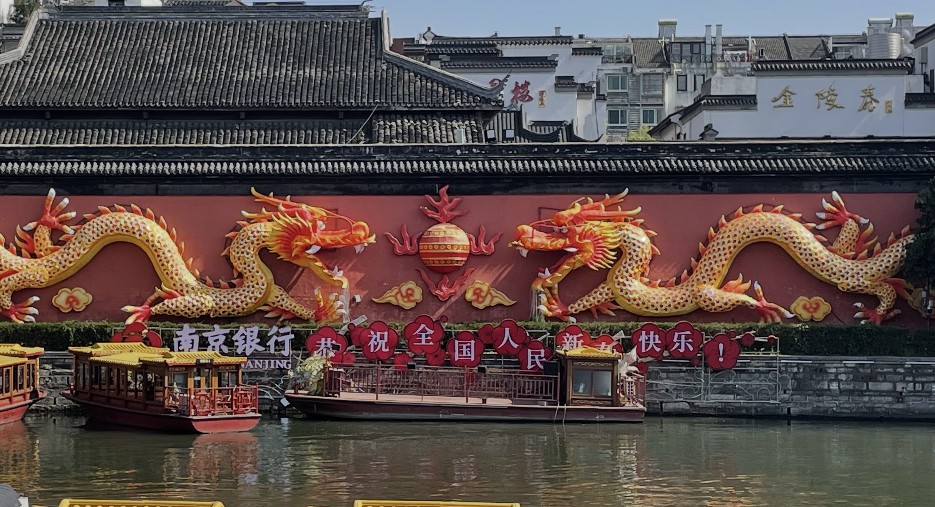
The Screen Wall, located on the south side of the Fuzimiao plaza along the north bank of the Qinhuai River, was first built in the Wanli reign of the Ming Dynasty. At approximately 110 meters in length, it is one of the longest surviving screen walls in China. Constructed of blue brick with a glazed-tile crown, its center features a relief carving of two dragons playing with a pearl, symbolizing literary prosperity. In front of the wall lies the Pan Pool, a semi-circular basin unique to Confucian temple complexes. The Nanjing Fuzimiao's Pan Pool uniquely incorporates the natural Qinhuai River channel as the pool itself—a rare design among Confucian temples nationwide. Stone balustrades with finely carved panels line the pool. At dusk, the illuminated screen wall reflects in the water alongside passing painted boats, creating Fuzimiao's most iconic nightscape.
"Greatest Center of Learning" Archway and Juxing Pavilion · 天下文枢坊与聚星亭
🎧 In app 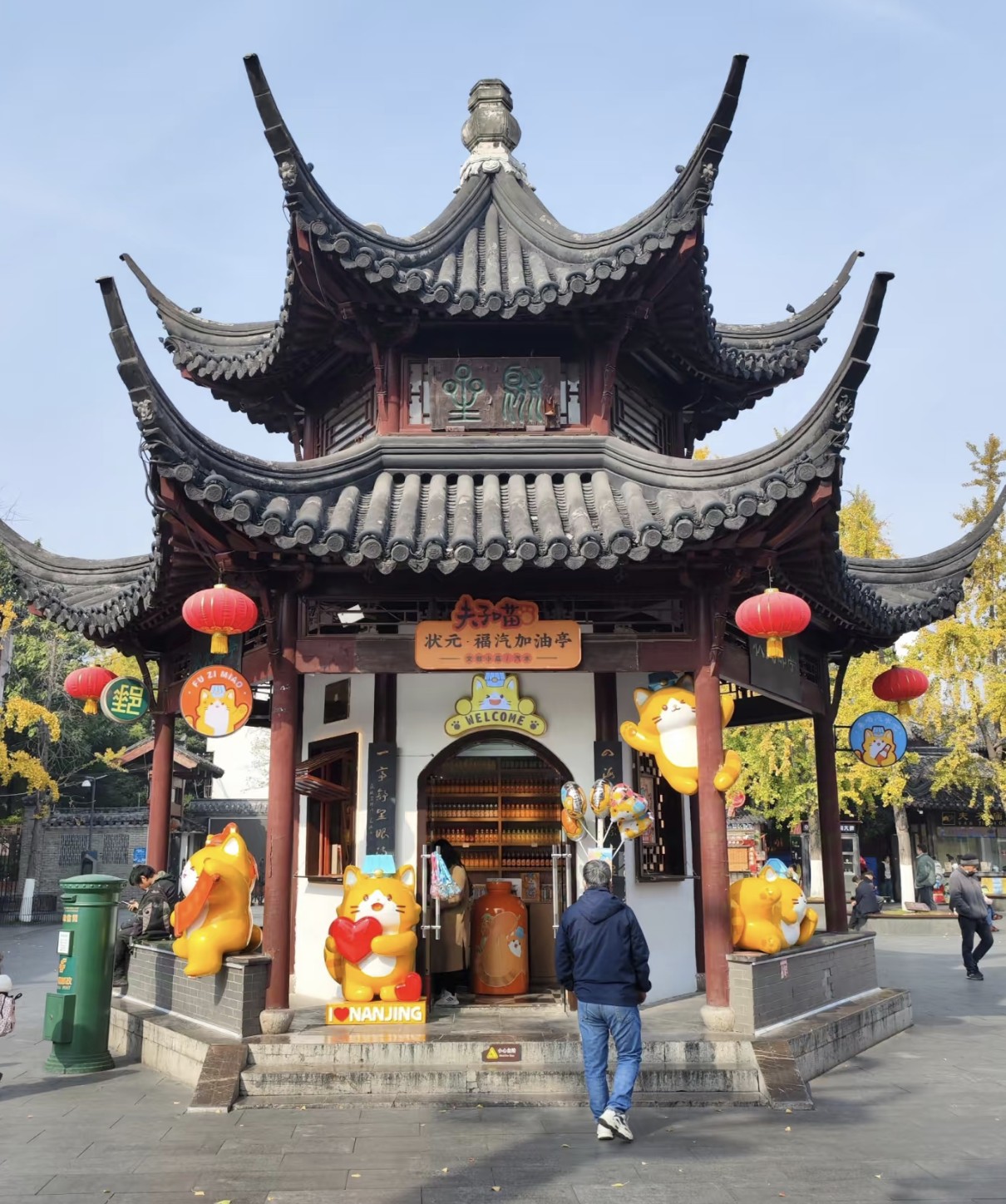
The "Greatest Center of Learning" Archway stands at the heart of the Fuzimiao plaza. This four-column, three-bay wooden archway bears the inscription "Tianxia Wenshu" ("Greatest Center of Learning Under Heaven") on its front and "Dongnan Diyi Xue" ("Foremost School of the Southeast") on its reverse, proclaiming the exalted status of Nanjing's Confucius Temple as a center of Chinese culture and education. With upturned eaves, painted bracket sets, and a commanding presence, the archway is flanked by the Juxing Pavilion, a hexagonal double-eaved pavilion whose name means "Gathering of Stars," symbolizing the assembly of literary talents. The pavilion was historically a meeting place for scholars to discuss literature and ideas. Its delicate form complements the grand archway in a harmonious contrast of scales, together forming the most ceremonial spatial node of the temple's front area and a classic photo spot.
Lingxing Gate · 棂星门
🎧 In app 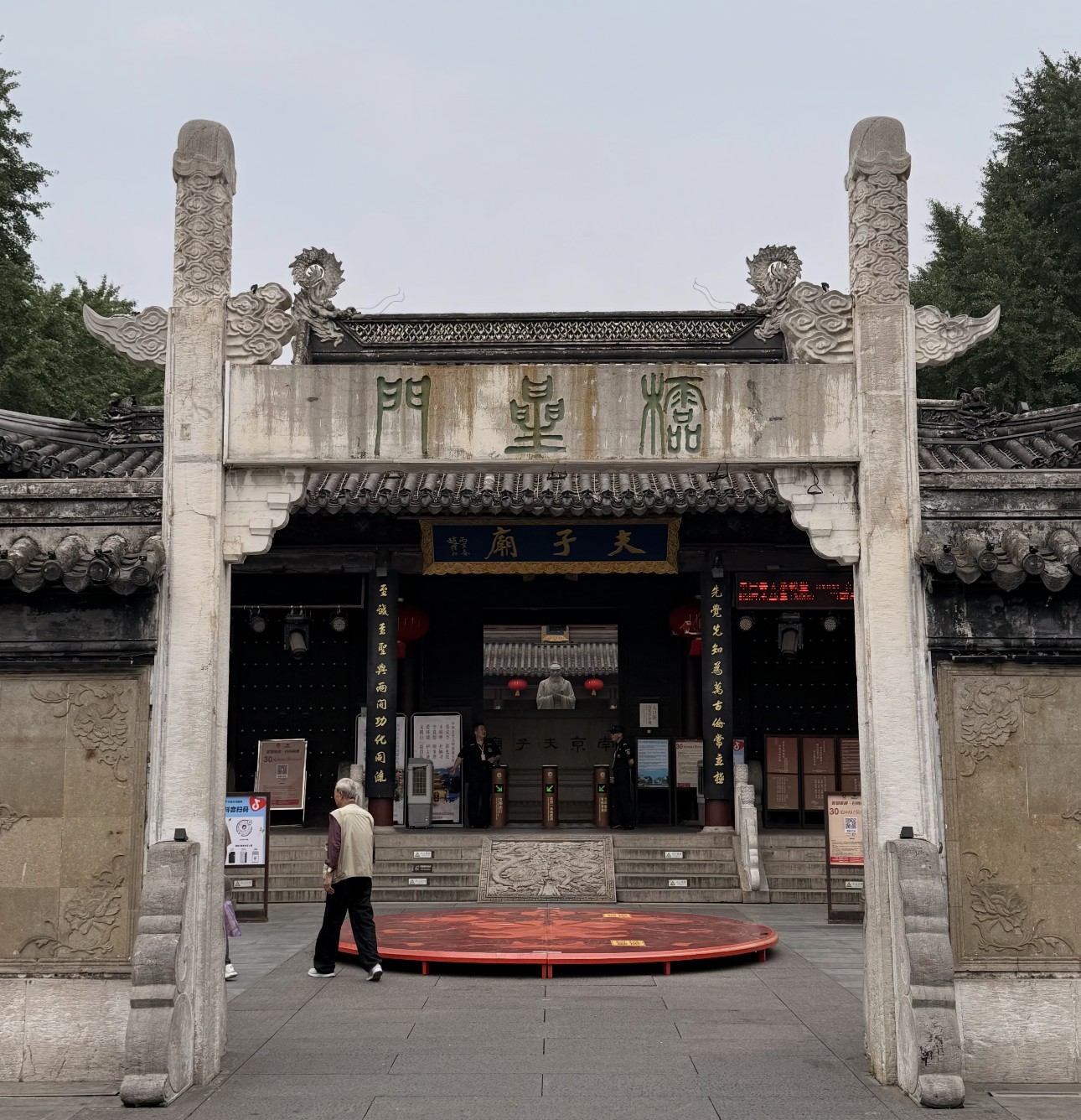
The Lingxing Gate is a key node along the central axis of the Fuzimiao complex, positioned before the Dacheng Gate. "Lingxing" refers to the celestial field star; ancients sacrificed to it to pray for abundant harvests, and its presence at a Confucian temple signifies honoring Confucius as one honors Heaven. The gate takes the form of a three-bay, four-column stone archway, with carved stone beasts atop the pillars, cloud-and-dragon reliefs on the lintels, and monolithic granite columns. Stone steps and a ceremonial path flank the gate; in ancient times, all civil and military officials were required to dismount and proceed on foot as a mark of reverence for Confucius. As a distinctive architectural symbol of Confucian temples, the Lingxing Gate serves both ritual and symbolic functions, marking the critical transition from secular to sacred space and setting the stage for the grand sequence of the Dacheng Gate and Dacheng Hall beyond.
Dacheng Gate · 大成门
🎧 In app 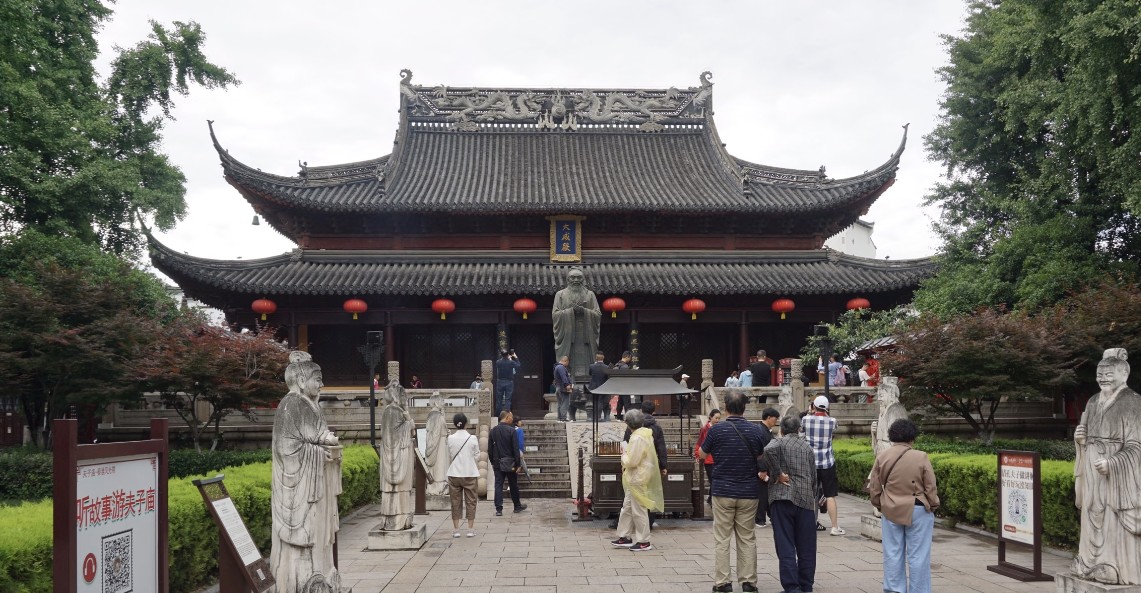
Also known as the Halberd Gate, the Dacheng Gate is the formal entrance to the core building complex of the Confucius Temple. Its name derives from Mencius's description of Confucius as one who "achieved the grand synthesis" (ji dacheng). The gate has a five-bay facade, a single-eave hip-and-gable roof with yellow glazed tiles, painted bracket sets, and door panels studded with nails and door knockers. Originally, halberd-bearing guardian figures flanked the entrance, giving rise to the alternative name. Normally only the central portal is opened; all three doors are opened together only during major ceremonies. Stone steles from the Ming and Qing dynasties line the flanking paths, recording temple renovations and ritual protocols. Crossing the high threshold, one enters the temple's core ritual courtyard, where ancient cypresses and rows of stone tablets transform the atmosphere from worldly bustle to solemn reverence.
Dacheng Hall · 大成殿
🎧 In app 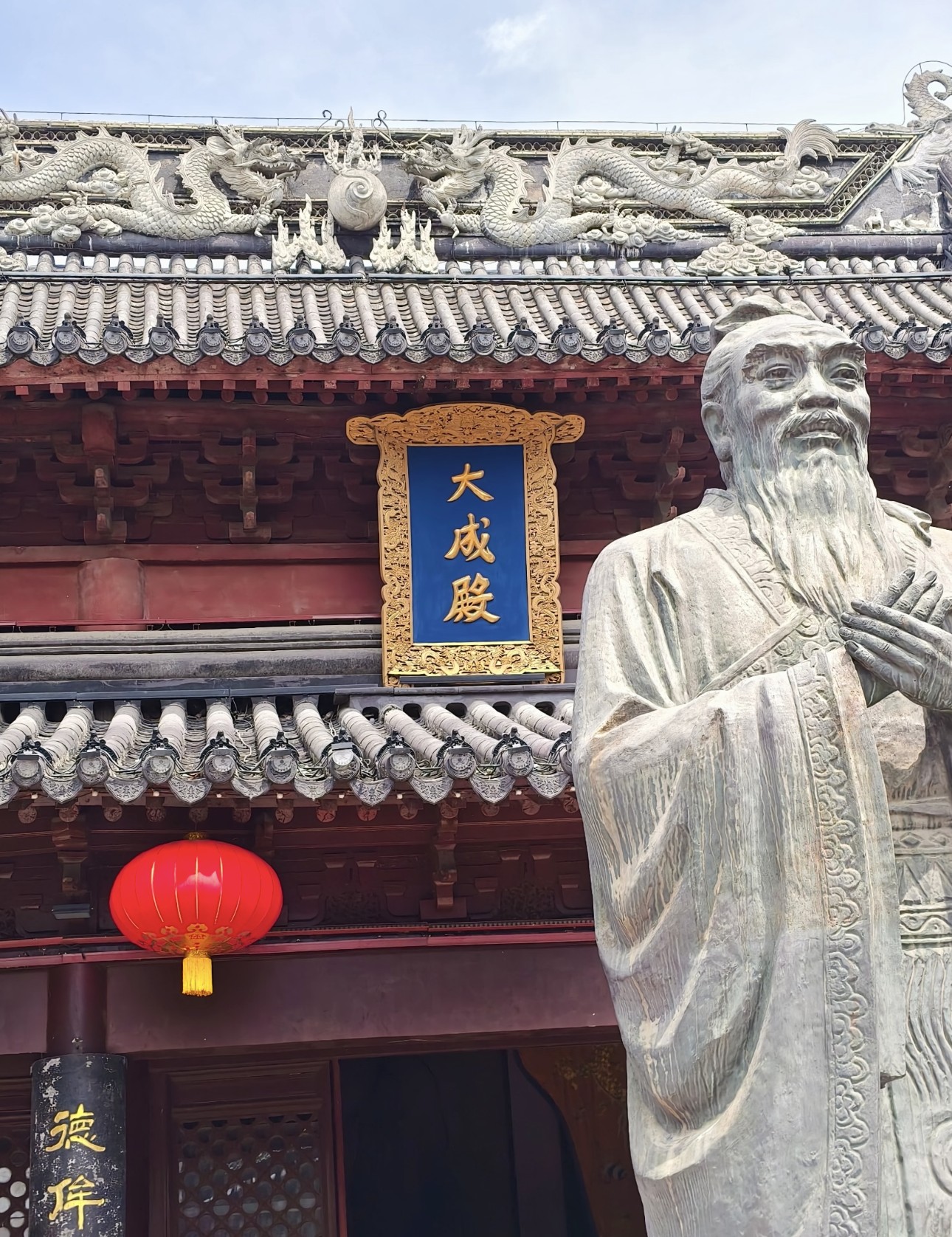
The Dacheng Hall is the centerpiece and soul of the Confucius Temple complex. First built in the first year of the Jingyou reign of the Northern Song Dynasty (1034), it was destroyed and rebuilt multiple times; the current structure was reconstructed in 1984 following Qing Dynasty specifications. The hall has a seven-bay facade, a double-eave hip-and-gable roof with yellow glazed tiles, and rises approximately 18 meters high. Inside, a seated statue of Confucius—about 4.5 meters tall—occupies the center, flanked by the Four Correlates (Yan Hui, Zengzi, Zisi, and Mencius) and the Twelve Wise Disciples, all fashioned in traditional painted clay. Thirty-eight mosaic murals depicting Confucius's life are displayed within, crafted with exquisite inlay work. The broad terrace before the hall was historically the site of grand Confucian sacrifice ceremonies, with a bronze incense burner at its center. Imperial plaques, including the Kangxi Emperor's calligraphy "Teacher of Ten Thousand Generations," hang from the beams, creating an overwhelming atmosphere of solemnity—this is the essential place to experience the majesty and reverence of Confucian culture.
Mingde Hall, Zunjing Pavilion, and Southeast's No.1 School · 明德堂、尊经阁与东南第一学
🎧 In app 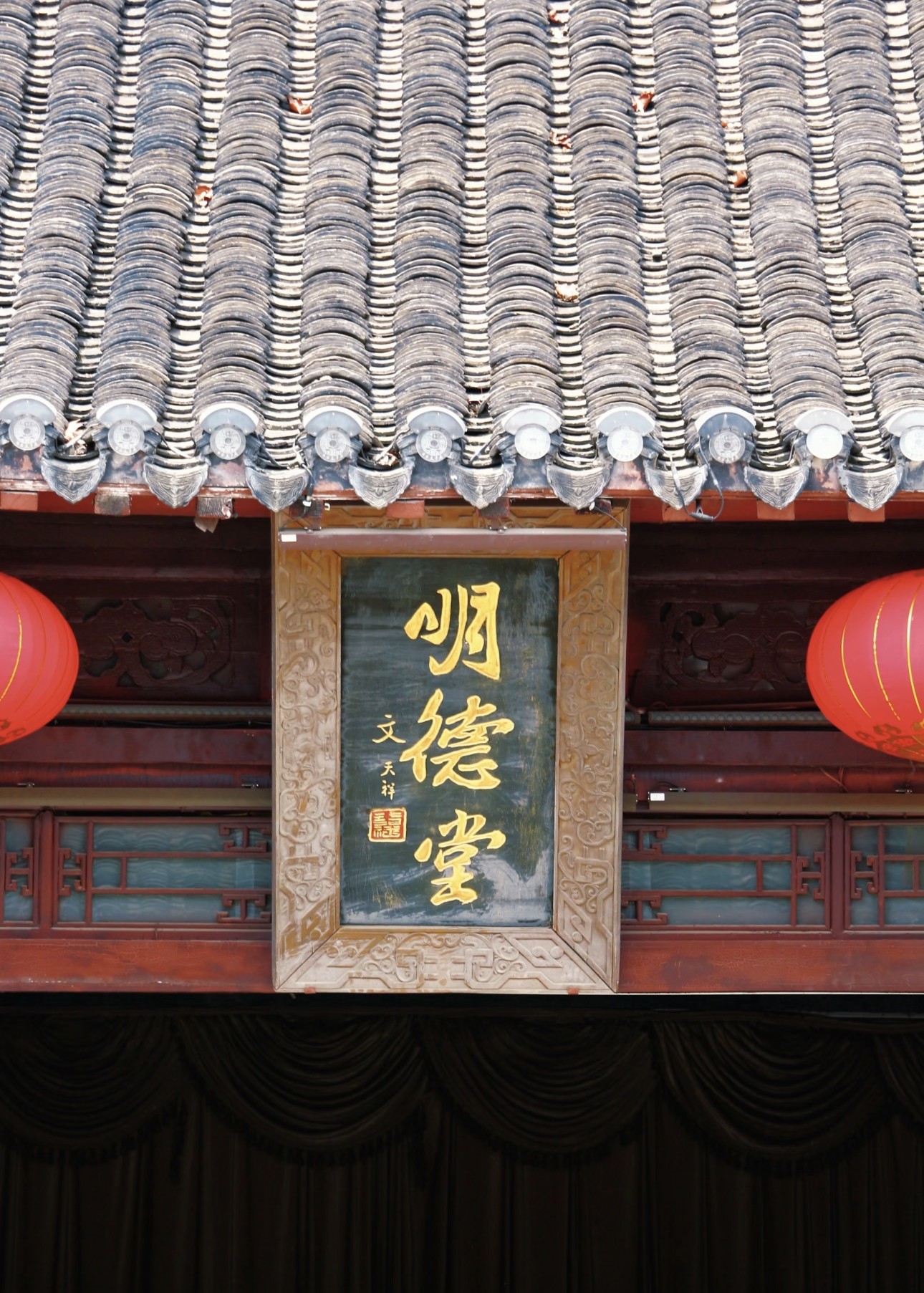
Mingde Hall, Zunjing Pavilion, and the "Southeast's No.1 School" comprise the academy section of the Confucius Temple complex, located behind the Dacheng Hall. Mingde Hall is the main building of the academy, named after the concept of "illustrating virtue" from The Great Learning, and served as a lecture hall in ancient times. It now displays imperial examination artifacts and classical Confucian texts. Zunjing Pavilion, a two-story building behind Mingde Hall, was originally a library housing Confucian classics and imperially bestowed books, ranking among the most prestigious structures in the academy. The plaque "Southeast's No.1 School" hangs at the academy entrance, proclaiming the preeminence of the Fuzimiao academy in the regional educational system. The three structures align along the central axis in ascending sequence, forming the integrated "temple-and-academy" layout. Visitors here can gain insight into the ancient Chinese system of combining temple and school, and the transmission of Confucian culture.
Jiangnan Imperial Examination Hall (South Branch of China Imperial Examination Museum) · 江南贡院(中国科举博物馆南馆)
🎧 In app 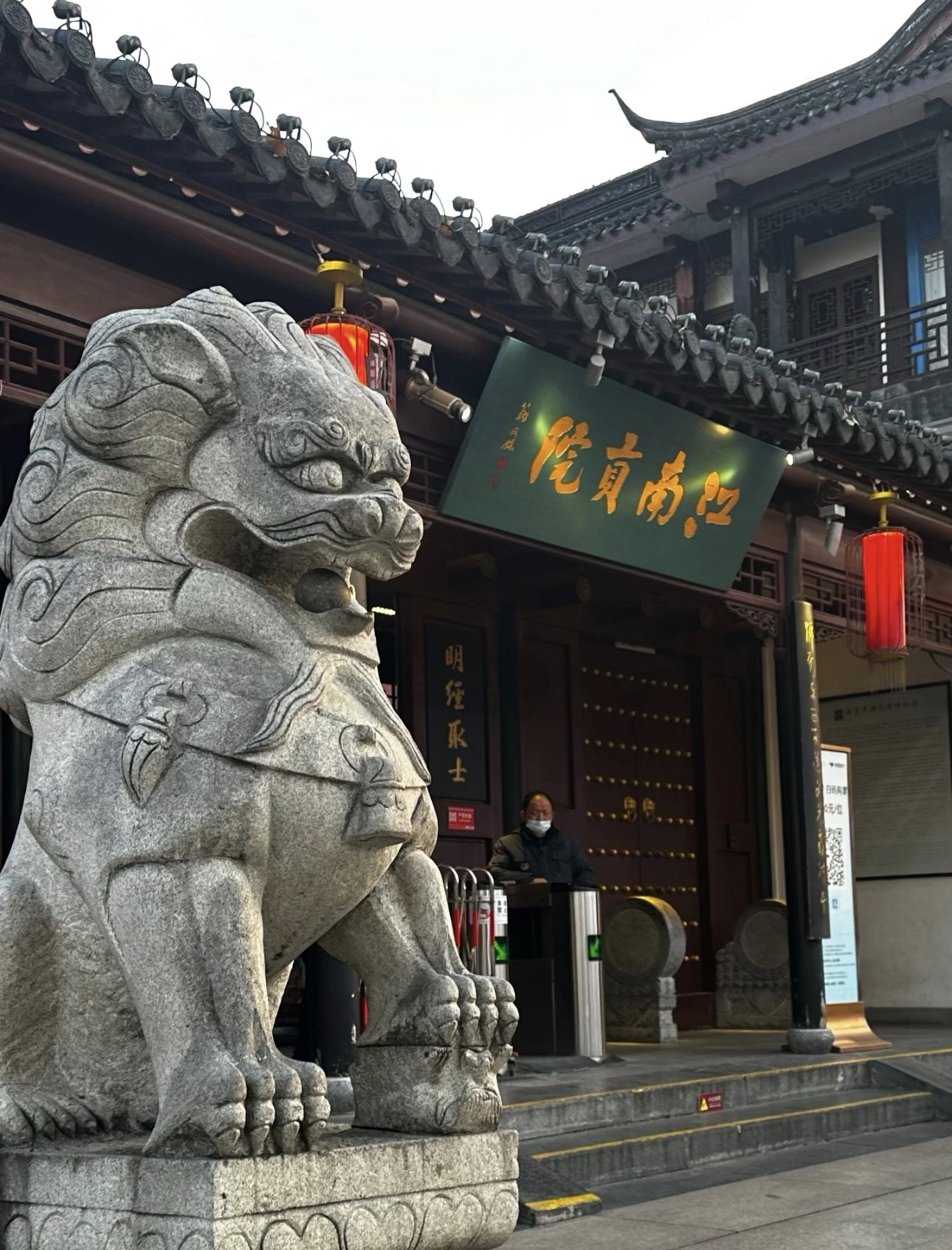
First established in the fourth year of the Qiandao reign of the Southern Song Dynasty (1168), the Jiangnan Imperial Examination Hall was continuously expanded through the Ming and Qing dynasties. At its zenith, it contained over 20,000 examination cells, making it the largest provincial examination venue in the Qing Dynasty. During each autumn examination, more than 20,000 candidates gathered here to endure nine days of testing across three sessions in cells of less than two square meters each—the most spectacular scene in the history of Chinese imperial examinations. In 2012, the China Imperial Examination Museum was built on this site. The South Branch preserves the historical layout and surviving structures of the Qing Dynasty examination hall, including reconstructed cells, the Dragon Gate, and archways, vividly recreating the examination experience through artifacts and immersive scenes. Walking through, visitors can deeply appreciate the hardship of "ten years of cold-window study" and the glory of "having one's name on the golden roll."
China Imperial Examination Museum (North Branch) and Mingyuan Tower · 中国科举博物馆(北馆)与明远楼
🎧 In app 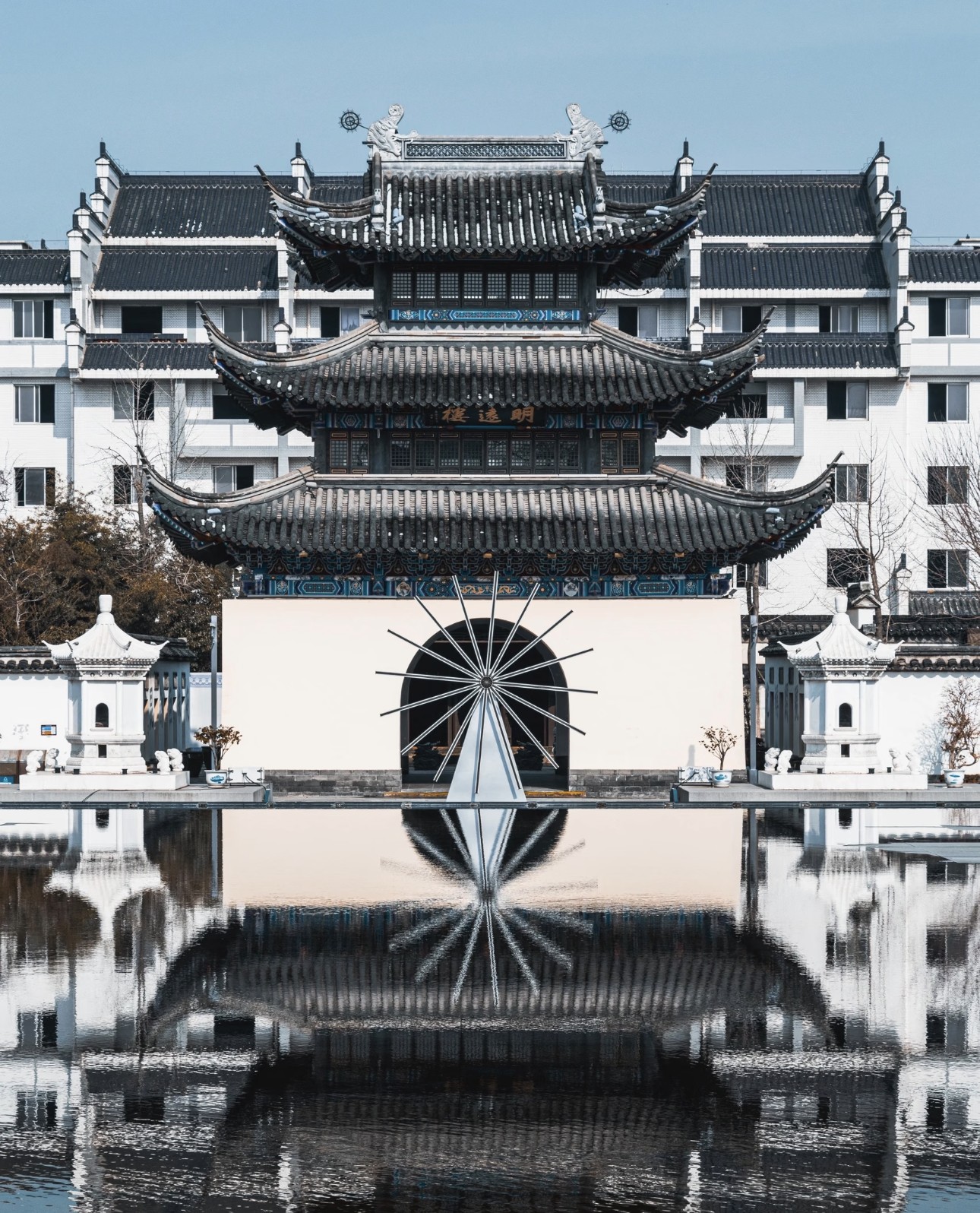
Opened in 2014, the North Branch of the China Imperial Examination Museum is China's only underground museum dedicated to the imperial examination system. Resembling a "scholar's treasure box" buried underground, the museum descends approximately 20 meters below ground level. The visitor route spirals downward along a ramp, progressively presenting the history, examination content, regulations, and profound social and cultural impact of the imperial examination system. The collection comprises over 10,000 artifacts, including examination papers, cheat sheets, plaques, and champion's robes. Mingyuan Tower stands at the museum's ground-level entrance, originally built during the Jiajing reign of the Ming Dynasty as the sole surviving structure of the Jiangnan Examination Hall. It once served as a surveillance tower for exam proctors, its three-story, four-sided eaved silhouette now an iconic landmark of the Fuzimiao area. The underground museum and the above-ground tower form a dialogue across time, offering the most comprehensive showcase of China's imperial examination culture.
Wende Bridge · 文德桥
🎧 In app 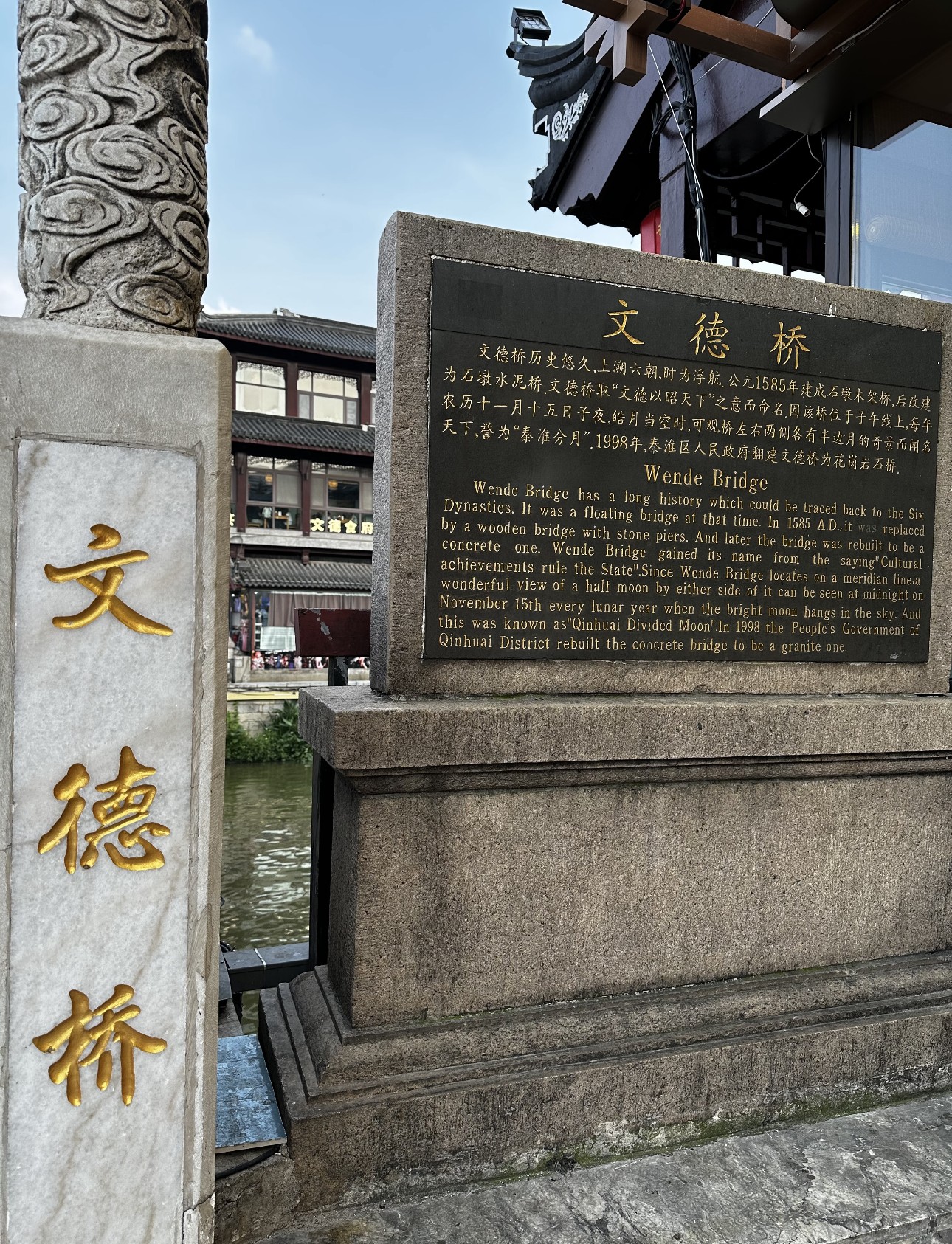
Originally built in the Wanli reign of the Ming Dynasty, Wende Bridge spans the Qinhuai River to the west of the Fuzimiao Pan Pool, serving as a vital link between the Confucius Temple and Wuyi Alley on the south bank. The name "Wende" means "literary virtue," resonating with Confucian culture. The bridge is most famous for the "Half Moon at Wende Bridge" phenomenon: according to legend, at midnight on the fifteenth day of the eleventh lunar month, viewers standing at a specific spot on the bridge can see the moon's reflection split in half—one half visible on each side of the bridge. This extraordinary optical effect inspired countless poems and literary works, ranking alongside the West Lake's Three Pools Mirroring the Moon. The stone arch bridge features balustrades carved with cloud and lotus motifs. Today, Wende Bridge offers one of the finest vantage points for the Qinhuai nightscape, where illuminated lanterns and passing painted boats create a scene that is an essential part of any Fuzimiao visit.
Wuyi Alley and Wang-Xie Ancient Residence · 乌衣巷与王谢古居
🎧 In app 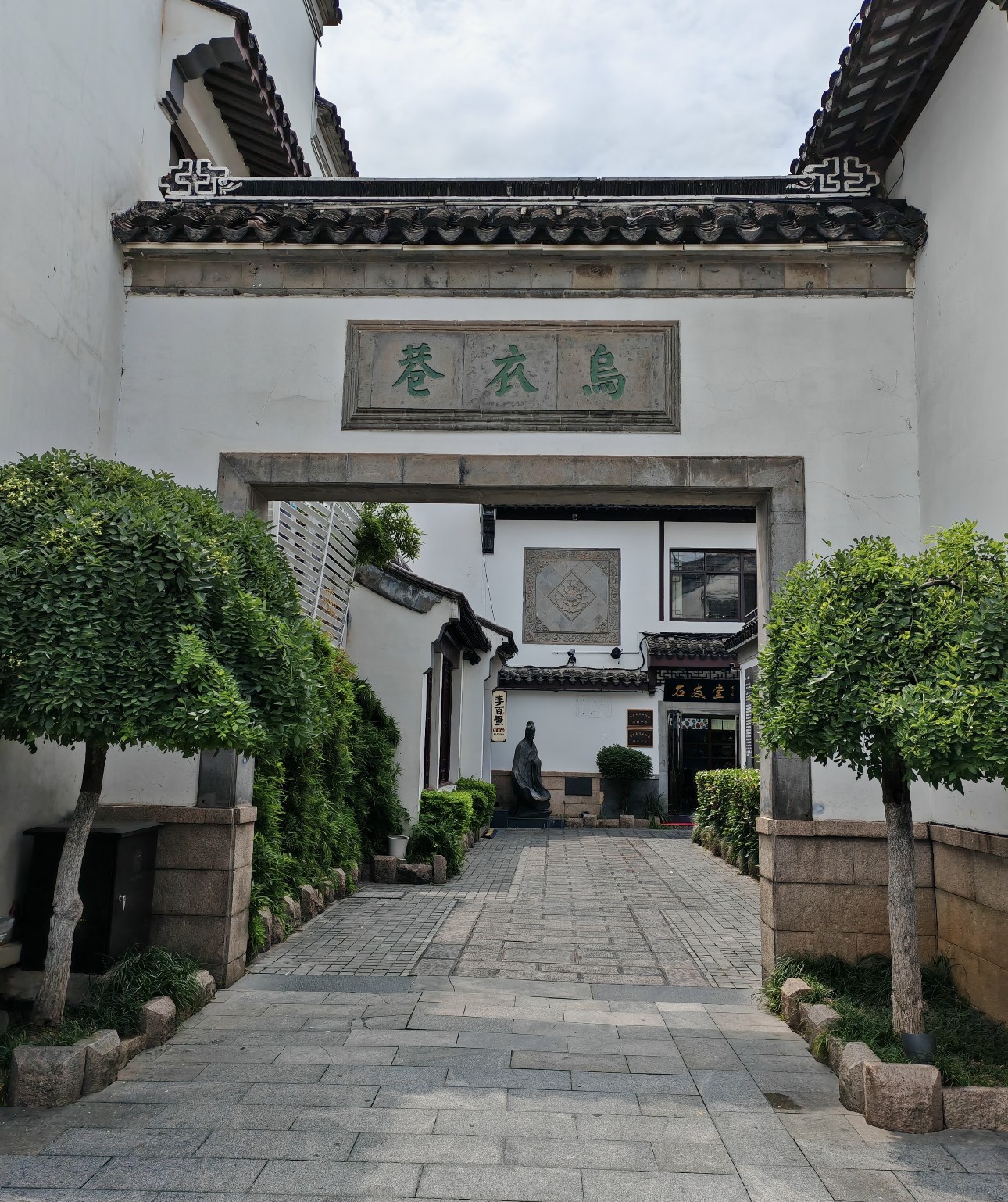
Located on the south bank of the Qinhuai River near Fuzimiao, Wuyi Alley is one of Nanjing's oldest lanes, with a history traceable to the Eastern Wu Kingdom of the Three Kingdoms period. During the Eastern Jin Dynasty, the Wang Dao and Xie An clans—two of the most powerful aristocratic families—resided here, and the alley was named for the dark robes ("wu yi") worn by their family members. The Tang Dynasty poet Liu Yuxi immortalized the alley with his famous lines: "Swallows that once nested before the halls of Wang and Xie, now fly into the homes of common folk," making it one of the most culturally evocative lanes in Chinese literary history. The Wang-Xie Ancient Residence within the alley is a memorial exhibition hall that uses Six Dynasties artifacts, genealogies, calligraphy, paintings, and reconstructed living scenes to showcase the contributions of the Wang and Xie families to the politics and culture of the Eastern Jin and Southern Dynasties. Built in the style of Six Dynasties residences, the hall features elegant layouts of reception rooms, studies, and courtyards that recreate the lifestyle of the era's noble families.
Qinhuai Painted Boat Wharf (Cruise Experience) · 秦淮画舫码头(游船体验)
🎧 In app 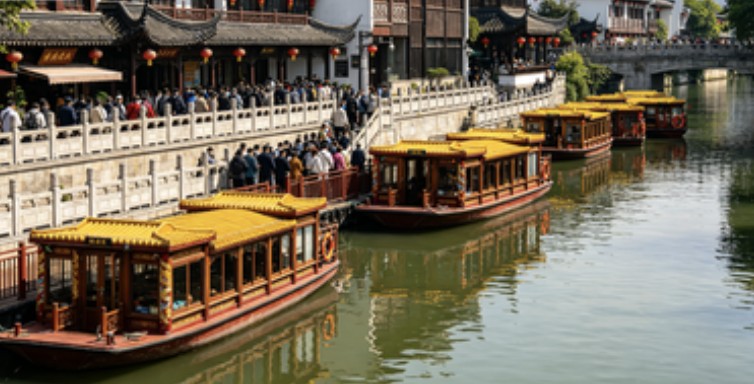
The Qinhuai Painted Boat Wharf is located beside the Fuzimiao Pan Pool, serving as the primary boarding point for Qinhuai River cruises. The painted boats (huafang) are traditional vessels unique to the Qinhuai River, featuring colorfully painted and carved hulls, red lanterns suspended from canopies, and cabins furnished with tables, chairs, and tea service in classical style. The cruise route covers the most scenic stretch of the Qinhuai River, passing Bailu Islet, Zhonghua Gate, and Taoye Ferry, with the full journey lasting approximately 50 minutes. Daytime cruises offer views of historic architecture and weeping willows along both banks, but the evening is the true highlight—brilliantly illuminated banks reflect shimmering light on the water, accompanied by the sound of traditional string and bamboo music from the bow, evoking the romantic imagery of Zhu Ziqing's celebrated essay "Splashing Oars and Lamp Shadows on the Qinhuai River." Drifting slowly between centuries-old bridges and riverside pavilions, the painted boat offers the most immersive way to experience Nanjing's Qinhuai culture.