← Nanjing

Nanjing · 南京明孝陵

Ming Xiaoling Mausoleum, Nanjing

🎫 Ticket 70 / 60 RMB
🕐 Duration 2–3 hours
🕘 Opening Hours 6:30–18:30
🚇 Metro Metro Line 2, Muxuyuan Station
📍 Address Ming Xiaoling Mausoleum Scenic Area, Purple Mountain Scenic Area, Xuanwu District, Nanjing, Jiangsu Province (at the foot of Wanju Peak, Dulongfu, on the southern slope of Purple Mountain) Map ↗
⚠️ BookingAdvance reservation required
🎧 11 audio walking guides for Ming Xiaoling Mausoleum, Nanjing — listen on the spot in the YOLO HAPPY app. →

Inside Ming Xiaoling Mausoleum, Nanjing

Xiama Fang Heritage Park · 下马坊遗址公园

🎧 In app
Xiama Fang Heritage Park

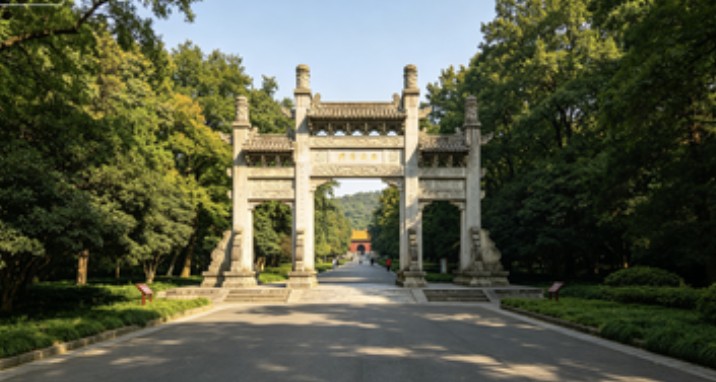
Built in 1393 during the Hongwu reign, the Xiama Fang (Dismount Archway) is the landmark entrance to Ming Xiaoling Mausoleum. Its lintel bears the imperial edict "All Officials Dismount Here." According to Ming court protocol, officials of every rank had to dismount and walk from this point forward as a gesture of respect for Zhu Yuanzhang, the founding emperor of the Ming Dynasty. The original archway was destroyed in wartime and later restored from surviving Ming-era remnants. The surrounding area has been developed into a tranquil heritage park with ancient trees, marking it as both the starting point of the sacred way and the first encounter with Ming imperial funerary etiquette.
Da Jin Men (Great Golden Gate) · 大金门

🎧 In app
Da Jin Men (Great Golden Gate)

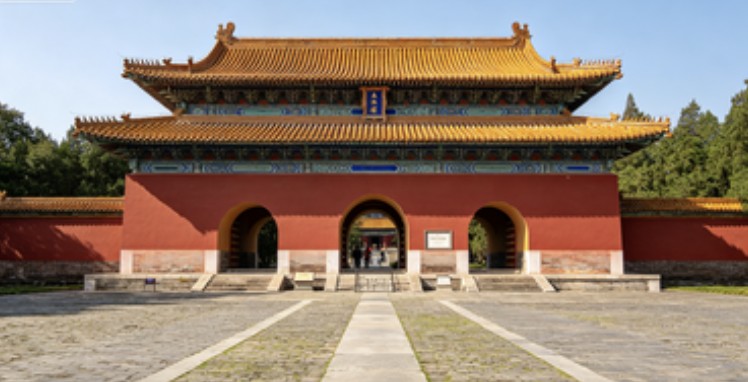
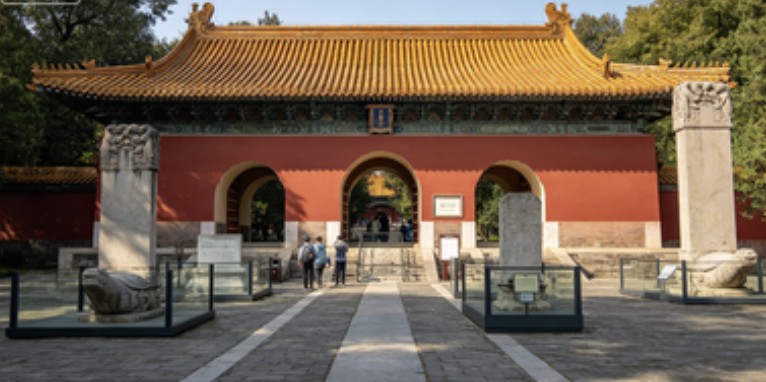
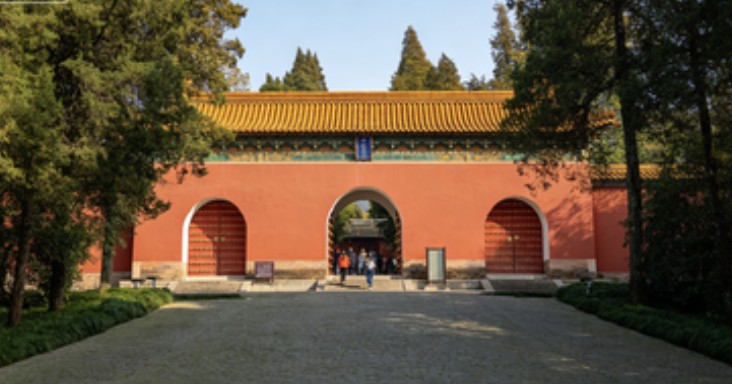
Constructed during the Hongwu reign, Da Jin Men is the first formal palace gate of the Ming Xiaoling Mausoleum complex and marks the southern origin of the entire mausoleum's central north-south axis. The gate was built with large imperial bricks and originally topped with yellow glazed roof tiles. It features three parallel archways: the central passage was reserved for the emperor's and empress's coffins, while the side passages were used by civil and military officials. Da Jin Men's architectural format pioneered the "gate-before-hall" layout that became standard for all subsequent Ming and Qing imperial mausoleums, profoundly influencing the design of the Thirteen Ming Tombs in Beijing and the Eastern and Western Qing Tombs. It stands as a milestone in the history of Chinese imperial funerary architecture.

Si Fang Cheng (Square City / Pavilion of Divine Merits and Sacred Virtues) · 四方城(神功圣德碑亭)

🎧 In app
Si Fang Cheng (Square City / Pavilion of Divine Merits and Sacred Virtues)

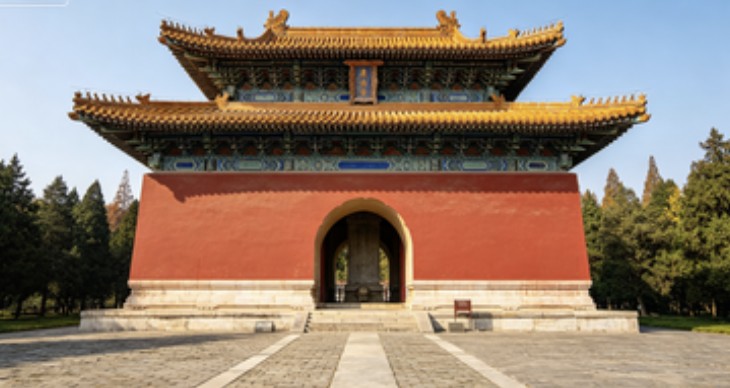
Originally named the "Pavilion of Divine Merits and Sacred Virtues," Si Fang Cheng earned its popular name "Square City" from its square plan and fortress-like walls. Inside stands the "Stele of Divine Merits and Sacred Virtues of Ming Xiaoling," personally composed by Emperor Yongle (Zhu Di) in 1413. The inscription, comprising 2,746 characters, recounts the life and achievements of Zhu Yuanzhang and ranks among the largest merit steles in ancient China. The pavilion originally featured a double-eaved hip-and-gable roof with yellow glazed tiles of imposing scale. The roof collapsed during the Taiping Rebellion, yet the four walls still stand majestically today. The brickwork is fitted without visible mortar, showcasing an extraordinary level of craftsmanship that evokes the grandeur of Ming imperial construction.

Shi Xiang Lu Sacred Way (Stone Elephant Road) · 石象路神道

🎧 In app
Shi Xiang Lu Sacred Way (Stone Elephant Road)

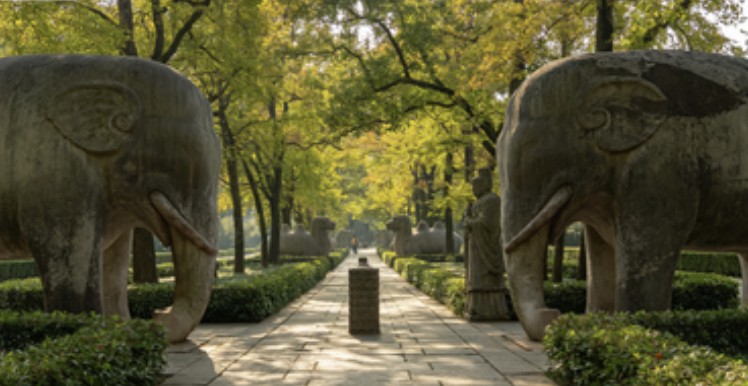
Shi Xiang Lu is the first segment of the Ming Xiaoling Mausoleum sacred way, stretching approximately 615 meters. Twelve pairs of stone animals — lions, xiezhi (mythical justice beasts), camels, elephants, qilin, and horses — line both sides in sequence, with each species represented by one standing pair and one kneeling pair, totaling twenty-four sculptures. Each was carved from a single monolithic stone block in the round, combining monumental scale with rustic yet lifelike modeling. These beasts symbolize the imperial guard of honor, auspiciousness, and loyalty. In autumn, golden ginkgoes and fiery maples arch over the path, framing the ancient stone animals in a dazzling canopy of color. This scene has earned the road the affectionate title "The Most Beautiful 600 Meters in Nanjing," offering visitors a perfect fusion of Ming stone carving artistry and natural beauty.

Weng Zhong Lu Sacred Way (Weng Zhong Road) · 翁仲路神道

🎧 In app
Weng Zhong Lu Sacred Way (Weng Zhong Road)

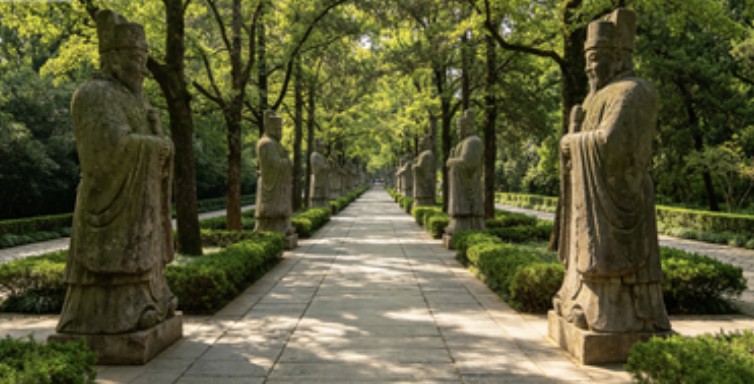
Weng Zhong Lu is the second segment of the Ming Xiaoling Mausoleum sacred way, extending approximately 250 meters northward from Shi Xiang Lu. Two pairs of military generals and two pairs of civil officials — eight statues in total — flank the path, each carved from a single stone block. The generals, clad in armor and wielding swords, project martial authority; the civil officials, wearing court caps and holding ceremonial tablets, exude dignified composure. The name "Weng Zhong" traces back to Ruan Weng Zhong of the Qin Dynasty, whose name later became a generic term for guardian stone figures at tombs. The statues are imposing in scale and exquisitely carved — every fold of drapery and scale of armor is crisply rendered — representing the pinnacle of Ming imperial stone sculpture. They symbolize the eternal vigilance of the emperor's civil and military retinue guarding his eternal rest.

Ling Xing Men and Jin Shui Qiao (Lingxing Gate and Golden Water Bridge) · 棂星门与金水桥

🎧 In app
Ling Xing Men and Jin Shui Qiao (Lingxing Gate and Golden Water Bridge)

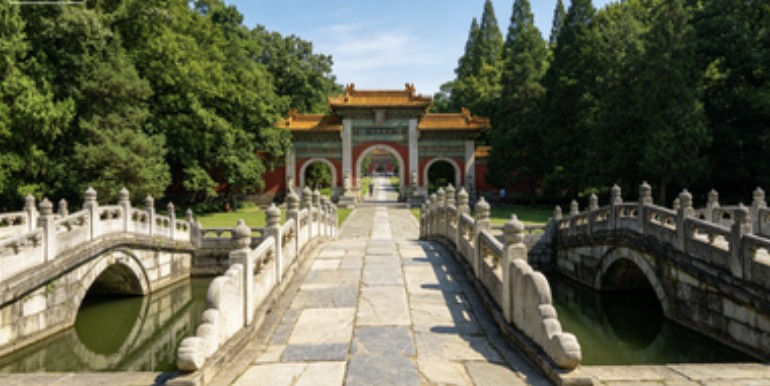
Ling Xing Men originally served as the ceremonial gateway at the terminus of the Ming Xiaoling Mausoleum sacred way. It featured three parallel passages with cloud-and-dragon carvings atop the pillars. The name "Lingxing" refers to the celestial field star, symbolizing reverence for heaven and ancestors. The original gate was destroyed in wartime and has been reconstructed based on archaeological findings. Beyond the gate lies the Jin Shui Qiao (Golden Water Bridge), a group of stone bridges spanning the inner Golden Water River. Originally five in number, three survive today. Built of grey limestone, the bridges are simple and elegant in form. The Golden Water River is an integral element of the mausoleum's drainage system and feng shui layout. North of the bridge stands the Wen Wu Fang Gate, beyond which lies the core palace complex of the mausoleum. Together, the Lingxing Gate and Golden Water Bridge form the pivotal transitional point from the sacred way to the mausoleum palace proper, both functionally and symbolically.

Wen Wu Fang Men (Gate of Civil and Military Officials) · 文武方门

🎧 In app
Wen Wu Fang Men (Gate of Civil and Military Officials)

Wen Wu Fang Men is the first formal gate of the Ming Xiaoling Mausoleum's core palace complex. It spans five bays in width and two in depth, with a single-eaved hip-and-gable roof covered in yellow glazed tiles. A plaque reading "Ming Xiaoling Mausoleum" was originally suspended above the entrance. According to Ming sacrificial protocol, during major ceremonies held on Qingming, Zhongyuan, and Winter Solstice, civil and military officials were required to assemble in ranked formation outside this gate before being admitted to perform rites — hence the name "Gate of Civil and Military Officials." The gate has three archways, with the central passage reserved exclusively for the emperor's and empress's coffins and sacrificial objects. Two side gates on the east and west provided daily access. The architecture is solemn and hierarchically precise, serving as the dividing line between the external sacred way and the internal sacrificial precinct. It occupies a pivotal linking position along the mausoleum's central axis.

Bei Dian (Stele Hall / "Zhi Long Tang Song" Stele) · 碑殿(治隆唐宋碑)

🎧 In app
Bei Dian (Stele Hall / "Zhi Long Tang Song" Stele)

The Stele Hall sits between Wen Wu Fang Men and the Sacrificial Hall. At its center stands the famous "Zhi Long Tang Song" stele, bearing the calligraphy of Emperor Kangxi of the Qing Dynasty, inscribed during his third southern inspection tour in 1699. The four characters mean "Governance Surpassing Tang and Song," declaring that Zhu Yuanzhang's achievements in statecraft exceeded those of Emperor Taizong of Tang and Emperor Taizu of Song. This expressed Kangxi's profound admiration for the Ming founding emperor while also serving the political purpose of winning the hearts of Han Chinese scholars and commoners in the Jiangnan region. The stele is crowned with a carved dragon head and rests on a bixi (mythical tortoise) base, reflecting its exalted status. The hall also preserves poetic steles and inscriptions left by Emperor Qianlong and other Qing monarchs during their southern tours, making it a vital material witness to the political and cultural interactions between the Ming and Qing dynasties.

Xiang Dian Yi Zhi (Ruins of the Sacrificial Hall) · 享殿遗址

🎧 In app
Xiang Dian Yi Zhi (Ruins of the Sacrificial Hall)

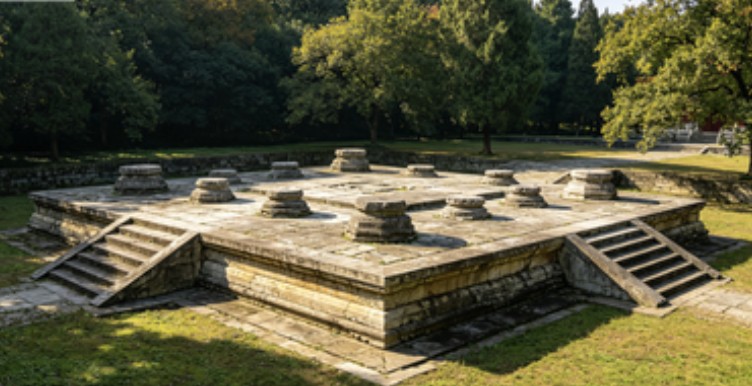
Originally named "Xiaoling Hall," the Sacrificial Hall was the architectural and functional centerpiece of the Ming Xiaoling Mausoleum palace complex, serving as the principal venue for grand sacrificial ceremonies. The original hall spanned nine bays in width and five in depth, with a double-eaved hipped roof sheathed in yellow glazed tiles. It housed the spirit tablets of Zhu Yuanzhang and Empress Ma and was comparable in scale to the Hall of Supreme Harmony in the Forbidden City. Tragically, the hall was destroyed during the Taiping Rebellion. What remains today is a three-tiered stone sumeru plinth foundation with fifty-six massive column bases, along with scattered architectural elements such as stone dragon-head water spouts. A smaller hall, rebuilt during the Tongzhi reign of the Qing Dynasty, stands in front of the original foundation. Though modest in comparison, it continues to host annual sacrificial rites and now displays historical photographs and excavated artifacts related to the mausoleum.

Fang Cheng Ming Lou (Square City and Ming Tower) · 方城明楼

🎧 In app
Fang Cheng Ming Lou (Square City and Ming Tower)

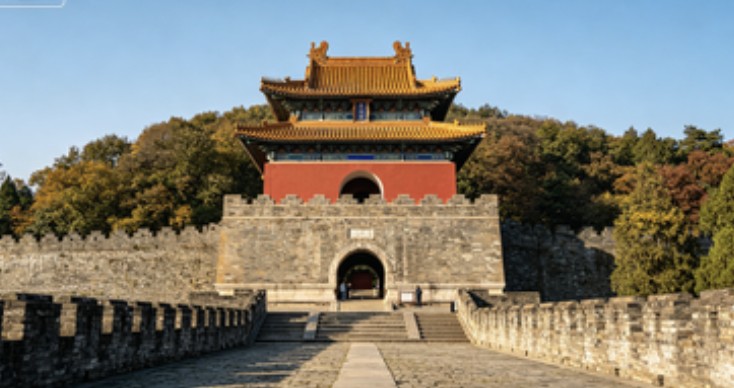
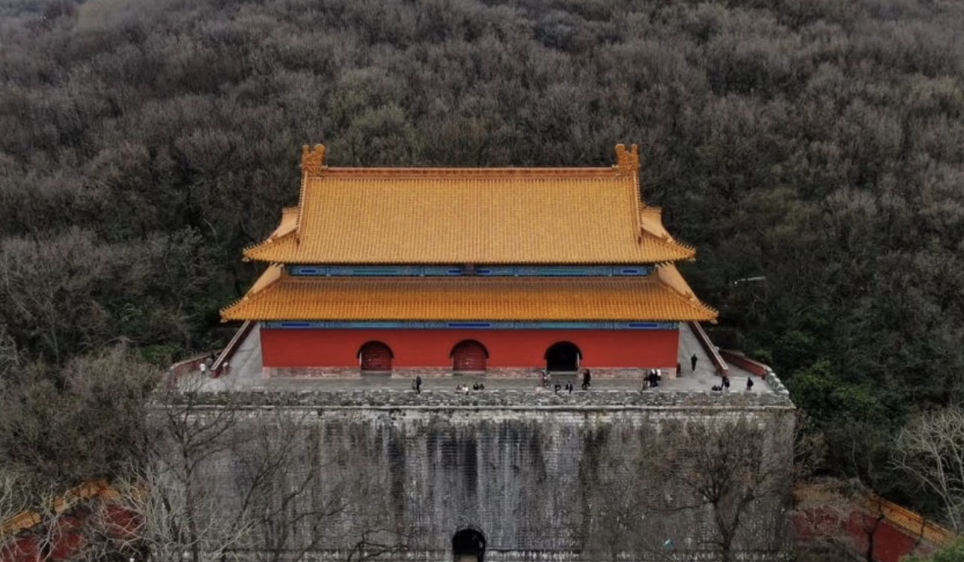
Fang Cheng Ming Lou is the last above-ground structure on the central axis of Ming Xiaoling Mausoleum and one of the most innovative designs in Chinese imperial funerary architecture. The "Square City" is a rectangular brick-and-stone platform approximately 16 meters tall, its base constructed from massive cut-stone blocks and its upper portion of stacked imperial bricks, rising fortress-like above the surrounding terrain. A vaulted tunnel runs through the center of the platform, its walls lined with stone lamp niches, creating a deep and solemn passageway. Above the south entrance to the tunnel, seven characters are carved: "This Mountain Is the Tomb of Ming Taizu," directly pointing toward the burial mound. The Ming Tower, originally a double-eaved hip-and-gable timber structure, was destroyed during the Taiping Rebellion and faithfully reconstructed in 2008–2009 based on Ming-era specifications. From its upper gallery, visitors can gaze across the layered ridges of Purple Mountain, taking in a sweeping panorama of cypress-covered slopes and the full grandeur of the mausoleum precinct.

Bao Ding (Treasure Peak) · 宝顶

🎧 In app
Bao Ding (Treasure Peak)

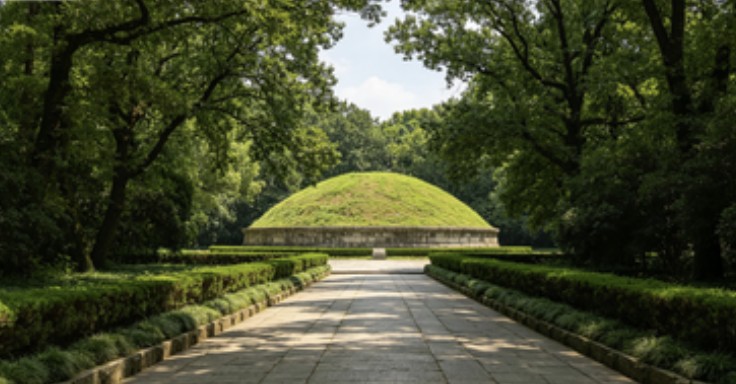
Bao Ding is the spiritual heart of Ming Xiaoling Mausoleum — the burial mound of Zhu Yuanzhang and Empress Ma (Empress Xiaoci Gao), situated directly behind the Fang Cheng Ming Lou. It is an enormous circular rammed-earth tumulus approximately 400 meters in diameter and 1,000 meters in circumference, built by layering yellow earth and crushed stone, then encased in a retaining wall of imperial bricks. Ancient pines and cypresses crown the mound in perpetual green, giving it the appearance of a lush hill when viewed from afar. A stone wall at the southern edge bears the carved inscription "This Mountain Is the Tomb of Ming Taizu," identifying the tomb's location for later generations. For over six centuries, the underground palace of Ming Xiaoling has never been archaeologically excavated, making it one of the few intact and undisturbed imperial tombs in Chinese history. In 2003, it was inscribed on the UNESCO World Heritage List as an extension of the "Imperial Tombs of the Ming and Qing Dynasties."

Get the app

The tool solved one problem. The app handles the whole trip.

Per-trip visa judgements, audio guides, prep checklists, and a real human concierge — offline-ready, in your language.

Download for iPhoneFree to download · No OTA upsells