← Nanjing

Nanjing · 南京博物院

Nanjing Museum

🎫 Ticket Free
🚇 Metro Metro Line 2, Minggugong Station
🕘 Opening Hours - **Opening hours:** Daily 9:00—17:00 (last ticket check at 16:00) - **Closing time:** Closed on Mondays (except for statutory holidays); closed on New Year's Eve and the first day of the Lunar New Year - **Night opening hours of the Intangible Cultural Heritage Hall:** Please pay attention to the announcements on Nanjing Museum's official website or official WeChat public account - **Recommended visiting time:** Half a day to a full day
❌ Closed Monday: Closed all day; open on Mondays that fall on statutory holidays; closed on Chinese New Year's Eve and the first day of Chinese New Year
📍 Address No. 321 Zhongshan East Road, Xuanwu District, Nanjing, Jiangsu Province Map ↗
⚠️ BookingAdvance reservation required
🎧 11 audio walking guides for Nanjing Museum — listen on the spot in the YOLO HAPPY app. →

Tips for international visitors

  • 1. Book 7 days in advance via the official WeChat mini-program; new slots for the next 7 days are released daily at 18:00; bring your original passport for verification at entry;
  • 2. Divided into morning session (9:00–13:00) and afternoon session (12:00–16:00); visitors must enter during their reserved time slot; late entry is not permitted.

Inside Nanjing Museum

Main Entrance and History Hall · 正门与历史馆大殿

🎧 In app
Main Entrance and History Hall

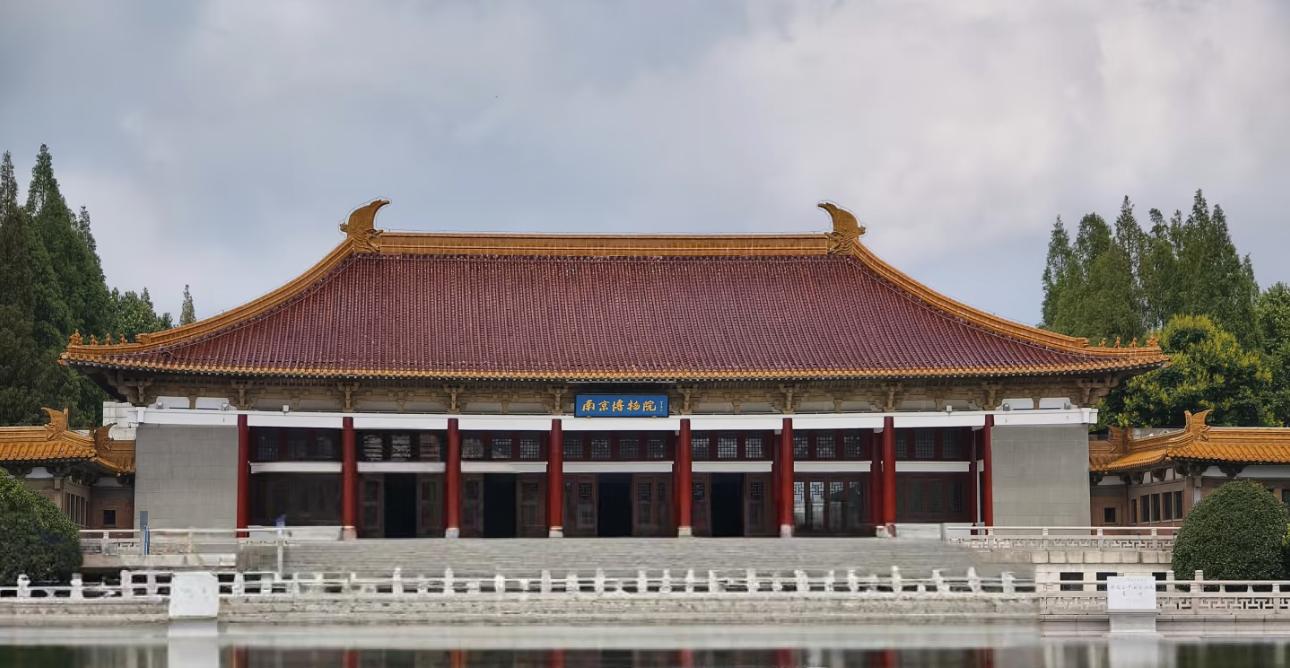
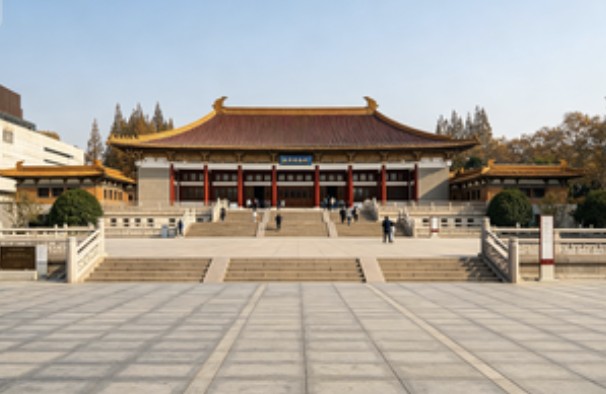
The predecessor of Nanjing Museum was the National Central Museum, proposed in 1933 by Cai Yuanpei and others — the first large-scale comprehensive museum in China built with government funding. The History Hall's grand hall was designed by the eminent architect Xu Jingzhi, with Liang Sicheng serving as consultant. The building emulates the architectural style of the Liao Dynasty, spanning nine bays with a single-eaved hipped roof. It is a landmark work of the "traditional revival" movement in modern Chinese architectural history. The hall now serves as the main entrance to the History Gallery. Approaching through the front plaza, visitors are greeted by a striking interplay of glazed flying eaves and vermillion columns — solemn yet elegant. This is the first stop of any Nanjing Museum visit and the starting point for appreciating the century-long journey of China's modern museum enterprise.
History Gallery · 2F Hall 1 — Ancient Impressions · 历史馆·2楼1号厅——远古印象

🎧 In app
History Gallery · 2F Hall 1 — Ancient Impressions

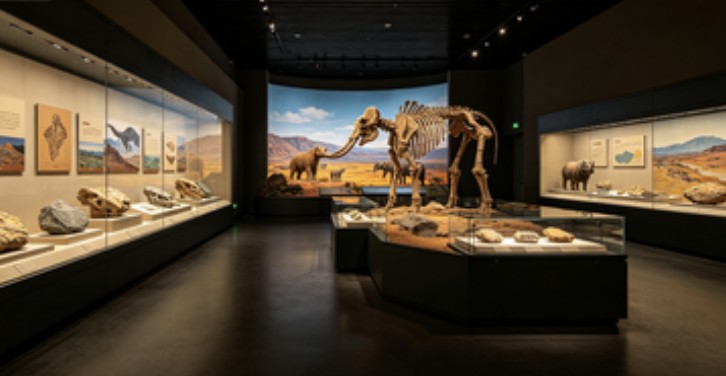
Located in Hall 1 on the second floor of the History Gallery, "Ancient Impressions" is the opening chapter of Nanjing Museum's permanent exhibition "Ancient Civilization of Jiangsu," focusing on the geological evolution and ancient life of the Jiangsu region. The hall displays a rich collection of paleontological fossils unearthed in Jiangsu, most notably large dinosaur skeletal specimens — including tyrannosauroid and sauropod dinosaurs — whose massive bones and dynamic postures recreate the spectacular scenes of the Mesozoic era when dinosaurs dominated the land. Also on view are fossils of trilobites, ammonites, and ancient fish, supplemented by stratigraphic cross-section models and geological time-scale charts that help visitors build a macro-level understanding of how the land of Jiangsu was transformed from ocean to continent across deep time.

History Gallery · 2F Hall 2 — Prehistoric Charm and the Wu-Yue Spring and Autumn Period · 历史馆·2楼2号厅——史前神韵与吴越春秋

🎧 In app
History Gallery · 2F Hall 2 — Prehistoric Charm and the Wu-Yue Spring and Autumn Period

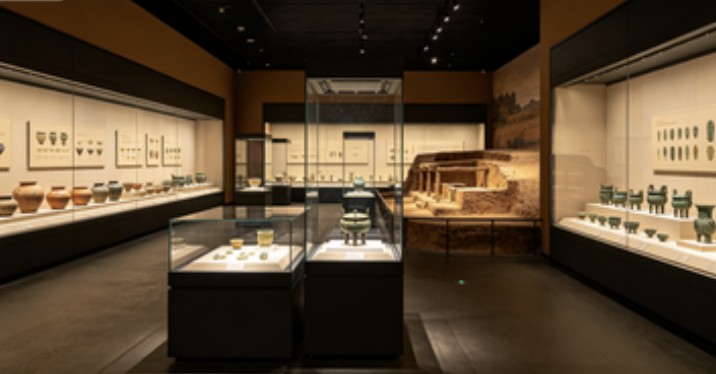
Located in Hall 2 on the second floor, this exhibition traces the historical evolution of the Jiangsu region from the Paleolithic era through the Spring and Autumn and Warring States periods. The hall assembles jade, pottery, and stone artifacts excavated from major Neolithic sites, including the Beiyinyangying, Qingliangang, and Liangzhu cultures. Ritual jades such as cong tubes and bi discs display remarkable craftsmanship, reflecting the religious concepts and aesthetic consciousness of early civilizations. During the Spring and Autumn and Warring States periods, Jiangsu was at the crossroads of the states of Wu and Yue. Exhibited bronze weapons of Wu, bronze ritual vessels of Yue, and the precious "Sword of King Fuchai of Wu" recreate the epic rivalry between these two ancient powers. Organized along archaeological findings, the gallery weaves a magnificent narrative of Jiangsu's transformation from wilderness to civilization.

History Gallery · 2F Hall 3 — The Han Homeland · 历史馆·2楼3号厅——汉家故里

🎧 In app
History Gallery · 2F Hall 3 — The Han Homeland

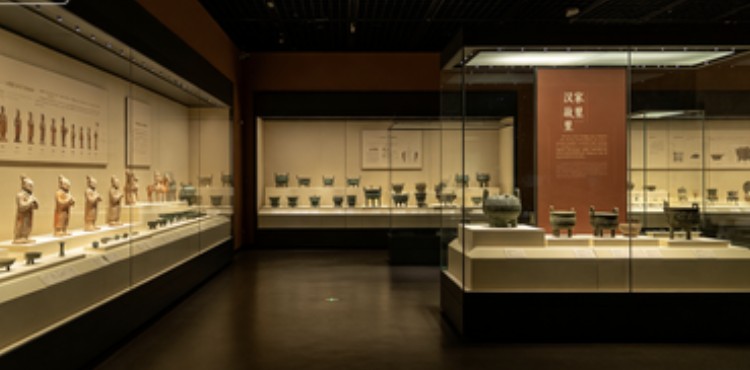
Located in Hall 3 on the second floor, "The Han Homeland" centers on archaeological discoveries from the Xuzhou region, showcasing the prosperity and splendor of northern Jiangsu during the Western and Eastern Han Dynasties. The most iconic exhibit is the silver-threaded jade burial suit unearthed from the tomb of a Chu king of the Western Han Dynasty, composed of over 2,000 jade plaques laced together with silver wire. Its craftsmanship is extraordinary, and it ranks among the most complete jade suits ever discovered in China. The hall also features an impressive array of Han Dynasty pictorial stones, painted pottery figurines, bronze vessels, and gold artifacts. The pictorial stones, carved in relief, depict mythological legends, historical tales, and scenes of daily life with rich content and vigorous lines — often called "epics in stone." The Han practice of lavish burial and the philosophy of "treating death as life" are vividly embodied in these remarkable artifacts.

History Gallery · 1F Hall 4 — Splendor of the Six Dynasties · 历史馆·1楼4号厅——六朝风华

🎧 In app
History Gallery · 1F Hall 4 — Splendor of the Six Dynasties

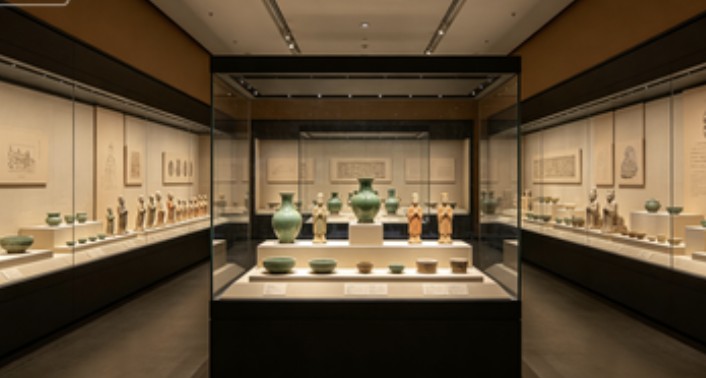
Located in Hall 4 on the first floor, "Splendor of the Six Dynasties" focuses on the period from the third to the sixth century, when six successive dynasties — Eastern Wu, Eastern Jin, Liu Song, Southern Qi, Liang, and Chen — established their capitals in Nanjing (ancient Jiankang). Despite frequent political upheavals, this era saw the flourishing of Jiangnan culture. The exhibition centers on Yue kiln celadon wares, including chicken-head ewers, lotus-petal vases, and spittoons, their glazes verdant and lustrous — representing the pinnacle of porcelain craftsmanship of the time. Also displayed are pottery figurines, bronze mirrors, gold and silver ornaments, and epitaphs excavated from Six Dynasties tombs. The human figurines are remarkably expressive, with finely detailed attire reflecting the aesthetic sensibilities and daily life of the era. The profound heritage of Nanjing as the "Ancient Capital of Six Dynasties" is presented here in a concentrated and captivating display.

History Gallery · 1F Halls 5–6 — Jiangnan Prosperity · 历史馆·1楼5-6号厅——江南盛世

🎧 In app
History Gallery · 1F Halls 5–6 — Jiangnan Prosperity

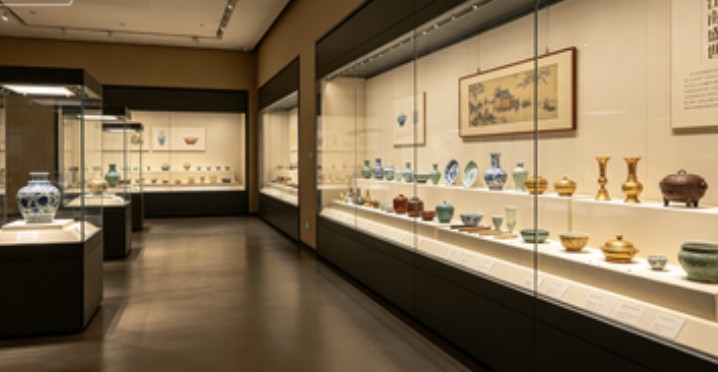
Located in Halls 5 and 6 on the first floor, "Jiangnan Prosperity" presents the glorious history of the Jiangsu region as the economic and cultural center of China from the Sui and Tang dynasties through the Ming and Qing. Since the opening of the Sui-Tang Grand Canal, Jiangnan gradually became the nation's granary and fiscal heartland, reaching its zenith during the Song, Yuan, Ming, and Qing. The exhibition follows a narrative thread from artifacts unearthed at the Tang-era Yangzhou city site, through Ming Dynasty imperial objects from Nanjing, to Qing-era crafts from Suzhou. On display are goldware, jade, silk, porcelain, lacquerware, and the Four Treasures of the Study. Particularly noteworthy are architectural components from Ming Xiaoling Mausoleum, a Ming Dynasty gold crown, and Qing Dynasty enamelware. Scene reconstructions and multimedia presentations recreate historical vistas such as Yangzhou salt merchants' gardens and Suzhou streetscapes, offering a panoramic view of Jiangnan's wealth and refinement as the "paradise on earth."

Special Exhibition Hall · 特展馆

🎧 In app
Special Exhibition Hall

The Special Exhibition Hall is a standalone, modernized exhibition space on the east side of the Nanjing Museum complex, dedicated to hosting temporary and traveling exhibitions. It contains several flexibly partitioned galleries equipped with climate-controlled display cases, professional lighting, and multimedia presentation systems, meeting international first-class exhibition standards. The hall regularly introduces fine exhibitions from domestic and international museums, covering diverse themes such as calligraphy and painting, porcelain, jade, bronze, Buddhist art, and world civilizations. It has hosted blockbuster exhibitions including "Pharaoh and King," "Mucha," and "Three Masters of the Renaissance." Each visit offers new surprises, making it an ideal platform for experiencing the global cultural pulse and the frontiers of art.

Digital Hall · 数字馆

🎧 In app
Digital Hall

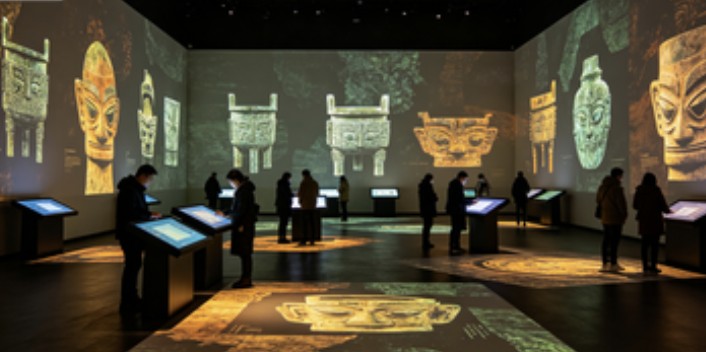
Located on the underground level of Nanjing Museum, the Digital Hall is one of the earliest purpose-built digital exhibition spaces in a Chinese museum. It employs cutting-edge technologies — including 3D projection, virtual reality, interactive sensing, and holographic imaging — to present the museum's collection and historical scenes in entirely new ways. Inside, a giant curved screen plays a spectacular panorama of Jiangsu's historical civilization, while floor-based interactive projections allow visitors to "step" out ripples and blossoms. A virtual reconstruction of the Six Dynasties capital Jiankang comes to life onscreen with stunning realism. Visitors can also use touchscreens to rotate and zoom in on 3D artifact models, examining every detail from any angle. The Digital Hall breaks down the barriers of traditional display cases, making history tangible and sensory — an experience especially beloved by younger audiences.

Republic of China Hall · 民国馆

🎧 In app
Republic of China Hall

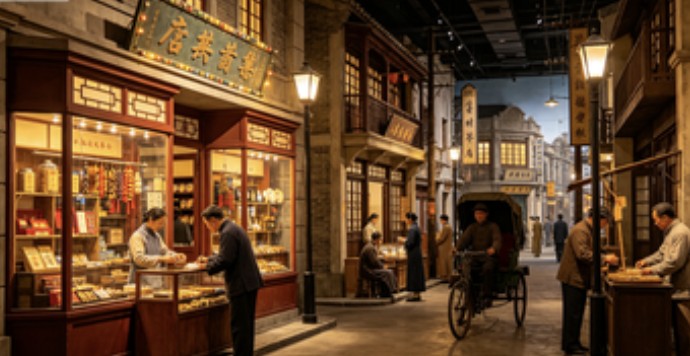
Located on the underground level of Nanjing Museum, the Republic of China Hall is a full-scale, 1:1 recreation of a Nanjing street from the Republican era. Stepping inside, visitors are instantly transported to the 1930s capital: along cobblestone streets lined with period buildings — a post office, bank, pharmacy, photo studio, bookstore, tailor shop, and train station — signage and advertisements faithfully reproduce the original designs of old Republican-era brands. Vintage mailboxes, rickshaws, retro streetlamps, and even a projected sky overhead have been meticulously designed to create a remarkably convincing sense of temporal immersion. The post office sells postcards with Republican-era scenery that can be mailed on-site, the train station features a vintage steam locomotive, and the bookstore stocks reproduced period publications. The Republic of China Hall is not merely an exhibition but a tactile, participatory historical experience.

Art Gallery · 艺术馆

🎧 In app
Art Gallery

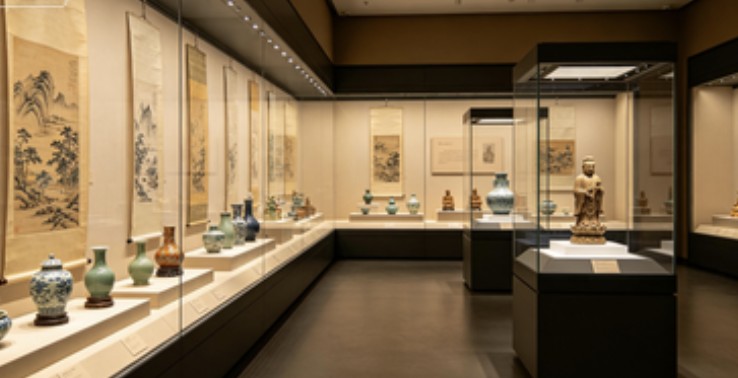
The Art Gallery is located along the central axis of the Nanjing Museum complex, serving as the dedicated venue for displaying the museum's finest art collections. It houses thematic galleries including the Historical Painting Gallery, Historical Calligraphy Gallery, Sculpture Gallery, Fu Baoshi Art Gallery, and Chen Zhifo Art Gallery, systematically presenting the development of Chinese art from ancient to modern times. The Painting Gallery exhibits masterworks from the Song, Yuan, Ming, and Qing dynasties, including representative works of the Four Masters of the Ming, the Four Wangs of the Early Qing, and the Eight Eccentrics of Yangzhou. The Calligraphy Gallery assembles ink treasures by masters across the ages in all major script styles. The Fu Baoshi Art Gallery is dedicated to the New Jinling School master's landscape paintings and seal carvings, characterized by their sweeping grandeur. The Chen Zhifo Art Gallery displays his exquisite gongbi flower-and-bird paintings, elegant and refined. The Art Gallery also regularly hosts contemporary art exhibitions and academic events, serving as an important platform for dialogue between traditional and contemporary art.

Intangible Cultural Heritage Hall (Jiangsu Provincial Intangible Cultural Heritage Museum) · 非遗馆(江苏省非物质文化遗产馆)

🎧 In app
Intangible Cultural Heritage Hall (Jiangsu Provincial Intangible Cultural Heritage Museum)

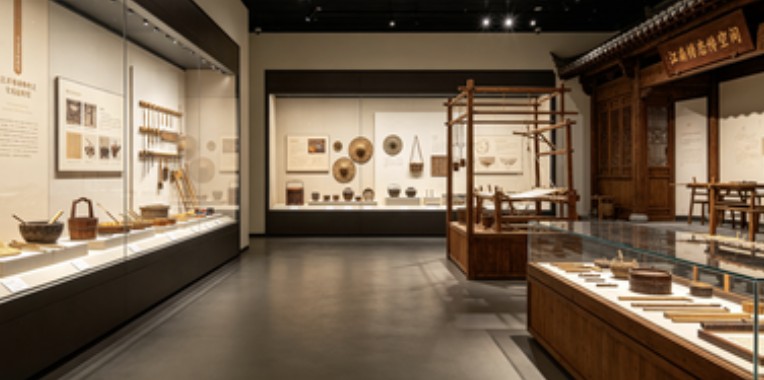
The Intangible Cultural Heritage Hall, officially named the Jiangsu Provincial Intangible Cultural Heritage Museum, is one of the first dedicated intangible heritage exhibition spaces established within a provincial-level museum in China. Its core philosophy is living heritage display, combining physical exhibits, scene reconstructions, live demonstrations, and interactive experiences to present representative items from Jiangsu's national and provincial intangible cultural heritage lists. Exhibits encompass dozens of heritage categories, including Kunqu Opera, the guqin zither, Nanjing Yunjin brocade hand-weaving techniques, Suzhou embroidery, Yixing purple clay pottery, Yangzhou lacquerware, and Nantong blue calico. A dedicated demonstration area hosts intangible heritage inheritors performing live craft demonstrations — visitors can observe Yunjin brocade weaving, purple clay shaping, and embroidery stitching up close. Hands-on activities such as rubbings and paper-cutting allow visitors to personally experience the warmth and artisanship of intangible cultural heritage.

Get the app

The tool solved one problem. The app handles the whole trip.

Per-trip visa judgements, audio guides, prep checklists, and a real human concierge — offline-ready, in your language.

Download for iPhoneFree to download · No OTA upsells