← Nanjing

Nanjing · 南京牛首山文化旅游区

Niushou Mountain Cultural Tourism Zone, Nanjing

🎫 Ticket 160 RMB
🕐 Duration 4 hours
🚇 Metro Metro Line S1, Hohai University·Focheng West Road Station (Exit 1), then take a taxi for about 15 minutes to the scenic area (approx. 15 RMB)
🕘 Opening Hours - **Opening hours:** All year round 08:30—17:30 (last entry at 17:00) - **Special note:** Opening hours may be adjusted during holidays, please pay attention to official announcements of the scenic area - **Recommended visiting time:** 3—4 hours
🕘 Opening Hours Friday and Saturday (night tour): 08:30–20:30, last admission at 19:00
❌ Closed Foding Palace Underground Palace: last entry at 16:00
📍 Address No. 18 Ningdan Avenue, Jiangning District, Nanjing, Jiangsu Province Map ↗
🎧 10 audio walking guides for Niushou Mountain Cultural Tourism Zone, Nanjing — listen on the spot in the YOLO HAPPY app. →

Inside Niushou Mountain Cultural Tourism Zone, Nanjing

Usnisa Front Garden · 佛顶前苑

🎧 In app
Usnisa Front Garden

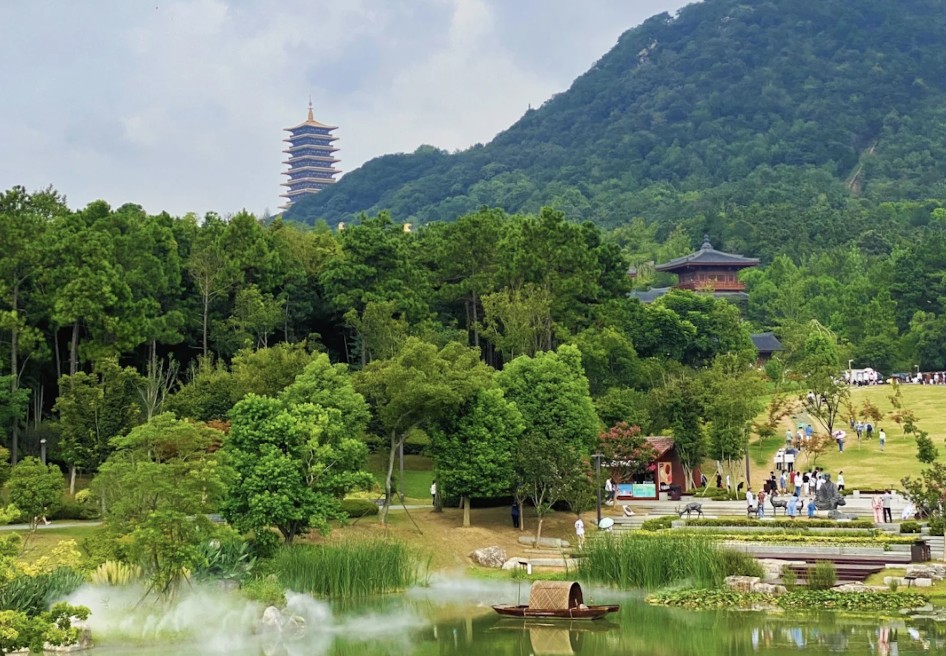
Opened in 2018, the Usnisa Front Garden features approximately 100,000 square meters of natural landscapes and artistic installations, showcasing the profound multicultural heritage of Niushou Mountain. As a key passageway leading to the Usnisa Temple and the Usnisa Palace, the garden comprises fifteen scenic nodes, including the Liuli Glazed Mural Wall, Jixian Bridge, the Ten Oxen Herding Pictures rockery, Tingxin Lake, the Farong Square, and the Xinlian (Lotus Heart) Plaza. The scene unfolds in three visual layers—a foreground of dragonflies over red lotuses, a middle ground of mist drifting like a white silk band, and a distant view of temples merging with mountain hues—together forming a serene traditional ink-painting-like landscape. As the birthplace of the Niutou (Ox-Head) school of Chan Buddhism, Niushou Mountain's deep Buddhist heritage is vividly presented through sculptures of Master Farong preaching to wild animals and a white marble wall inscribed with the "Xinming" (Inscription of Mind).
Usnisa Temple · 佛顶寺

🎧 In app
Usnisa Temple

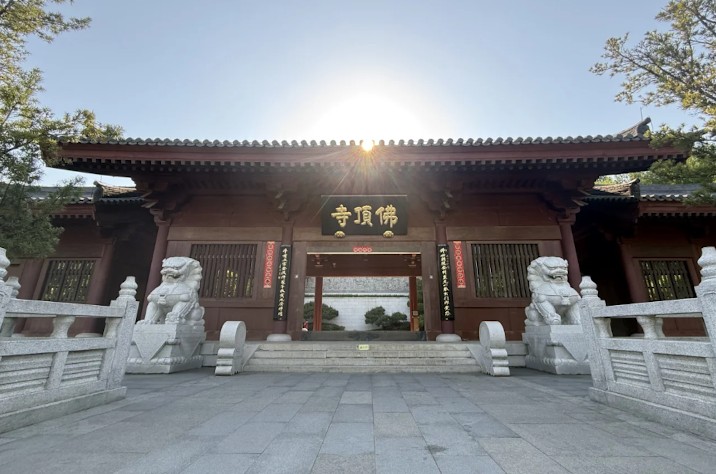
The Usnisa Temple is the core monastery of the Niushou Mountain Cultural Tourism Park, built in the traditional Tang dynasty seven-hall (Shichido Garan) layout with a grand and dignified architectural style imitating that of the Tang era. Situated on the southern foothills of Niushou Mountain's East Peak and facing south, the temple complex is arranged along a central axis with the Mountain Gate, Heavenly Kings Hall, and Mahavira Hall, flanked symmetrically by a bell tower, drum tower, Guanyin Hall, and Ksitigarbha Hall. Covering over 30,000 square meters, the temple features spacious halls, sweeping eaves, and robust bracket sets that embody the spirit of High Tang Buddhist architecture. Beyond being a place of worship, the temple also houses monks' quarters and a meditation hall that reveal the daily practice of Chan Buddhism, making it an ideal destination for visitors seeking spiritual tranquility.

Usnisa Palace (Exterior and Minor Dome) · 佛顶宫(外观与小穹顶)

🎧 In app
Usnisa Palace (Exterior and Minor Dome)

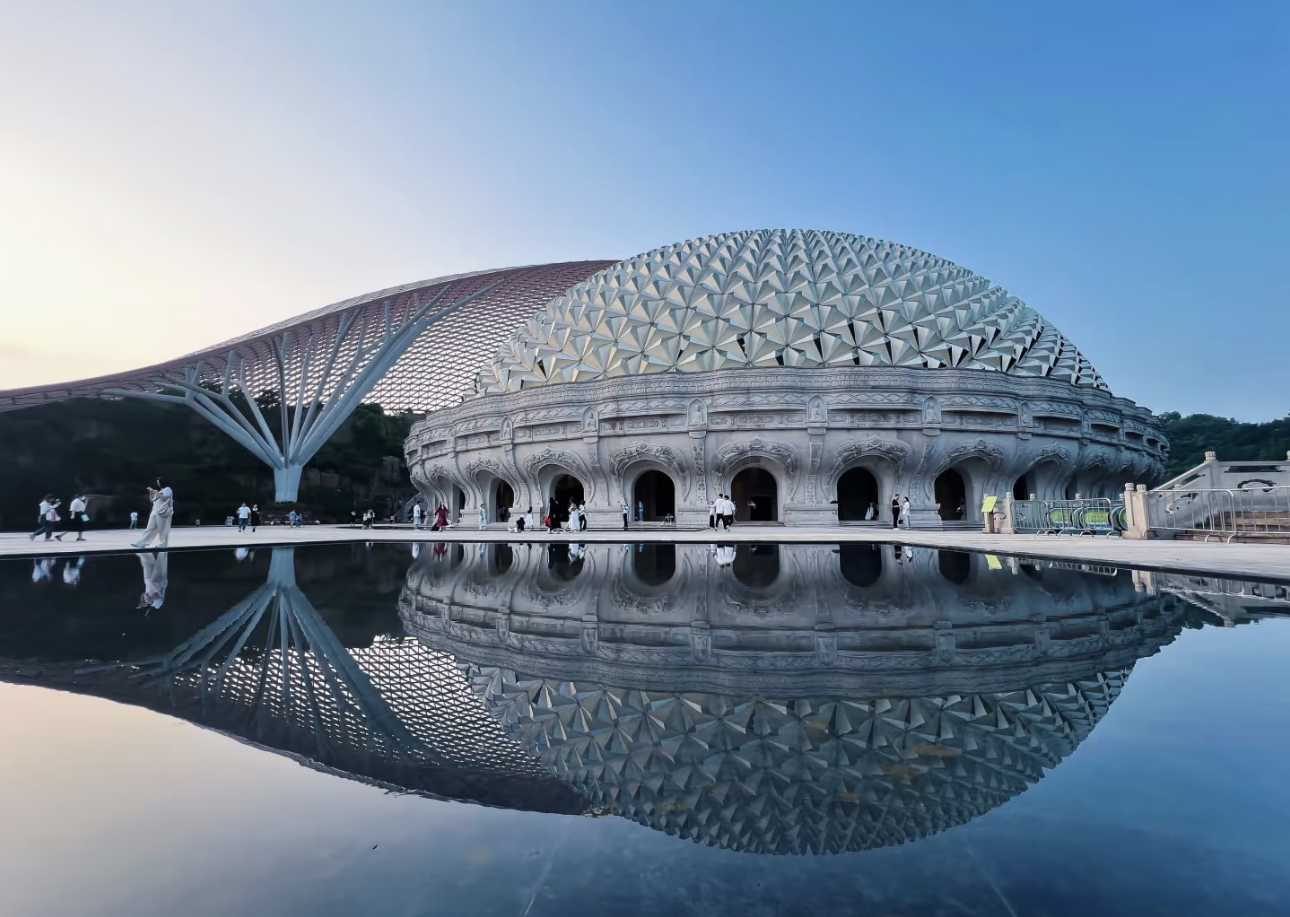
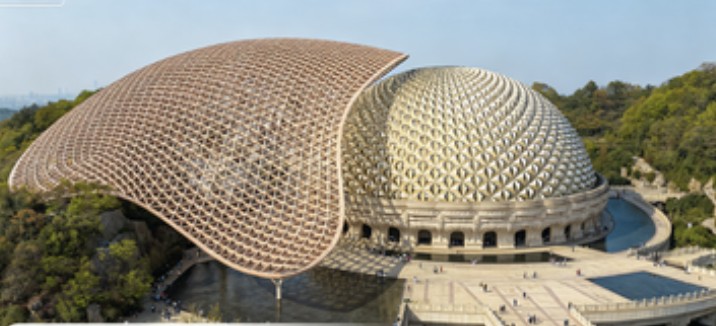
The Usnisa Palace is the centerpiece of the Usnisa Sacred Realm, constructed within a massive abandoned iron-ore mining pit on the western peak of Niushou Mountain. Measuring 220 meters long, 160 meters wide, and 89.3 meters high, with a total floor area of approximately 136,000 square meters, the structure spans nine levels—three above ground and six below. The exterior is themed around "offering" and is divided into a Major Dome and a Minor Dome. The 120-meter Major Dome resembles the Buddha's kasaya (monastic robe), draping over the Minor Dome below to symbolize the Buddha's boundless blessing, while echoing Niushou Mountain's East Peak across the valley. The Minor Dome takes the form of the Buddha's usnisa (cranial protuberance), with each segment shaped like a pair of hands folded in prayer, representing the devotion of countless believers. The Minor Dome's base forms a lotus throne composed of 56 Flying Apsara Bodhi Gates and 56 Cloud-Door Wish-Fulfilling Pillars, creating the sacred imagery of "a jewel supported by a lotus." From afar, the golden dome gleams against the green mountains, as if growing from the pit itself—a truly breathtaking sight.

Usnisa Palace · Zen Grand View · 佛顶宫·禅境大观

🎧 In app
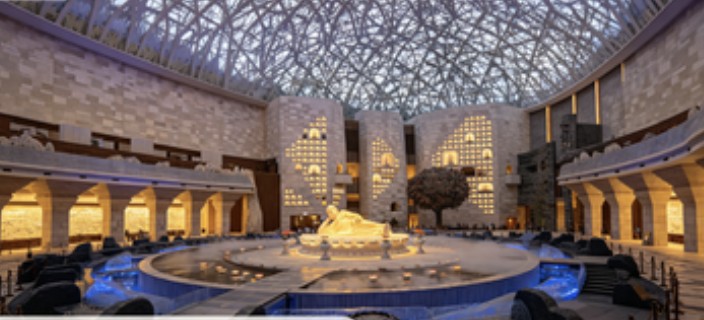
Usnisa Palace · Zen Grand View

Located on the first above-ground level of the Usnisa Palace, the Zen Grand View (Chanjing Daguan) is the first major space visitors encounter upon entering. It spans 112 meters north to south, 62 meters east to west, with a total architectural height of 46.5 meters and an interior clearance of approximately 38 meters. The elliptical, vaulted hall covers over 6,000 square meters. Centered on Chan (Zen) culture, the space comprises three sections: the Zen Garden of the Buddha's Birth, the Zen Garden of the Buddha's Enlightenment, and the central Lotus Theater, together narrating the life story of Shakyamuni Buddha from birth to parinirvana. At the heart of the hall, a 7.5-meter-long reclining Buddha statue lies serenely upon a lotus stage. When no performance is underway, the lotus petals fold inward and the stage becomes an open public space. During performances, giant lotus leaves rise from below as the reclining Buddha slowly descends, accompanied by an interplay of sound, light, and visual effects, creating an otherworldly audiovisual spectacle that conveys the profound meaning of Buddhist "nirvana."

Usnisa Palace · Relic Hall (Thousand Buddha Hall) · 佛顶宫·舍利大殿(千佛殿)

🎧 In app
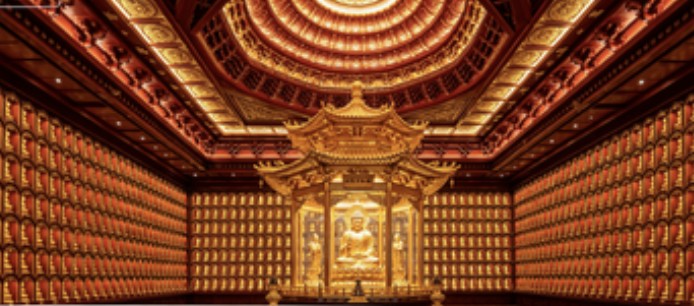
Usnisa Palace · Relic Hall (Thousand Buddha Hall)

The Relic Hall, also known as the Thousand Buddha Hall, is situated on the fifth underground level of the Usnisa Palace and serves as the core space for enshrining the Buddha's usnisa bone relic. The hall features a vaulted, elliptical plan with a color palette of red, gold, and dark gold, exuding solemn grandeur. At its center rises a 21.8-meter-tall relic pagoda, cast entirely in bronze and inlaid with the Buddhist "Seven Treasures"—gold, crystal, lapis lazuli, and gemstones—employing dozens of traditional crafts including bronze casting, fire-gilding, cloisonné enamel, sculpture, and metal chasing. The blue finial portion of the pagoda, standing 2.8 meters tall, is crafted entirely in cloisonné enamel, making it one of the tallest and most intricate pagodas of its kind in the world. The hall is laid out according to the Five Directional Buddhas of the Avatamsaka realm, with the relic pagoda representing Vajradhatu Mahavairocana at its center, surrounded by the Four Paramita Bodhisattvas, the Four Directional Buddhas, the Sixteen Wisdom-Gate Vidyarajas, and the Eight Inner and Eight Outer Offering Bodhisattvas, together forming a three-dimensional rendering of the Fourth Offering Assembly of the Vajradhatu Mandala. On major Buddhist holidays, the usnisa bone relic is ceremonially escorted from the deepest relic chamber to the great pagoda for public veneration.

Usnisa Palace · Ten Thousand Buddha Corridor and Relic Hidden Chamber · 佛顶宫·万佛廊与舍利藏宫

🎧 In app
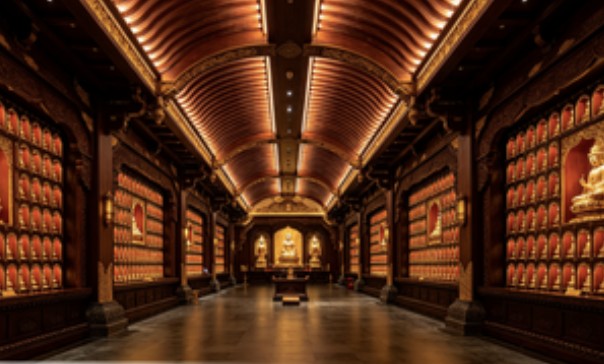
Usnisa Palace · Ten Thousand Buddha Corridor and Relic Hidden Chamber

The Ten Thousand Buddha Corridor encompasses the third, fourth, and fifth underground levels of the Usnisa Palace, forming a circular passageway around the exterior of the Thousand Buddha Hall. The third underground level focuses on Chinese Buddhist culture, featuring two sutra verse corridors and sixteen silk-mounted Gongbi paintings. The fourth level showcases Indian Buddhist culture, with statues of the Twenty Devas and seven lacquer paintings depicting Indian Buddhist teachings. The fifth level centers on the Buddha's past-life stories (Jataka) and relic culture, including multimedia displays, ten porcelain paintings of the Sixteen Bodhisattvas of the Bhadrakalpa, and the Eight Great Stupas with related artifacts. The Relic Hidden Chamber (Sharicang Gong), located 44 meters below ground, is the deepest space in the Usnisa Palace and the permanent enshrinement site of the Buddha's usnisa bone relic. The chamber is rendered in dark tones to create a solemn and mysterious atmosphere. Its 66-meter corridor is arranged according to the Six Paramitas (precepts, generosity, patience, diligence, meditation, and wisdom), and the central area serves as a consecrated religious hall where the relic is permanently enshrined.

Usnisa Pagoda · 佛顶塔

🎧 In app
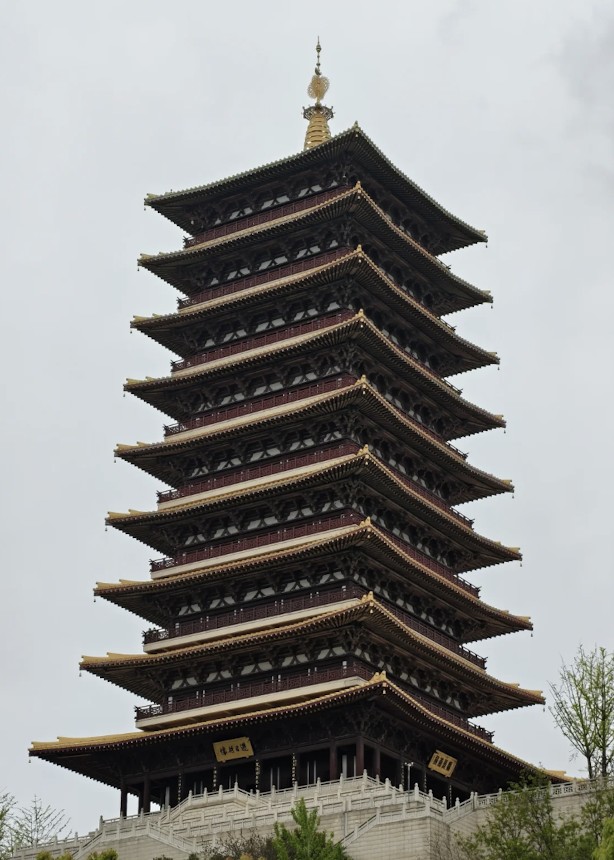
Usnisa Pagoda

The Usnisa Pagoda stands atop the western peak of Niushou Mountain, above the Usnisa Palace, and is one of the iconic landmarks of the Usnisa Sacred Realm. Built in the Tang dynasty architectural style as an imitation-wood brick pagoda, it is octagonal with nine stories, rising approximately 88 meters to crown the western summit. The construction of the Usnisa Pagoda restored the historic "twin peaks, twin pagodas" panorama of Niushou Mountain—the new western pagoda now faces the centuries-old Hongjue Temple Pagoda on the eastern peak across the valley, recreating one of ancient Jinling's most celebrated vistas. The pagoda features layered flying eaves, stacked bracket sets, and a graceful tapered silhouette. Visitors who climb to the top are rewarded with panoramic views of the Usnisa Palace, the forested mountains, and the Jinling landscape beyond. The pagoda's interior houses Buddhist statues and scriptures, making it an ideal spot for sightseeing, worship, and prayer.

Niutou Chan Cultural Park (Hongjue Temple Pagoda) · 牛头禅文化园(弘觉寺塔)

🎧 In app
Niutou Chan Cultural Park (Hongjue Temple Pagoda)

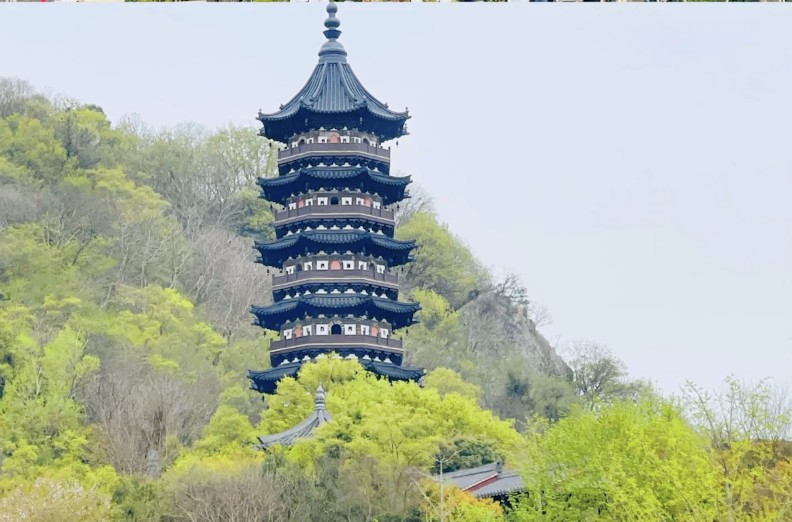
The Niutou Chan Cultural Park was built on the site of the Hongjue Temple, the birthplace of the Niutou (Ox-Head) school of Chan Buddhism. The temple was first constructed in 503 CE during the Liang Dynasty under Emperor Wu of Liang, originally named Foku Temple and also known as Hongjue Temple. Its name was changed to Hongjue Temple during the Qing dynasty to avoid the naming taboo of Emperor Qianlong (Hongli). The temple was burned down by Japanese forces during the War of Resistance, leaving only the pagoda standing. The Hongjue Temple Pagoda, the park's centerpiece, stands 45 meters tall with seven stories in an octagonal plan. It is an imitation-wood brick pagoda—the oldest surviving structure of its kind in the Nanjing area. In 1956, the pagoda's underground chamber yielded a gilded Lamaist pagoda, a jade vase, a gold sleeping Buddha, and a celadon jar, among other precious artifacts. The gilded Lamaist pagoda is now one of the Nanjing Museum's greatest treasures. In 1957, the pagoda was designated a Jiangsu Provincial Cultural Heritage Protection Unit. Over seventy visitor inscriptions from the Ming and Qing dynasties have been discovered on the pagoda walls, adding significant historical and archaeological value.

Zheng He Cultural Park · 郑和文化园

🎧 In app
Zheng He Cultural Park

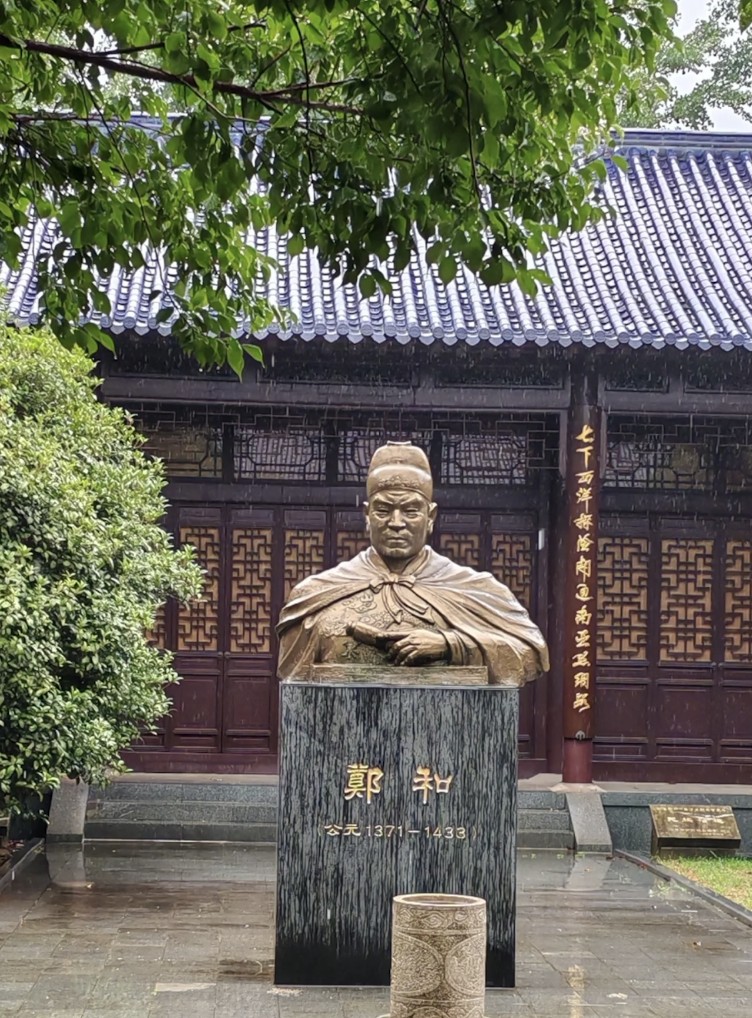
The Zheng He Cultural Park is located on the southwestern foothills of Niushou Mountain and is the burial site of Zheng He (1371–1433), the great navigator of the Ming dynasty. Originally surnamed Ma and courtesy-named Sanbao, Zheng He was born in Kunyang, Yunnan, and was of Hui ethnicity. He conducted seven maritime expeditions to the Western Seas over twenty-eight years, reaching more than thirty countries and regions across Asia and Africa—a monumental achievement in the history of world navigation. Zheng He died of illness in 1433 during his seventh voyage and was buried at Niushou Mountain. The park contains his tomb, built in traditional Hui Islamic style, with a stele erected before it. The park also houses a maritime cultural relics exhibition displaying historical artifacts, models, and archival materials related to Zheng He's voyages, comprehensively presenting the life and achievements of this great navigator. It is an important destination for understanding Ming dynasty maritime history and the culture of the Maritime Silk Road.

Yue Fei's Anti-Jin Rampart · 岳飞抗金故垒

🎧 In app
Yue Fei's Anti-Jin Rampart

The Yue Fei Anti-Jin Rampart is a historic site within the Niushou Mountain scenic area where the renowned Southern Song dynasty general Yue Fei stationed his troops to resist the Jin invasion. During the Jianyan era (1127–1130 CE), as Jin forces advanced southward, Yue Fei led his army to establish defensive positions at Niushou Mountain, constructing stone ramparts along the mountain ridges. The surviving rampart stretches approximately 200 meters, built from mountain stone. Despite over eight centuries of weathering, the outline and scale of the ancient military fortification remain discernible. Winding along the ridge, the rampart reflects the architectural wisdom of ancient mountain defense works. As an important historical relic, the site not only bears witness to the turbulent years of the Southern Song resistance against the Jin but also carries the heroic spirit of defending the nation. Visitors can touch the stone remains, imagine the fierce battles of the past, and feel the weight of history.

Get the app

The tool solved one problem. The app handles the whole trip.

Per-trip visa judgements, audio guides, prep checklists, and a real human concierge — offline-ready, in your language.

Download for iPhoneFree to download · No OTA upsells