← Shanghai

Shanghai · 苏州河十二国色

Suzhou Creek Twelve Nations Colors

🕐 Duration Open 24 hours a day
🎫 Ticket Free and open
🚇 Metro M50 / 1000 Trees area: Take Line 13 to Jiangning Road Station, about 8 minutes' walk - Jade Buddha Temple: Take Line 13 to Jiangning Road Station, or Line 7 / Line 13 to Changshou Road Station - Mengqing Park: Take Line 13 to Jiangning Road Station, or Line 3 / Line 4 to Zhongtan Road Station
📍 Address Along Suzhou Creek, Putuo District, Shanghai (core experience area concentrated around Changshou Road, Changhua Road, Moganshan Road, and Guangfu West Road); specific starting points vary by route Map ↗
🎧 11 audio walking guides for Suzhou Creek Twelve Nations Colors — listen on the spot in the YOLO HAPPY app. →

Tips for international visitors

  • Some are free self-guided routes; some organized activities by travel agencies or official bodies may charge fees
  • subject to event announcements

Inside Suzhou Creek Twelve Nations Colors

Gaoling Market (Goose Yellow) · 高陵集市(鹅黄色)

🎧 In app
Gaoling Market (Goose Yellow)

Gaoling Market is a renovated community food market along Suzhou Creek, named for its warm goose-yellow façade that has become a visual landmark of the Putuo District riverfront. Originally a traditional wet market, it was transformed in 2023 into a modern, multi-level food hall combining fresh produce, cooked-food stalls, and community dining spaces. The interior features clean industrial design with exposed ductwork and polished concrete floors, while the exterior's yellow cladding references both the historical grain warehouses of the area and the warm, approachable spirit of neighborhood market culture. The market serves as both a daily grocery destination for local residents and a foodie stop for visitors exploring the Suzhou Creek waterfront trail.

Caoyang New Village (Moon White) · 曹杨新村(月白色)

🎧 In app
Caoyang New Village (Moon White)

Caoyang New Village is China's first planned workers' residential community, built in 1951 as a model socialist housing project. Its moon-white façade color references the clean, optimistic aesthetic of 1950s modernist architecture. The neighborhood features a distinctive radial layout with curved lanes, low-rise apartment blocks, and generous green spaces designed around the concept of 'neighborhood units.' Designated as a national cultural relic in 2021, the village preserves original Soviet-influenced residential architecture, community centers, and the historic Caoyang Workers' Cultural Palace. A small museum inside the community documents the history of workers' housing in Shanghai, making it a key site for understanding the city's post-1949 urban development.

Jade Buddha Temple (Vermilion) · 玉佛寺(朱红色)

🎧 In app
Jade Buddha Temple (Vermilion)

The Jade Buddha Temple is a Chan Buddhist temple founded in 1882 to house two white jade Buddha statues brought from Myanmar by monk Huigen. The temple's vermillion-red walls and golden roof tiles follow traditional Chinese Buddhist temple architecture, with a layout comprising the Heavenly Kings Hall, the Great Treasure Hall, and the Jade Buddha Tower where the seated jade Buddha (1.92 meters tall) is enshrined. A second reclining jade Buddha lies in a side hall. The temple remains an active place of worship and is one of Shanghai's most important Buddhist sites, drawing both devotees and tourists. The complex was rebuilt in 1928 at its current Putuo District location after the original temple was destroyed by fire.

M50 Creative Park (Emerald Green) · M50 创意园(翠绿色)

🎧 In app
M50 Creative Park (Emerald Green)

M50 Creative Park is Shanghai's premier contemporary art district, housed in a former textile printing and dyeing factory complex dating to the 1930s. The emerald-green accents of its industrial façade reference the site's manufacturing heritage. Since 2000, when artist Xue Song established the first studio here, M50 has grown into a dense cluster of galleries, artist studios, design firms, and independent cultural spaces, hosting over 100 artists and 30+ galleries. The complex retains its raw industrial character—exposed brick walls, rusted steel frames, and factory windows—while serving as the epicenter of Shanghai's contemporary art scene, regularly hosting exhibitions, open studio events, and art fairs.

Wuyuantang Teahouse (Sky Blue) · 雾苑堂茶室(天青色)

🎧 In app
Wuyuantang Teahouse (Sky Blue)

Wuyuantang Teahouse is a contemporary tea space perched along the Suzhou Creek waterfront, its sky-blue façade evoking the celadon glazes of Song dynasty ceramics. Designed as a quiet retreat from the urban riverfront, the teahouse features floor-to-ceiling glass walls framing views of the creek, a minimalist interior with raw concrete and warm wood, and a curated tea menu spanning Chinese white, green, and dark teas. The architecture blends traditional tea-culture aesthetics with modernist sensibility, creating a space where visitors can experience the ritual of tea preparation against the backdrop of Suzhou Creek's industrial heritage. The teahouse also hosts tea ceremony workshops and seasonal cultural events.

Bamboo Weaving ICH Experience Hall (Bamboo Green) · 竹丝编非遗体验馆(竹青色)

🎧 In app
Bamboo Weaving ICH Experience Hall (Bamboo Green)

The Bamboo Weaving Intangible Cultural Heritage Experience Hall is a craft workshop and exhibition space dedicated to the traditional art of bamboo splint weaving, a craft listed on China's intangible cultural heritage registry. The bamboo-green color of its entrance reflects the natural hue of its primary material. Inside, visitors can view intricate bamboo-woven artworks—from practical baskets and tea trays to large-scale installation pieces—and participate in hands-on workshops led by master craftsmen. The hall documents the history of bamboo weaving in the Jiangnan region, showcases tools and techniques passed down through generations, and sells finished pieces, making it both a cultural preservation site and an interactive craft destination along the Suzhou Creek cultural corridor.

Gu Zhenghong Memorial Hall (Dark Purple) · 顾正红纪念馆(玄采色)

🎧 In app
Gu Zhenghong Memorial Hall (Dark Purple)

The Gu Zhenghong Memorial Hall commemorates Gu Zhenghong, a workers' movement leader whose death in 1925 sparked the May 30th Movement, a pivotal event in modern Chinese history. The dark purple-gray exterior conveys solemnity and historical weight. The memorial hall, built on the site of the former Japanese-owned cotton mill where Gu worked and was killed, displays historical photographs, documents, and artifacts related to the workers' movement and the anti-imperialist struggle of 1920s Shanghai. The adjacent bronze statue of Gu Zhenghong and the memorial plaza serve as sites for commemorative events. The hall provides crucial historical context for understanding Shanghai's role as a birthplace of the Chinese labor movement.

Suzhou Creek Industrial Civilization Exhibition Hall (Lilac) · 苏州河工业文明展示馆(丁香色)

🎧 In app
Suzhou Creek Industrial Civilization Exhibition Hall (Lilac)

The Suzhou Creek Industrial Civilization Exhibition Hall is housed in a converted factory building along the creek, its lilac-grey façade blending with the industrial brick textures of the surrounding Putuo District waterfront. The museum traces the industrial history of Suzhou Creek from the late 19th century through the present, displaying vintage machinery, factory models, historical photographs, and interactive exhibits that show how the creek's banks became China's most concentrated corridor of light industry, textiles, and flour mills. The exhibits also document the creek's environmental remediation and waterfront renewal, offering a comprehensive narrative of Shanghai's industrial rise, decline, and post-industrial transformation.

Half-Marathon Suzhou Creek Park (Cobalt Blue) · 半马苏河公园(钴蓝色)

🎧 In app
Half-Marathon Suzhou Creek Park (Cobalt Blue)

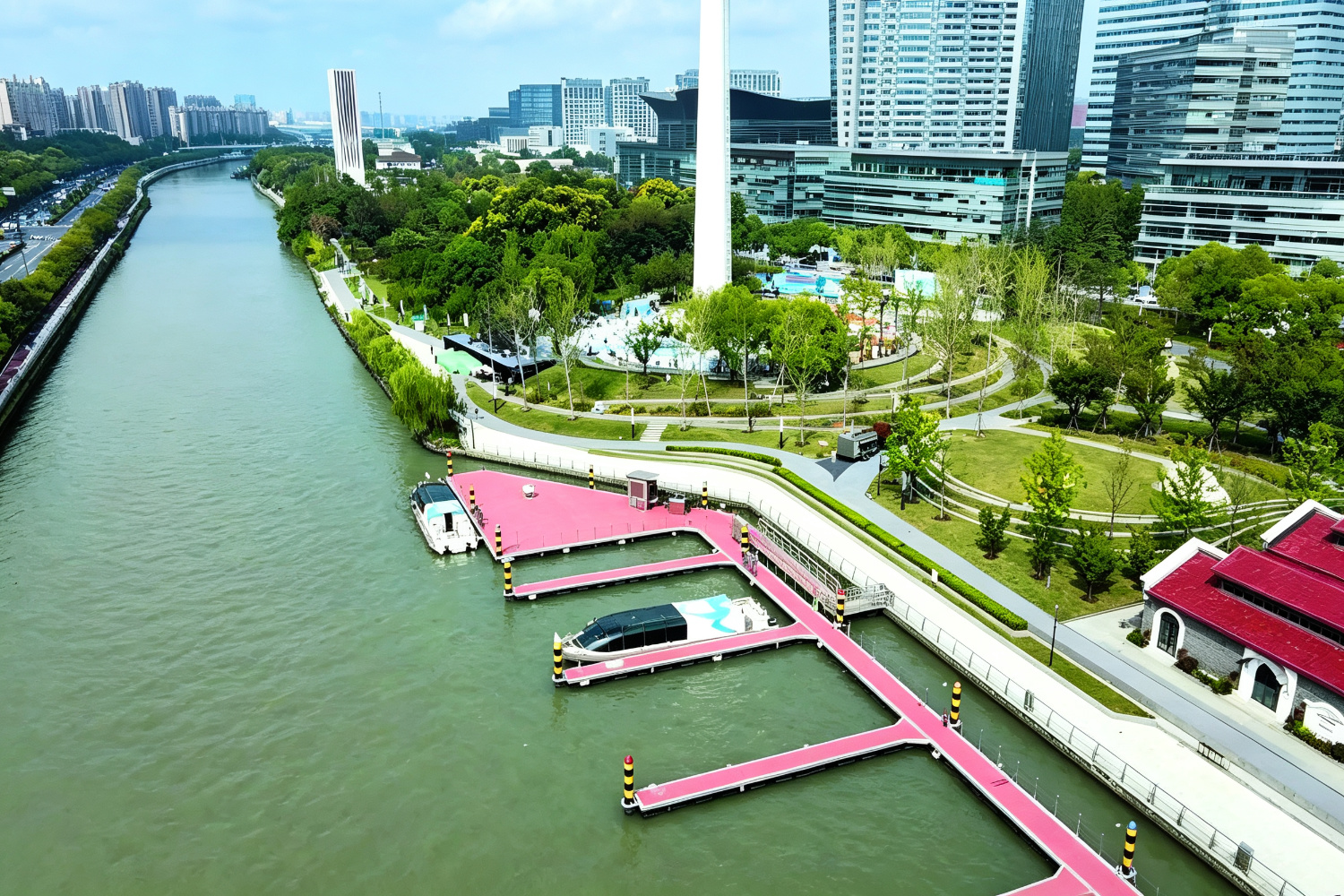
Half-Marathon Suzhou Creek Park is a 21-kilometer linear waterfront park stretching along both banks of Suzhou Creek, named for its half-marathon-length continuous trail. The cobalt-blue accents of its wayfinding and recreational facilities echo the water itself. Opened progressively from 2021, the park connects dozens of previously inaccessible industrial waterfront parcels into a unified public space, featuring running and cycling paths, riverside seating, children's play areas, and ecological wetlands. The park passes through multiple districts, linking landmarks such as M50, the Dream Center, and Changfeng Park, and has become Shanghai's most popular urban linear park for jogging, cycling, and riverside leisure.

Baixi Park (Purple Brown) · 百禧公园(紫棠色)

🎧 In app
Baixi Park (Purple Brown)

Baixi Park is an elevated linear park built on the former site of the Baixin Railway, Shanghai's longest abandoned railway corridor. Its purple-brown paving references the rust and earth tones of the decommissioned rail tracks. Opened in 2021, the park stretches approximately 800 meters at elevated levels, featuring three tiers of public space: a ground-level community garden, a mid-level walking promenade with fitness equipment, and an elevated skywalk with panoramic views of the surrounding Caoyang neighborhood. The design integrates the park's rail heritage—preserving sections of original track—while providing much-needed green space in one of Shanghai's densest residential areas. It is often compared to New York's High Line as a model of post-industrial urban reuse.

Hongshoufang (Amber) · 鸿寿坊(琥珀色)

🎧 In app
Hongshoufang (Amber)

Hongshoufang is a historic shikumen neighborhood recently revitalized into a mixed-use commercial and cultural complex, its amber-toned brick façades preserving the warm hues of 1920s Shanghai residential architecture. The site retains the original lane-and-courtyard layout of traditional shikumen housing while introducing boutique retail, specialty food halls, co-working spaces, and cultural exhibition areas. The renovation carefully preserved historic elements—stone gateways, carved lintels, and internal staircases—while inserting modern amenities. Located near the Suzhou Creek waterfront in Putuo District, Hongshoufang has become a model for adaptive reuse of Shanghai's historic lilong architecture, blending neighborhood-scale retail with heritage preservation.

Get the app

The tool solved one problem. The app handles the whole trip.

Per-trip visa judgements, audio guides, prep checklists, and a real human concierge — offline-ready, in your language.

Download for iPhoneFree to download · No OTA upsells