← Shanghai 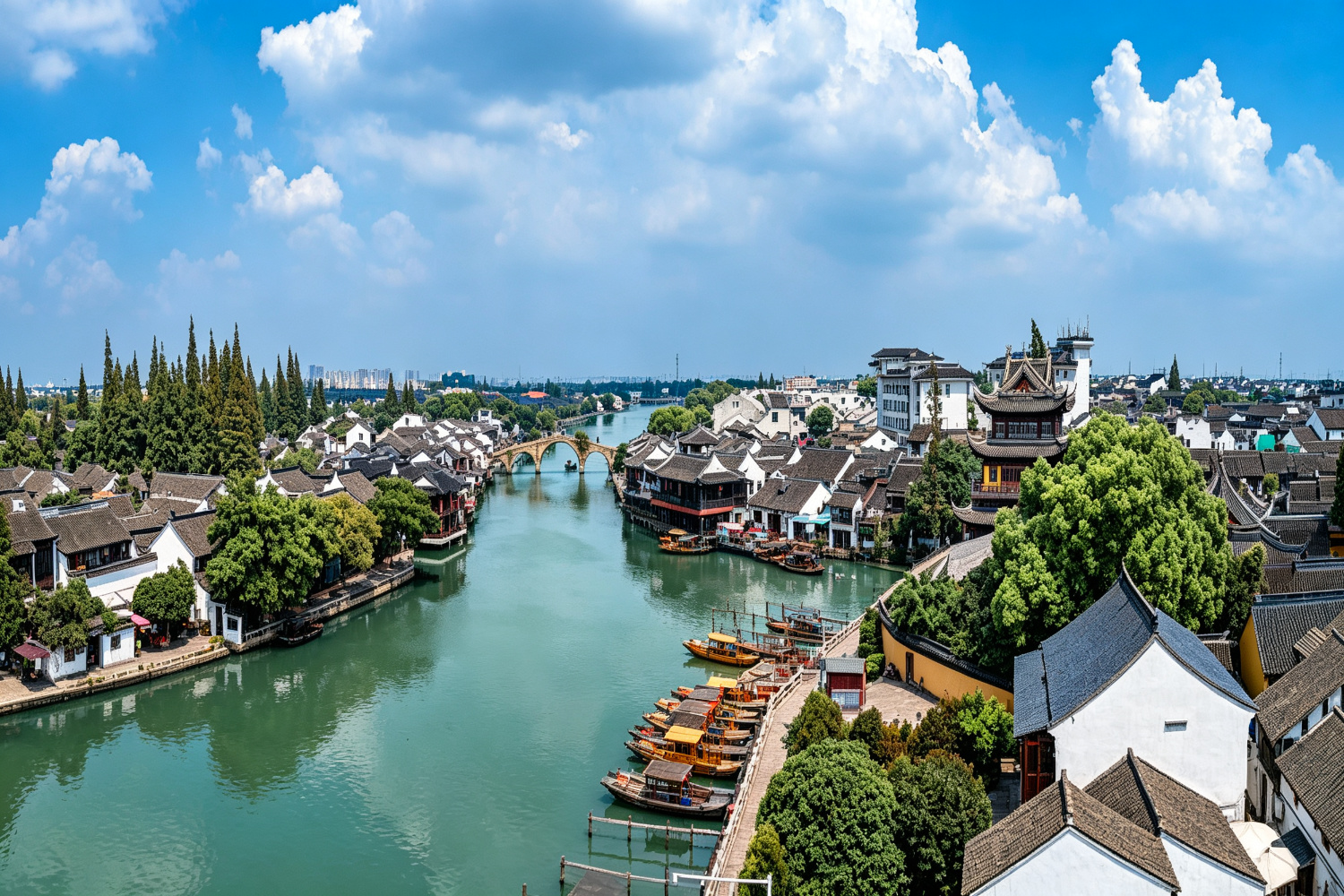 🎧 9 audio walking guides for Zhujiajiao Ancient Town — listen on the spot in the YOLO HAPPY app. →
Shanghai · 朱家角古镇
Zhujiajiao Ancient Town
🎫 Ticket No. 555 Kezhi Garden Road, Zhujiajiao Town, Qingpu District, Shanghai (Ancient Town Tourist Center / main entrance)
🕐 Duration Open 24 hours a day
🚇 Metro Take Line 17 to Zhujiajiao Station, exit at Exit 1, then transfer to Qingpu Bus No. 19, Qingpu Bus No. 29, or Zhujiajiao Bus No. 1, about 10 minutes to the ancient town - Alternatively, walk about 15–20 minutes from Zhujiajiao Station, or take the ancient town shuttle
📍 Address No. 555 Kezhi Garden Road, Zhujiajiao Town, Qingpu District, Shanghai (Ancient Town Tourist Center / main entrance) Map ↗
Tips for international visitors
- **Taxi:** About 1–1.5 hours from downtown Shanghai
- costing approximately RMB 150–250
Inside Zhujiajiao Ancient Town
North Street (Bei Dajie) · 北大街
🎧 In appDid you notice? The moment we stepped off Fangsheng Bridge and came onto this street, the lane suddenly felt much narrower. That's right — this is the famous "Yixian Street," or One-Sliver-of-Sky Street, otherwise known as North Street. Why that name? Look up — do you see it? The eaves on either side almost meet overhead, leaving only a thin sliver of sky between them. That's how the locals have always called it. At its narrowest point, two people walking side by side barely have enough room — you have to turn sideways to pass.
There's nothing ordinary about North Street. It is the best-preserved Ming-Qing commercial street in the Shanghai suburbs, running east from Fangsheng Bridge to Meizhou Lane in the west, stretching more than 300 meters. Look at the buildings on both sides: whitewashed walls, dark-tiled roofs, wooden doors and windows, upswept eaves — all of it original Ming and Qing architecture. More than a thousand homes have been built along this canal, and some of these houses are older than your great-great-great-grandfather.
Do you have any idea how prosperous this street used to be? There was a saying: "a long street of shops stretching without end" — that was said of North Street. During the Ming and Qing dynasties, this was Zhujiajiao's busiest commercial thoroughfare: silk merchants, grain dealers, sauce and pickle shops, herbalists, teahouses, pawnbrokers — one after another, without a gap. Boats came and went on the Caogang River, and traders gathered from all around. North Street was no small part of why Zhujiajiao grew into such a major Jiangnan town. In 2005, it was named one of Shanghai's Ten Best Leisure Streets.
As you walk, take a look at the shops on either side. Most of the old buildings have been turned into snack stalls and handicraft stores. If you catch the scent of bamboo leaves and sticky rice, that's the local grandmothers wrapping zongzi dumplings — Zhujiajiao's granny-made dumplings are quite famous, with pork belly that's rich but never greasy, and glutinous rice that's moist and tender. There's also haitang cake, braised pork, and water chestnut cake, all local specialties worth trying.
Watch your step as you walk. The street is paved with old stone slabs, some of which have been worn to a shine by centuries of footsteps. In the rain they become particularly slippery, so non-slip shoes are a must. One more thing to keep in mind: although the lane is narrow, the alleyways on either side are still home to local residents. Please don't wander into private courtyards when you're taking photos, and lower your voice as you pass in front of doorways out of respect for the people who live here.
Photographers, pay attention. North Street has two especially good angles for shots. The first: stand in the middle of the lane, use a longer focal length to compress the perspective of the old houses on both sides, and capture that narrow-sky effect. The second: find any window along the canal side of the street, frame the view through the wooden window surround, and shoot the scenery across the water — that framing gives the image a truly water-town feel. Around ten in the morning the light is at its best, when sunlight angles down through the gaps between rooftops and falls in dappled patches on the stone paving — the play of light and shadow is wonderful.
We'll take our time on North Street. Just ahead there's a legendary time-honored shop — Handalong Sauce Garden, which won international awards over a century ago. Let's go take a look.
Handalong Sauce Garden · 涵大隆酱园
🎧 In appLook at the shopfront ahead of you — grey brick, dark tiles, a wooden signboard with three bold black characters reading "Handalong." This is Zhujiajiao's most celebrated century-old institution: Handalong Sauce Garden. The store was founded in 1886, the twelfth year of the Guangxu reign of the Qing dynasty, making it nearly 140 years old. Look at this facade — it has kept the architectural style of the late Qing and early Republic era without any modernization, and it's precisely that unrestored, time-worn quality that gives it such character.
Want to know just how impressive this sauce garden's history is? In 1915 — more than a hundred years ago — Handalong's rose-flavored fermented tofu and premium soy sauce were entered in the Panama Pacific International Exposition, the very same fair where Moutai liquor made its name. Both products came home with awards. More prizes followed at the Nanyang Industrial Exhibition and the National Products Exhibition. Think about it: in that era, a small-town Jiangnan condiment shop competing on the international stage and winning — that would be a big deal even by today's standards.
Feel free to have a look inside. The store still sells traditional condiments and fermented goods: fermented tofu, soy sauce, pickled radish, sweet bean paste — a solid range. That rose-flavored fermented tofu is the same prize-winning product from all those years ago; if you're curious, pick up a small jar and give it a try. The flavor is genuinely different from anything you'd find in a supermarket. The soy sauce here is made using a traditional fermented soybean process with no additives. The color isn't as dark as commercial varieties, but the savory, fermented aroma is far more pronounced.
Let me give you a bit of background on the condiment trade here. Zhujiajiao sits in the heart of the Jiangnan waterway network, with canals running in every direction. Water transport made it a major commercial hub from the Ming and Qing dynasties onward, and fermented condiments were an essential part of every Jiangnan household's table — with rice, with porridge, you couldn't do without them. What made Handalong grow into what it was, was exactly that canal access: soybeans arrived by water from other regions, and finished condiments went back out by boat to Shanghai's city center and the surrounding townships. When the government nationalized private businesses in 1956, Handalong was merged with several other local sauce shops, but the name "Handalong" has been kept right up to the present day.
For photos, the old wooden signboard above the entrance is highly recommended. The characters were written in the early days of the shop, in a robust and classical style. The best angle is from across the lane: capture the full grey-brick facade and the signboard together, with the red lanterns hanging by the door adding color — it has all the warmth of old Jiangnan. If the shop isn't too crowded, you might also try shooting the rows of traditional ceramic crock jars lined up inside — that kind of old earthenware is increasingly hard to find anywhere else.
One thing to bear in mind when buying: the fermented tofu and soy sauce here have a limited shelf life and no preservatives, so keep them refrigerated once you're home. If you're taking them back to your home country as gifts, go for the vacuum-sealed packaging. The staff are very helpful and can vacuum-seal your purchase on the spot.
Alright, that's Handalong. Let's continue along North Street — just ahead is a stone bridge called Tai'an Bridge, the steepest ancient bridge in the entire town.
Tai'an Bridge · 泰安桥
🎧 In appThe stone arch bridge you see ahead is Tai'an Bridge, commonly called He Family Bridge. This bridge was first built in 1584, the twelfth year of the Wanli reign of the Ming dynasty — over four hundred years ago. Look at the stonework: the bridge is built entirely of grey granite, with a cleanly formed arch and graceful curves, a classic example of Ming-dynasty single-arch stone bridge construction.
There's one thing that makes this bridge stand out — it has the steepest gradient of any stone arch bridge in Zhujiajiao. Once you climb it, you'll know exactly what I mean: the pitch is steep enough that it feels a bit like climbing a small hill. As you go up, hold onto the stone railings on both sides and watch your footing — especially in wet weather, moss on the stone steps can make them very slippery.
Come, let's head up together. One step, two steps, three steps — you can feel that incline, can't you? Why did the builders make the bridge this steep? There's a practical reason behind it. Zhujiajiao is crisscrossed with waterways, and bridges need to allow boats to pass underneath. The higher the arch, the easier it is for boats to clear the bridge. But a higher arch means a steeper approach. Tai'an Bridge stands at the entrance to Yuanjin Zen Temple — an important crossing between the two banks — so the builders accepted a steep climb in exchange for unobstructed passage for the canal boats below.
Let's pause at the top. Look ahead — that's the gate of Yuanjin Zen Temple, which we'll be visiting in just a moment. Look back, and you'll see the layered rooftops of North Street; if a hand-rowed boat happens to be passing on the Caogang River, the scene is pure water-town poetry. This is the ideal position to photograph the temple gate: the arc of the bridge and the upswept eaves of the temple echo each other beautifully.
Take a look at the stone railings on either side of the bridge. These balusters and handrail slabs are original Ming-dynasty stonework. Some of the post tops are still carved with simple cloud and lotus motifs — four hundred years of wind and rain have softened the details, but if you look carefully you can still make them out. These carvings are nothing like the refined work you'd find in an imperial garden, but that's exactly what makes them appealing: they have the straightforward, unpretentious character of folk craftsmen.
There's also a story behind the name "He Family Bridge." According to local tradition, a wealthy family by the surname He once lived here and funded the construction of this bridge as a service to the community. Naming a bridge after its benefactor's family was a common custom in the Jiangnan water towns, and it reflects the tradition among Zhujiajiao's merchants and gentry of giving back to their hometown.
Good, take your time coming down — watch your step. At the bottom, the entrance to Yuanjin Zen Temple is on your right. Let's go in and take a look at this ancient temple that dates back to the Yuan dynasty.
Yuanjin Chan Temple · 圆津禅院
🎧 In appWelcome to Yuanjin Zen Temple. This is one of the oldest surviving structures in all of Zhujiajiao — it was founded in 1341, during the Zhizheng reign of the Yuan dynasty, nearly seven hundred years ago. Look at this entrance gate: not especially grand, but composed and ancient, with a quality of stillness and calm.
Yuanjin Zen Temple belongs to the Caodong school of Chan Buddhism, tracing its lineage through the sixth patriarch Huineng. That lineage is the mainstream orthodox line of Chan in China. The fact that a small Jiangnan water town like Zhujiajiao was home to a noted Chan temple tells you how vibrant Buddhist culture was here in those earlier centuries.
Once you step inside, you may notice that locals also call this place the "Ladies' Temple." Why? Because the temple enshrines Guanyin Bodhisattva, and folk tradition refers to Guanyin as the "Lady" deity. Locals have been coming here for generations — at New Year and other festivals — to pray for children, seek blessings, and offer incense, and the temple has always been well attended.
What makes this temple truly extraordinary is its cultural legacy. You might not expect a temple in a small water town to have attracted some of the greatest names in Chinese art and letters, and yet that is exactly what happened here during the Ming and Qing dynasties. Wang Shimin, Wang Yuanqi, Dong Qichang, Zheng Banqiao, Qian Daxin, Liu Yong — every one of these figures is a landmark name in the history of Chinese painting and calligraphy, and every one of them came to Yuanjin Zen Temple and left behind poems, paintings, and brushwork. There are very few temples anywhere in China that can claim that kind of cultural gathering.
Follow me inside and upstairs. The upper floor is home to the famous Qinghua Pavilion. Come — push open this wooden window and look out. Do you see it? Right outside is the canal. If a hand-rowed boat happens to be gliding past, the scene is simply stunning. The old houses on the far bank are reflected in the water, and when a ripple moves through, the reflection shatters and reforms. This is the very spot where those scholars and artists used to sit, looking out at this same water-town view, drinking tea, writing poems, and painting. The fluid, ink-washed Jiangnan landscapes that Dong Qichang put on paper — the inspiration for them probably came through this exact window.
Take a look at the inscribed steles and couplets on the walls. The compound preserves quite a number of Ming and Qing-era stone inscriptions, including texts composed by local scholars of distinction. Wang Chang, a prominent Qing-dynasty intellectual who grew up in Zhujiajiao, returned to his hometown in his later years, frequented this temple, and stored the woodblocks of his own works here. Yuanjin Zen Temple underwent an extensive restoration in 2000, and the appearance you see today is the result of that work.
Photography suggestions: two positions are especially recommended. The first is standing at the window of the Qinghua Pavilion, using the wooden window frame as a natural border and shooting the canal and the scenery along both banks. The second is looking up from the courtyard below, capturing the upswept eaves against the sky — in the afternoon between three and four o'clock, when sunlight falls at an angle onto the roof tiles, the texture of the eaves is especially clear and beautiful.
That's our visit to Yuanjin Zen Temple. Next, we'll go and see another distinctive bridge in Zhujiajiao — the Corridor Bridge.
Covered Bridge (Langqiao) · 廊桥
🎧 In appNotice how the bridge ahead looks different from the stone arch bridges we've crossed so far? This one has a roof, a covered gallery, and upswept eaves — this is the Corridor Bridge of Zhujiajiao, also known as Huimin Bridge, meaning "a bridge that benefits the people." Covered bridges aren't rare in the Jiangnan water towns, but this one has a particularly fine location and an elegant form, making it one of the most photogenic spots in the ancient town.
Come on up and have a look. The bridge deck is paved with stone slabs, with wooden railings and benches along both sides. The covered gallery above has a tiled roof with upswept eaves, and the pillars are arranged in an orderly row — some wood, some stone, a combination chosen for both structural soundness and visual appeal. Notice the color of the wooden pillars: years of sun and wind have turned the timber a deep dark brown, giving it a composed, seasoned quality.
What's the greatest benefit of a covered bridge? It keeps the rain off. The Jiangnan region gets a lot of rain — in the plum rain season especially, showers arrive without warning. In the old days, when locals went out without umbrellas and got caught in a downpour, they would duck into the nearest covered bridge and wait for the rain to pass. That's why this bridge is called Huimin Bridge — "benefit the people." If you get caught in a shower during your visit, remember where this bridge is.
Stop in the middle of the bridge and look in both directions. The Corridor Bridge spans the town's main canal. Below, clear water flows quietly; if a hand-rowed boat passes under the arch, the sound of the oar echoes in the tunnel in a way that's wonderfully musical. On both banks stand whitewashed, dark-tiled old houses — some with laundry drying in the windows, some with flower pots by the door, brimming with the textures of everyday life. This is the most quintessential Jiangnan water-town scene: little bridge, flowing water, and homes alongside — all three in one place.
The Corridor Bridge is also an outstanding photography location. Why? Because the eaves and pillars create a natural play of light and shadow: sunlight filters through the gallery roof and falls in bright patches and dark stripes across the bridge deck, giving the image a rich, layered quality. Try standing at one end of the bridge, using a pillar as a foreground element, and shooting toward the far exit. The sense of depth and natural framing that creates is really compelling. If someone happens to be walking across and steps into one of the pools of light at the right moment, pressing the shutter then will give you a photograph full of narrative.
Another angle well worth trying: from the stone path along the riverbank, shoot a full view of the Corridor Bridge — eaves, upswept tips, and their reflection in the water all in one frame. The best time is in the evening around five or six o'clock, when the setting sun warms the bridge to a golden amber color and the reflection in the water turns golden too. Keep in mind that the light will be dim by then, so smartphone photos may blur easily; if you have a camera, bringing a tripod is worthwhile.
On the history of this bridge: it has been repaired multiple times over the years. The current structure is a restoration built on the original foundations, preserving traditional construction methods and materials. Look at the roof tiles — they are the traditional grey tiles of Jiangnan, laid in overlapping rows one by one, exactly as they would have been done for centuries.
That's our time at the Corridor Bridge. Next, I'll take you to the City God Temple, where a ginkgo tree several hundred years old stands alongside a beautifully crafted ancient opera stage.
City God Temple (Zhujiajiao Chenghuang Miao) · 城隍庙
🎧 In appWelcome to Zhujiajiao's City God Temple. This temple has a history of more than two hundred years and is one of the most important religious sites in the ancient town. Look at the entrance — not particularly grand, but composed and dignified, with the quiet gravitas of a long-established temple.
Zhujiajiao's City God Temple has one very unusual feature: it is one of the rare "one temple, two city gods" arrangements in the Jiangnan region. What does that mean? It means two city god deities are enshrined here together. Most city god temples hold only one, but this temple holds two. According to tradition, one is the local city god of Zhujiajiao, and the other was invited here from elsewhere. The exact origin story varies depending on who you ask, but regardless of the details, this double city god arrangement is genuinely uncommon in Jiangnan — and it's one of the distinguishing features of this particular temple.
Follow me inside. The first thing to look at, just inside the entrance on your left, is a big tree. Do you see it? That is an ancient ginkgo, several hundred years old. Look at that trunk — it would take two people joining hands to encircle it. The branches spread wide, the canopy dense enough to block the sky. In autumn the whole tree turns golden and fallen leaves carpet the ground below — a scene as beautiful as an oil painting. This ancient ginkgo is the temple's most treasured living landmark, having witnessed more than two hundred years of the temple's history.
Now look further ahead — that is the ancient opera stage. Look carefully at its craftsmanship: carved beams, painted rafters, interlocking bracket-sets along the eaves — the workmanship is exceptional. The most impressive feature is the coffered ceiling above the stage. What is a coffered ceiling, exactly? It's the recessed dome structure in the ceiling above the stage, where layers of brackets converge upward like an inverted bell. The coffered ceiling isn't purely decorative — it also has an acoustic function. When a performer sang on stage, the sound traveled upward into the dome and was reflected back down, effectively acting as a natural amplifier. The ingenuity of the people who built this is evident at every turn.
Picture the scene as it once was. On the occasion of the city god festival or any major celebration, this stage would ring with drums and gongs as kunqu opera or local drama was performed. The townspeople would drag out benches and settle in to watch, cracking seeds and listening to the singing — those were the liveliest days in the life of the ancient town. No performances are held here now, but standing before this empty stage, if you close your eyes, you can almost hear the music and the voices of another era.
The temple also preserves several Qing-dynasty stone inscriptions. If you're interested, look for the steles set into the walls; they record the history of the temple's construction and the folk beliefs of the town. The characters have faded in places over the years, but these inscriptions are primary historical sources, first-hand and irreplaceable.
Photography suggestions: the ancient ginkgo and the opera stage are both excellent subjects. For the ginkgo, try a wide-angle lens angled upward to capture the full spread and presence of the canopy. For the opera stage, stand directly in front and use a standard focal length to capture the symmetry of the structure — if you can include the coffered ceiling in the frame, even better. In autumn, gathering a few fallen ginkgo leaves and placing them on a stone step for a close-up shot works beautifully as well.
That's our visit to the City God Temple. Next comes the highlight of today's tour — Kezhi Garden, the largest private garden in all of Zhujiajiao.
Kezhi Garden · 课植园
🎧 In appWelcome to Kezhi Garden — the largest manor-style garden in all of Zhujiajiao. Located at Number 147 Jing Street in the western part of the town, it is popularly known as Ma Family Garden. What does "Kezhi" mean? It comes from the phrase "study and cultivate the fields" — the idea of combining scholarship with working the land, an expression of the traditional Chinese ideal of the scholar-farmer. The garden's owner, Ma Weiqi, gave himself the studio name "Nongpu," meaning "farmer." That name alone tells you something: a man of considerable means, but one who at heart yearned for a life close to the soil.
How big is this garden? It covers 53,000 square meters and contains more than two hundred buildings of various kinds. Construction began in 1912 and took fifteen years to complete, at a cost of three hundred thousand silver taels. Consider what three hundred thousand silver taels meant in that era — enough to buy several fine Western-style houses in Shanghai. The Ma family put that kind of money into this garden; that alone tells you how much it meant to them.
Come in with me — we'll go through the garden section by section. The whole estate is divided into three parts: the hall area, the rockery area, and the garden area. Let's start with the hall area. The buildings here blend Chinese and Western styles — notice the windows: some are traditional carved wooden lattice, while others are Western-style stained glass. This Chinese-Western hybrid style was fashionable in the early years of the Republic, a sign that Ma Weiqi was a man of broad experience who could hold onto Chinese tradition while absorbing Western elements.
Now for the rockery area. The artificial hills here are built from Lake Tai stones, chosen according to four classical principles: lean, furrowed, perforated, and transparent — meaning the stones should be elongated rather than stocky, covered in layered surface textures, pierced by holes that let light through, and open enough that you can see through those holes from front to back. Look at these stones — they check all four qualities. The rockery contains winding tunnels and stone steps that you're welcome to walk through, experiencing for yourself the old Chinese saying "You think the path has ended, but then another world opens up around the bend."
The most rewarding part of the garden is the inscription gallery. Come this way — set into the walls of this covered walkway are stone carvings of poetry and calligraphy by celebrated Ming-dynasty artists! You'll find the cursive script of Zhu Zhishan, the delicate regular script of Wen Zhengming, and the poetry of Tang Yin. These carved stones were collected from various sources and are original Ming-dynasty pieces, installed here nearly a century ago. Take a close look at the Wen Zhengming small-script carvings: the characters are precise, refined, and composed with remarkable discipline. Tang Yin — the celebrated scholar-painter also known as Tang Bohu — having his poetry in stone here is genuinely rare. These inscriptions are the most precious cultural artifacts in Kezhi Garden, and they are not the kind of thing you come across easily anywhere else.
The garden area is the most beautiful part of Kezhi Garden. Pavilions, terraces, walkways, and halls are arranged in an easy, natural flow, with streams, stepping stones, and winding paths. Look at the reflections in the water, the weeping willows along the banks, the finely detailed stone railings and wooden covered walkways — this is paradise for photography enthusiasts. A live-performance recording of the classical opera "The Peony Pavilion" was once filmed here on location; see if you can find the angles that match the scenes from that production.
Photography suggestions: Kezhi Garden rewards a slow, unhurried approach. A few positions worth trying: in the rockery area, shoot a close-up of the Lake Tai stone textures with a wide aperture to blur the background; in the inscription gallery, use raking side-light to bring out the carved characters most clearly; in the garden area, find a windless moment when the water surface is mirror-still, and shoot the reflection that makes the scene and its image perfectly symmetrical. The light is softest in the afternoon between three and four o'clock, ideal for shooting the garden's wider views.
A quick note on admission: Kezhi Garden has a ticket price of ¥20, or you can include it in a combo ticket. The garden is quite large — allow forty minutes to an hour to explore it properly.
That's our time in Kezhi Garden. Our last stop is the Qing Dynasty Post Office, at the southern end of the ancient town — the final destination on today's tour.
Da Qing Post Office · 大清邮局
🎧 In appLadies and gentlemen, we've arrived at our final stop of the day — the Qing Dynasty Post Office. Look at this building: above the entrance, the words "Qing Dynasty Post Office" are still displayed in their original form. This is a late-Qing brick-and-timber structure, dignified and full of character. The post office was established in 1903, the twenty-ninth year of the Guangxu reign, making it more than 120 years old — one of the earliest postal institutions in the Shanghai area.
Do you know where the name "Qing Dynasty Post Office" comes from? In 1896, the Qing government officially launched a national postal service, called the "Great Qing Post." Zhujiajiao, being a major Jiangnan trading town with an excellent canal network and a thriving commercial scene, had its postal office established in 1903, which quickly became the postal hub for the surrounding region. At the time, sending a letter or transferring a sum of money all depended on this office. In that sense, the Qing Dynasty Post Office is a witness to how modern postal civilization spread through the Jiangnan water towns.
Come inside and have a look. The interior has been adapted into a creative retail space, but it retains many original postal elements. Look at this counter — this was the operational counter in the working days of the post office, the timber now darkened to a deep walnut brown. Old photographs and postal artifacts hang on the walls, telling the story of how the postal system operated a hundred years ago. Notice the old envelopes and stamps on display — some are original pieces from the late Qing and early Republic era, with postmarks still clearly legible. The history is palpable.
The rear courtyard is the part many visitors love most. Follow me through — look at this: grey brick underfoot, old trees overhead, quiet and serene. There's a small reading room where you can sit, browse through a book, and rest your feet. More importantly, this is where the postmark-stamping service is offered! If you've picked up a postcard or a notebook, you can have it stamped with an official "Qing Dynasty Post Office" commemorative postmark right here — a genuinely meaningful souvenir. The stamping service is free, but there may be a short queue when it's busy.
The front shop sells a range of creative items. Fridge magnets, notebooks, bookmarks, canvas totes — all designed around postal history and Zhujiajiao. The quality is good. If you're looking for gifts to bring home, this is a good place to browse: the prices are fairer than the typical tourist shops outside, and the "Qing Dynasty Post Office" branding makes them especially nice to give.
For photos, the Qing Dynasty Post Office has a few particularly rewarding angles. The first is the shopfront — stand across the lane and shoot the signboard together with the grey brick facade and the old wooden door; it's unmistakably a building with age and history. The second is the rear courtyard — the old tree's branches spread outward, and sunlight filtering through the leaves casts dappled shadows on the grey brick floor, creating a beautifully atmospheric scene. The third is inside the reading room — wooden window, old desk, lamp, bookshelves — it has the feel of a Republic-era scholar's study; sit by the window for a side-profile portrait and it's quietly poetic.
The Qing Dynasty Post Office is the closest stop to Zhujiajiao Station on Metro Line 17 — about a ten-minute walk from the station exit. Many visitors choose to start or end their tour here. We've placed it at the end of today's route, so after your visit, you can head south directly to the metro station and take the train back to the city center.
And with that, friends, our tour of Zhujiajiao Ancient Water Town is complete! Today we've visited Fangsheng Bridge, North Street, Handalong Sauce Garden, Tai'an Bridge, Yuanjin Zen Temple, Corridor Bridge, City God Temple, Kezhi Garden, and the Qing Dynasty Post Office — nine stops in all, covering roughly 1.6 kilometers. We hope you've fallen in love with this "Venice of Shanghai." If there's still time to spare, don't miss the granny-made dumplings and haitang cake on North Street, and a seat in a teahouse makes a perfect way to close the day. Safe and happy travels!
Get the app
The tool solved one problem. The app handles the whole trip.
Per-trip visa judgements, audio guides, prep checklists, and a real human concierge — offline-ready, in your language.
Download for iPhoneFree to download · No OTA upsells