🎫 Ticket Not free; real-name reservation and ticket purchase required; no on-site ticket sales
🕘 Opening Hours - Peak season (March 1 – November 15): 07:30–17:30 (ticket sales and entry stop at 17:00)
- Off-season (November 16 – February 28): 07:30–17:00 (ticket sales and entry stop at 16:30)
🚇 Metro Suzhou Metro Line 6 "Humble Administrator's Garden Suzhou Museum Station" Exit 1/2, walk 3–5 minutes directly to South/East Gate (closest and best)
🎫 Ticket Peak season (March 1 – October 31): 80 RMB/person
🎫 Ticket Off-season (November 1 – February 28 of the following year): 70 RMB/person
🕘 Opening Hours Off-season (November 1 – February 28): 07:30–17:00, last admission at 16:30
🚇 Metro Alternative: Line 4 "Beisi Pagoda Station" Exit 3/4, walk 10–15 minutes
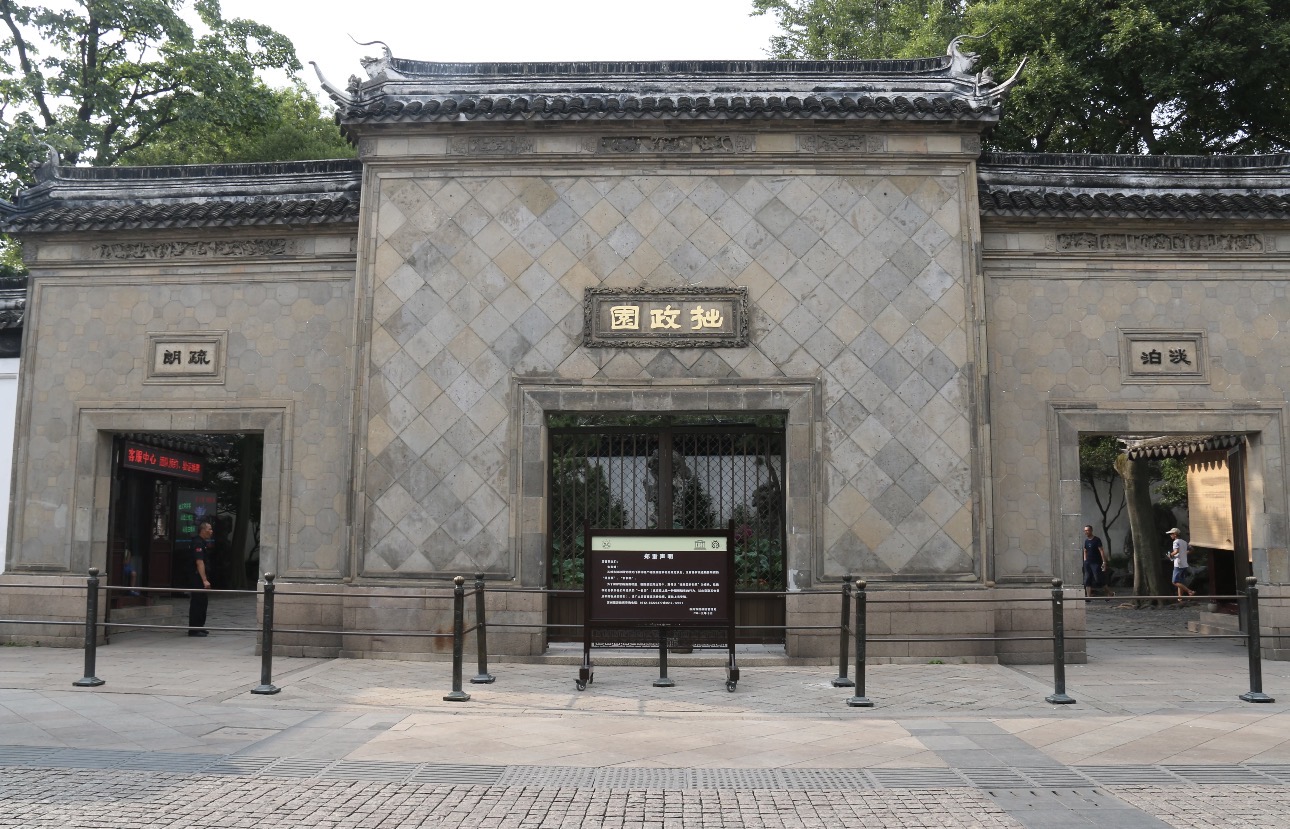
📍 Address No. 178 Northeast Street, Gusu District, Suzhou, Jiangsu Province, China Map ↗ ⚠️ BookingAdvance reservation required
Inside Humble Administrator's Garden
Lanxue Hall (Hall of Orchid and Snow) · 兰雪堂
🎧 In app 
Lanxue Hall is the main entrance hall of the Humble Administrator's Garden, a three-bay structure with a rigid gable roof. Its name comes from Li Bai's verse "Standing alone between heaven and earth, a fresh breeze scatters orchids and snow," reflecting the garden owner's lofty aspirations and integrity. In front of the hall stands a large lacquer carving of the full garden panorama. Inside, the decor is restrained and refined, with a painting of pines and bamboo hanging in the central hall and a couplet extolling both natural beauty and scholarly pursuits — setting the tone for the entire literati garden.
Yuanxiang Hall (Hall of Distant Fragrance) · 远香堂
🎧 In app 
Yuanxiang Hall is the architectural centerpiece of the garden's middle section, a three-bay hall raised on a bluestone platform. Its name draws from Zhou Dunyi's famous essay "On Loving the Lotus" — "the farther the fragrance travels, the purer it becomes" — subtly expressing the owner's self-identification with the lotus's noble character. With floor-to-ceiling latticed windows on all four sides and no solid walls, the hall offers uninterrupted views in every direction: northward to the Snow-Fragrant Cloud-Like Pavilion, southward to the yellowstone rockery and magnolia, westward to the Lotus Breeze Pavilion, and eastward to the Embroidered Silk Pavilion. It is a masterclass in the Chinese garden techniques of "framed views" and "borrowed scenery."
Xiangzhou (Fragrant Isle) · 香洲
🎧 In app 
Xiangzhou is one of the garden's most distinctive structures, ingeniously combining four architectural forms into a single composition: a stone-paved platform at the bow, a covered corridor as the cabin, and a two-story tower at the stern — creating the illusion of an ornate pleasure boat moored by the water. The name "Fragrant Isle" evokes a lush, grassy islet. A plaque inscribed by the Ming master Wen Zhengming hangs at the bow, while the upper level, named "Chengguan Tower" (Tower of Clear Contemplation), offers sweeping views across shimmering garden waters. This is a quintessential example of the "dry boat" motif in classical Chinese gardens, brilliantly merging water-town imagery with garden architecture.
Hefeng Simian Pavilion (Lotus Breeze from All Sides Pavilion) · 荷风四面亭
🎧 In app 
Hefeng Simian Pavilion is a delicate hexagonal pavilion with a pointed roof, built on a rocky islet at the center of the garden's main pond and connected to both shores by winding bridges. Its name, borrowed from Tang poet Meng Haoran's line "the lotus breeze bears its fragrance," perfectly captures its poetic essence. In midsummer, when lotus blooms carpet the surrounding water and a gentle breeze carries their scent from all four sides, one feels as though standing inside a painting. The couplet on its pillars — "Lotus blossoms on four sides, willows on three; half a pool of autumn water, a mountain in one room" — elegantly evokes the changing seasons. Beyond being an exquisite lotus-viewing perch, this pavilion is the compositional linchpin of the garden's waterscape, skillfully linking Yuanxiang Hall, Xiangzhou, and Jianshan Tower.
Xiaofeihong (Little Flying Rainbow) · 小飞虹
🎧 In app 
Xiaofeihong is a supremely poetic covered bridge and the only surviving example of its kind among Suzhou's classical gardens. The three-span bridge features vermilion balustrades beneath a full-length roof, with green water flowing gently beneath. Its name, drawn from Bao Zhao's verse "a flying rainbow gazes upon the Qin River," likens the bridge's graceful arc to a rainbow. Connecting Yiyu Pavilion on one end to Dezhi Pavilion on the other, the bridge casts its reflection onto the water, blurring the line between reality and illusion. Viewed from Yuanxiang Hall, Xiaofeihong appears as a crimson arc suspended above the water, forming a richly layered composition with the pavilions, rockeries, and foliage beyond — a brilliant demonstration of "borrowed" and "divided" scenic techniques.
Jianshan Tower (Tower of Seeing the Mountain) · 见山楼
🎧 In app 
Jianshan Tower is the tallest structure in the garden, a two-story double-eaved building with a hip-and-gable roof standing on the northern shore of the garden's main pond. Its name echoes Tao Yuanming's famous lines "Picking chrysanthemums by the eastern hedge, I gaze in leisure upon the southern mountain," expressing the owner's longing for a life of reclusion amid nature. The open-sided ground floor serves as a cool hall for watching fish and lotus, while the upper study commands a view that frames Suzhou's iconic North Temple Pagoda — the supreme achievement of the Chinese garden technique of "borrowed scenery," pulling a city landmark into the garden's visual field and vastly expanding its perceived depth. The waterfront terrace in front is one of the best spots for panoramic photography.
Sanshiliu Yuanyang Guan (Thirty-Six Mandarin Duck Hall) · 卅六鸳鸯馆
🎧 In app 
Sanshiliu Yuanyang Guan is the principal building of the garden's western section, originally named for the thirty-six pairs of mandarin ducks that once graced the pond before it. The hall follows the "mandarin duck hall" layout — two halls separated by a screen partition: the southern hall is warm in winter with abundant sunlight, while the northern hall stays cool in summer with cross-ventilation from the water, a brilliant demonstration of traditional architectural wisdom. Its most striking feature is the stained-glass lattice windows on all four sides — blue-and-white diamond-patterned panes that refract dreamlike light and shadow, a rarity in classical Chinese gardens and a precious trace of Western influence during the late Qing period. The owner Zhang Luqian once entertained guests and enjoyed Kunqu opera here, and the hall's exquisite wood carvings, plaques, and couplets still whisper of literati refinement.
Yushei Tongzuo Pavilion (With Whom Shall I Sit Pavilion) · 与谁同坐轩
🎧 In app 
Yushei Tongzuo Pavilion is one of the garden's most inventive architectural designs: the pavilion is fan-shaped in plan — its roof, walls, doors, windows, stone table, stone stools, and even the hanging plaque are all in the form of a fan, an exquisite conceit. Its name comes from Su Shi's celebrated verse "With whom shall I sit? The bright moon, the fresh breeze, and me" — a rhetorical question that conveys a transcendent detachment, a communion with the universe in splendid solitude. Perched at the southeastern corner of the western pond, with water on three sides and a covered corridor at its back, it faces Sanshiliu Yuanyang Guan across the water. This tiny fan-shaped space holds infinite poetry and philosophy, a perfect distillation of the classical Chinese garden aesthetic of "seeing the great in the small."
Liuting Ge (Pavilion for Lingering and Listening) · 留听阁
🎧 In app 
Liuting Ge is a small, elegantly understated waterside pavilion in the garden's western section — a single-story structure with a hip-and-gable roof, surrounded by water on three sides in serene seclusion. Its name is taken from the late Tang poet Li Shangyin's haunting line "Leave the withered lotus to listen to the sound of rain," a verse suffused with melancholy and depth. In autumn, when the lotus blooms have faded and only withered stalks remain, the patter of rain on dry lotus leaves creates a rustling, intimate music — a celebration of imperfect, quiet beauty that represents the highest expression of the traditional Chinese aesthetic of wabi-like poignancy. Leaning on the railing, one gazes upon clear pond waters, a distant pagoda silhouette, and nearby withered lotus whispering in the rain — a moment of transcendence where time dissolves and the self merges with the scene. Liuting Ge is not merely a viewpoint; it is a state of mind.