🎫 Ticket Not free; real-name reservation required; no on-site ticket sales
🎫 Ticket Peak season (March 1 – October 31): 40 RMB/person
🎫 Ticket Off-season (November 1 – February 28): 30 RMB/person
🕘 Opening Hours - Peak season (April, May, July–October): 07:30–17:30 (ticket sales and entry stop at 17:00)
- Off-season (January–March, June, November, December): 07:30–17:00 (ticket sales and entry stop at 16:30)
🕘 Opening Hours Off-season (November 1 – February 28): 07:30–17:00, last admission at 16:30
🕘 Opening Hours Holidays: Often extended to 18:00, last admission at 17:30
🚇 Metro Line 6 "Humble Administrator's Garden Suzhou Museum Station" Exit 2, walk 3–5 minutes directly (closest, preferred)
🚇 Metro Alternative: Line 4 "Beisi Pagoda Station" Exit 4, walk about 10–15 minutes
📍 Address No. 23 Yuanlin Road, Gusu District, Suzhou, Jiangsu Province, China Map ↗ Inside Lion Grove Garden
Yanyu Hall (Hall of Swallow's Honor) · 燕誉堂
🎧 In app 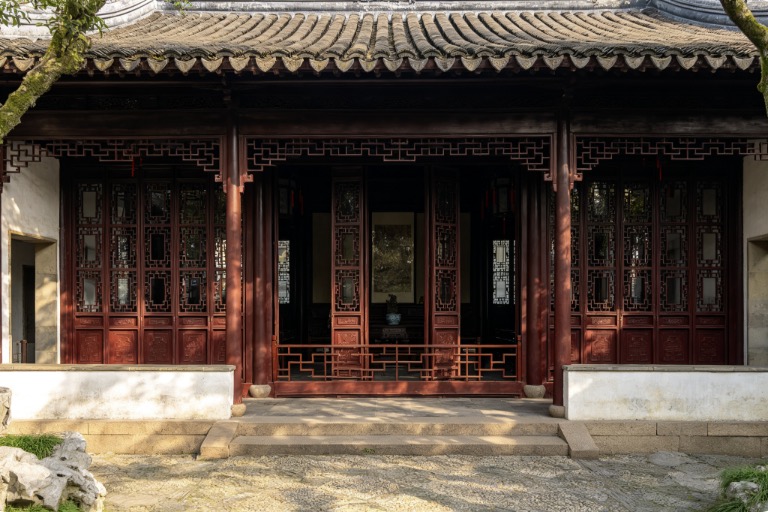
Yanyu Hall is Lion Grove Garden's main hall and the first building visitors encounter. "Yanyu" derives from the Shijing (Book of Odes): "The gentleman has wine, and the guests feast joyfully"—where "Yan" means banquet and "Yu" means delight. The hall's interior is elegantly appointed, with screen paintings depicting Lion Grove panoramas and poetic inscriptions by masters past. Through the windows, the garden's lake-stone labyrinth already looms tantalizingly. Yanyu Hall establishes the garden's tone of festive exploration, signaling that Lion Grove is not merely for contemplation but for a sensory adventure brimming with playfulness.
Xiaofang Hall (Small Square Hall) · 小方厅
🎧 In app 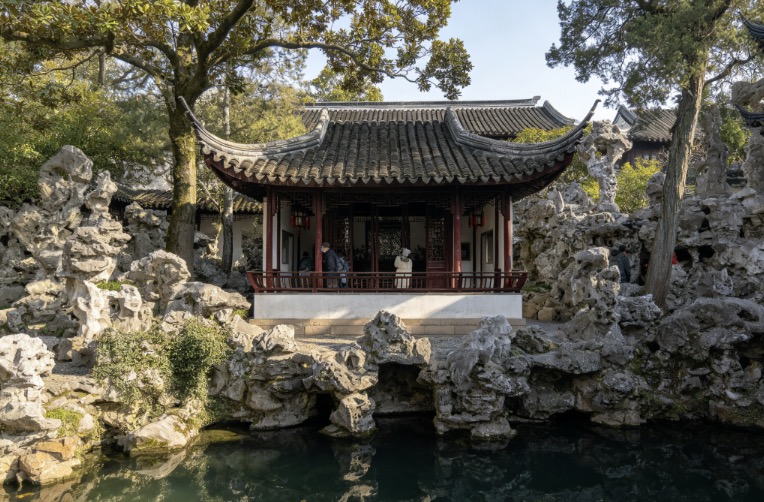
Xiaofang Hall sits directly north of Yanyu Hall—a small yet meticulously designed square hall. The name "Xiaofang" refers both to its regular square plan and to the garden philosophy of "seeing the cosmos within a square inch." Its most ingenious feature is the window design: east and west ornamental windows act as picture frames, precisely cropping different fragments of the rockery group, so that standing inside, visitors preview sections of the stone labyrinth they will soon enter. This framing technique turns the diminutive hall into a visual prelude for the entire rockery. The interior is restrained—simple furnishings and blank walls creating an austere elegance that contrasts brilliantly with the rugged lake stones beyond the windows, a dialogue of softness and strength.
Nine Lion Peak · 九狮峰
🎧 In app 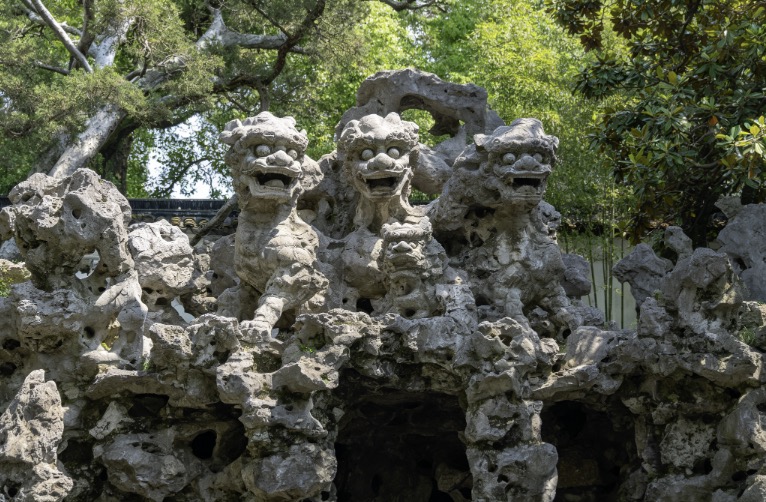
Nine Lion Peak is the rockery group's most arresting element and the most direct visual proof of the garden's naming origin. Composed of multiple Taihu (lake) stones assembled in their natural forms, its overall silhouette and surface undulations reveal lion shapes—some head-raised, some crouching, some playing, some guarding. Careful observation identifies nine lions in distinct, vivid poses. Lion Grove Garden was built by Yuan dynasty monk Tianru to honor his master Zhongfeng; "lion" refers both to the rockery's lion-like forms and to the Buddhist metaphor of the "lion's roar" symbolizing the power of enlightenment preaching. Nine Lion Peak stands at the rockery entrance between Xiaofang Hall and Zhibai Pavilion, serving as both the labyrinth's landmark and a extraordinary work where Buddhist Chan philosophy and secular stone-appreciation aesthetics intersect.
Zhibai Pavilion (Point-to-Cypress Pavilion) · 指柏轩
🎧 In app 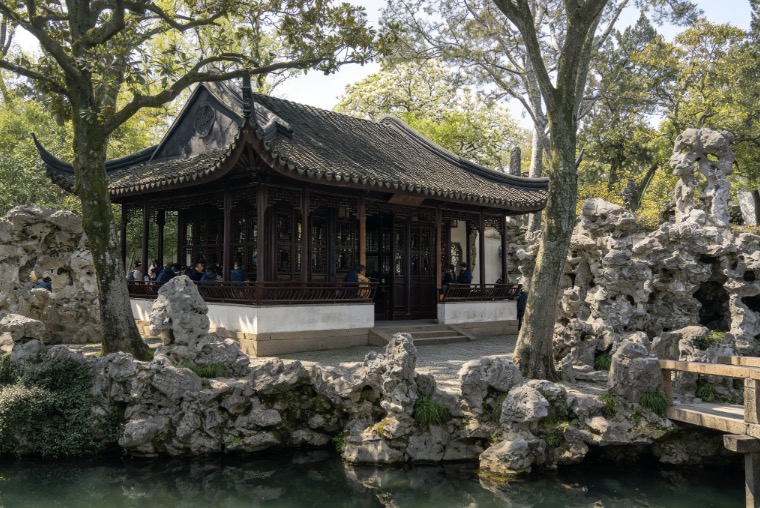
Zhibai Pavilion is the main viewing hall on the south side of the rockery group. Its name originates from a Chan (Zen) koan: when a monk asked Zhaozhou Congshen, "What is the meaning of the Patriarch's coming from the West?" Zhaozhou replied, "The cypress tree in the courtyard"—pointing to an ordinary object to expound the dharma's essence, transcending textual convention. Zhibai Pavilion embodies this Chan spirit in garden architecture: an ancient cypress stands verdant and upright before the hall, rugged lion-shaped rocks behind it; from within, one can survey the entire stone labyrinth while contemplating the Chan insight that "the path is right before your eyes." The pavilion once served as a monk's meditation space, later transforming into a literati gathering place, with poetic inscriptions on screen panels. It is Lion Grove's building where Buddhist Chan thought and Jiangnan garden viewing are most tightly interwoven.
Hualan Hall (Flower Basket Hall) · 花篮厅
🎧 In app 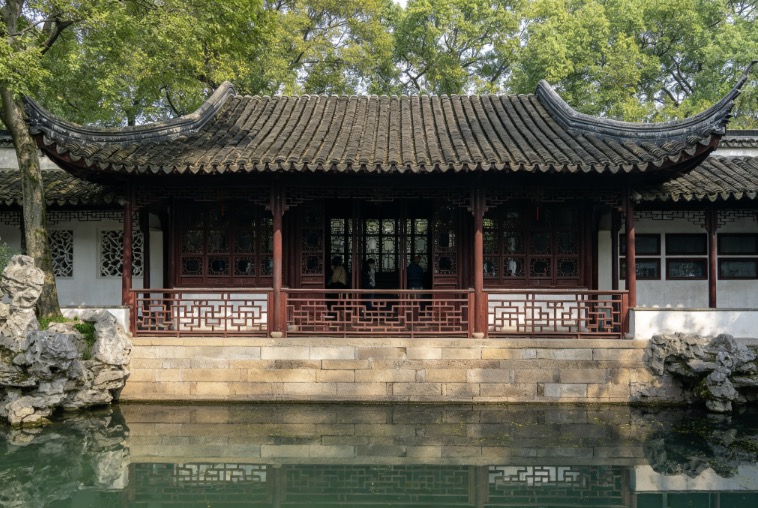
Hualan Hall is an exquisite hall on the south side of Lion Grove's pool, named after the flower-basket motifs carved on its dangling-lotus columns (short eaves columns). These carved flower baskets demonstrate superb craftsmanship—each basket holds different blooms: peony, lotus, plum, or orchid, with flowing lines and layered depth, representing the finest of Suzhou garden wood-carved ornamentation. The hall is partially built over the water, its base partly submerged in the pool. Sitting inside, one views the pool reflections and the full rockery panorama opposite, where rippling light and rugged peaks converge, creating the uncanny visual experience of "the hall in the water, the mountain in the mirror." Interior displays follow a floral theme, with seasonal vase flowers creating an engaging contrast between "carved flowers" and "real flowers."
Zhenqu Pavilion (True Delight Pavilion) · 真趣亭
🎧 In app 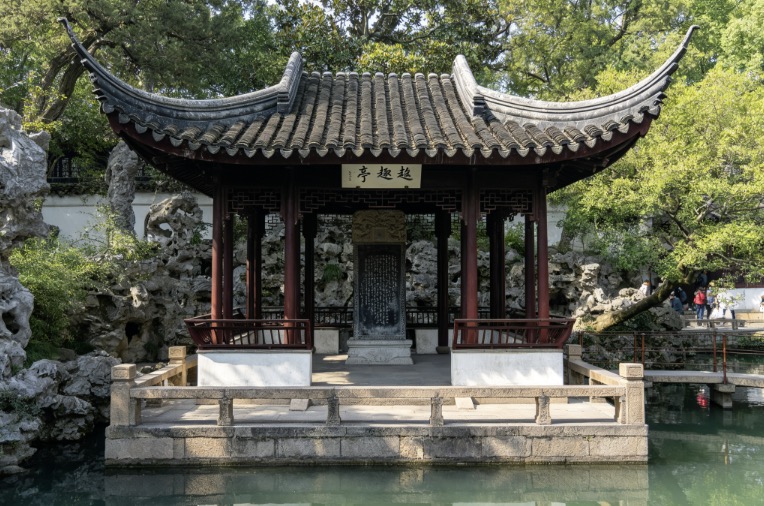
Zhenqu Pavilion sits beside the pool on the east side of the rockery group, the garden's building most deeply connected to Emperor Qianlong. During his six southern tours, Qianlong visited Lion Grove each time; on one occasion, lost in delight within the rockery maze, he brush-wrote "Zhen You Qu" (truly interesting). A accompanying minister deemed "You Qu" too colloquial and tactfully suggested keeping "Zhen" and changing to "Qu" (delight), preserving imperial joy while elevating literary refinement—Qianlong gladly agreed. "Zhen Qu" (True Delight) carries both the documentary sense of the emperor's garden pleasure and the Chan philosophical dimension of "true suchness"—only by playful wandering in the labyrinthine rockery does one attain life's "true delight." The plaque remains preserved inside the pavilion, one of Lion Grove's most precious historical artifacts.
Stone Boat · 石舫
🎧 In app 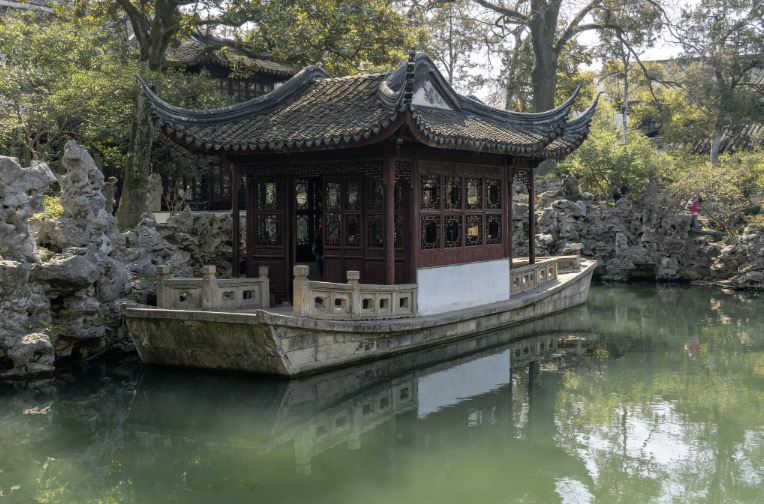
The Stone Boat is a boat-shaped water structure in Lion Grove's pool, entirely constructed of stone with realistic bow, cabin, and stern forms, stone railings along the sides, and stone tables and benches inside for resting. Fixed in place, it is called an "untethered boat"—an image derived from Zhuangzi's philosophical parable of drifting "like an untethered boat," symbolizing spiritual freedom and non-attachment. The stone boat is a highly representative Jiangnan garden building type: it fulfills the desire to linger on water while creating unique aesthetic tension through the static paradox of "a boat that stays, water that moves." Sitting inside the cabin, surrounded by water on all sides, pool reflections and distant rockery compose a framed view—as if truly boating on a lake yet without risk of wind or waves, achieving playful delight between reality and illusion.
Anxiang Shuying Building (Faint Scent & Sparse Shadows Building) · 暗香疏影楼
🎧 In app 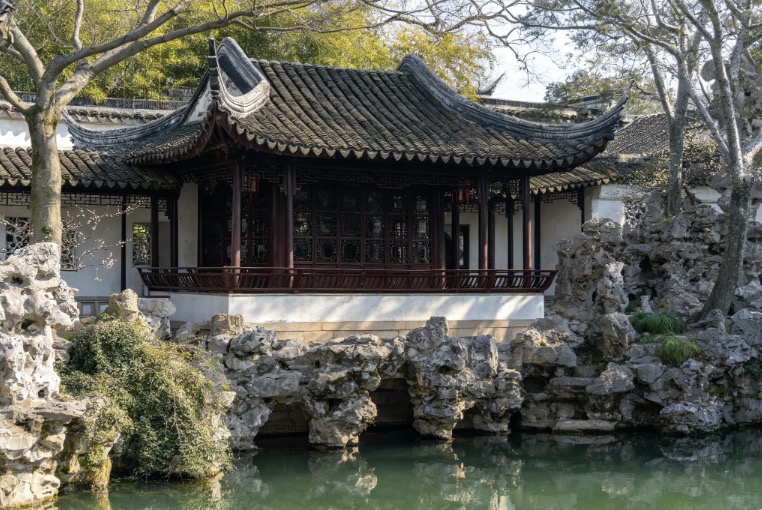
Anxiang Shuying Building sits at the northwest corner of Lion Grove, a two-story pavilion themed around plum appreciation. Its name draws from the Northern Song recluse Lin Bu's immortal plum verses: "Sparse shadows slant across clear shallow water; faint scent drifts at moonlit dusk"—two lines that virtually defined the plum blossom aesthetic standard in Chinese culture: sparse branches, subtle fragrance. Several ancient plum trees grow before the building; in winter bloom, ascending the upper floor reveals branch shadows reflected in the pool and delicate fragrance drifting through windows, making the poem's imagery tangibly realized through direct sensory experience. Interior displays include related poetic calligraphy and paintings; window lattice designs deliberately lower the sightline to match plum-viewing angles. From naming to spatial design, the building is tightly bound to the plum theme—an outstanding example of translating poetic imagery into architectural experience at Lion Grove.
Huxin Pavilion (Lake-Center Pavilion) · 湖心亭
🎧 In app 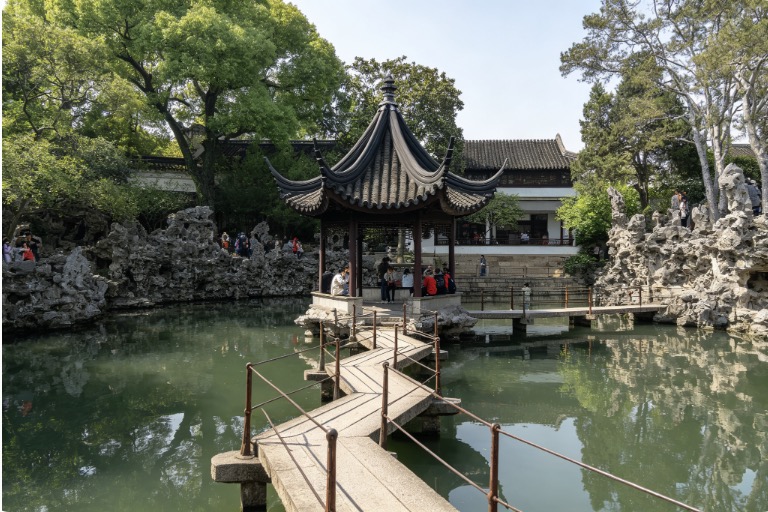
Huxin Pavilion occupies the exact center of Lion Grove's main pool—a single-story hexagonal pavilion connected to both banks by stone curved bridges. Though small, it holds the absolute core of the garden's spatial composition: standing inside with a 360-degree panorama, the rockery group, Zhibai Pavilion, Hualan Hall, Stone Boat, and other major scenes encircle the view like a painting; the pavilion itself becomes a borrowed-view object for other buildings, creating a mutual viewing relationship of "the pavilion as center, every scene seeing every scene." Huxin Pavilion's design embodies Suzhou garden's essence of "seeing the vast through the small": the smallest-volume building placed at the center of the largest-scale water surface, the pavilion's transparency in exchange for the pool's sense of expansiveness—inside, one does not feel the pavilion small but the pool vast. Under morning light or evening shadow, the pavilion floats on the water as one of Lion Grove's most photogenic spots.
Woyun Chamber (Cloud-Reclining Chamber) · 卧云室
🎧 In app 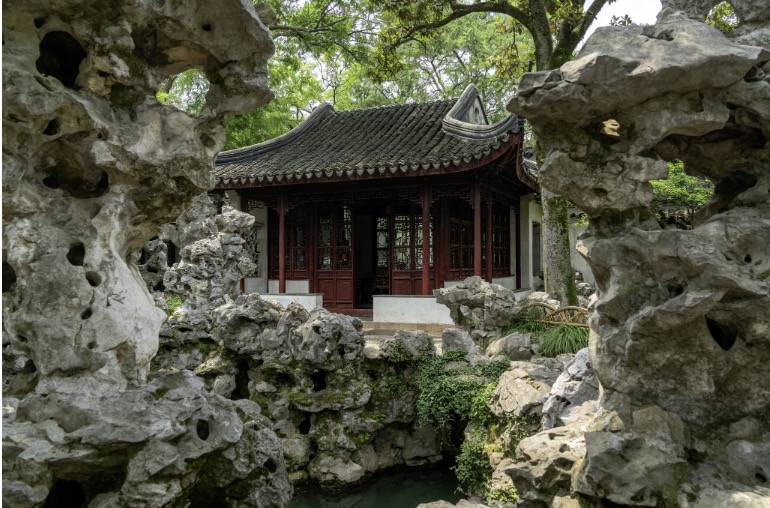
Woyun Chamber occupies the highest point of Lion Grove's rockery—the garden's highest-altitude building and the only Chan meditation space embedded within a stone peak. "Woyun" (Cloud-Reclining) is richly poetic and Chan-inflected: clouds above, the chamber amid the rocks, the person inside seemingly resting on clouds looking down at the mortal world; it also echoes monk Tianru's "cloud-and-water Chan mind" practice philosophy. The chamber is extremely small, accommodating only a few seated people, austere inside—just meditation cushions and a simple table contrasting with the rough stone walls outside. Gazing outward, rock tunnels, pool ripples, and distant garden walls compose a framed view; the spatial elevation confers a genuine sense of psychological detachment—looking down from the "clouds" upon the "red dust." This is Lion Grove's most exquisite work of embedding architecture within rockery, and the supreme expression of Chan philosophy merged with garden art.