🎫 Ticket Not free; daytime session requires real-name reservation; no on-site tickets
🎫 Ticket Peak season (April 1 – October 31): 40 RMB/person
🎫 Ticket Off-season (November 1 – March 31 of the following year): 30 RMB/person
🎫 Ticket Night tour (Master of the Nets Night Garden, separate session, not included in daytime ticket): Open mid-March to mid-November, 120 RMB/person (includes Kunqu opera / Pingtan live performance; garden pass not accepted, no additional discounts)
🕘 Opening Hours - Daytime:
- Peak season (April, May, July–October): 07:30–17:30 (ticket sales and entry stop at 17:00)
- Off-season (January–March, June, November, December): 07:30–17:00 (ticket sales and entry stop at 16:30)
- Night Garden: generally open from around March to November, approximately 19:30–22:00; specific sessions subject to official announcement
🕘 Opening Hours Daytime off-season (November 1 – March 31): 07:30–17:00, last admission at 16:30
🕘 Opening Hours Night tour: Sunday–Thursday 18:25–21:40 (last admission at 20:55); Friday/Saturday/holidays 18:25–22:20 (last admission at 21:35)
🚇 Metro Line 5 Nanyuan North Road Station Exit 2/4, walk about 8–10 minutes (closest, preferred)
🚇 Metro Alternative: Line 4 Sanyuanfang Station, walk about 10 minutes
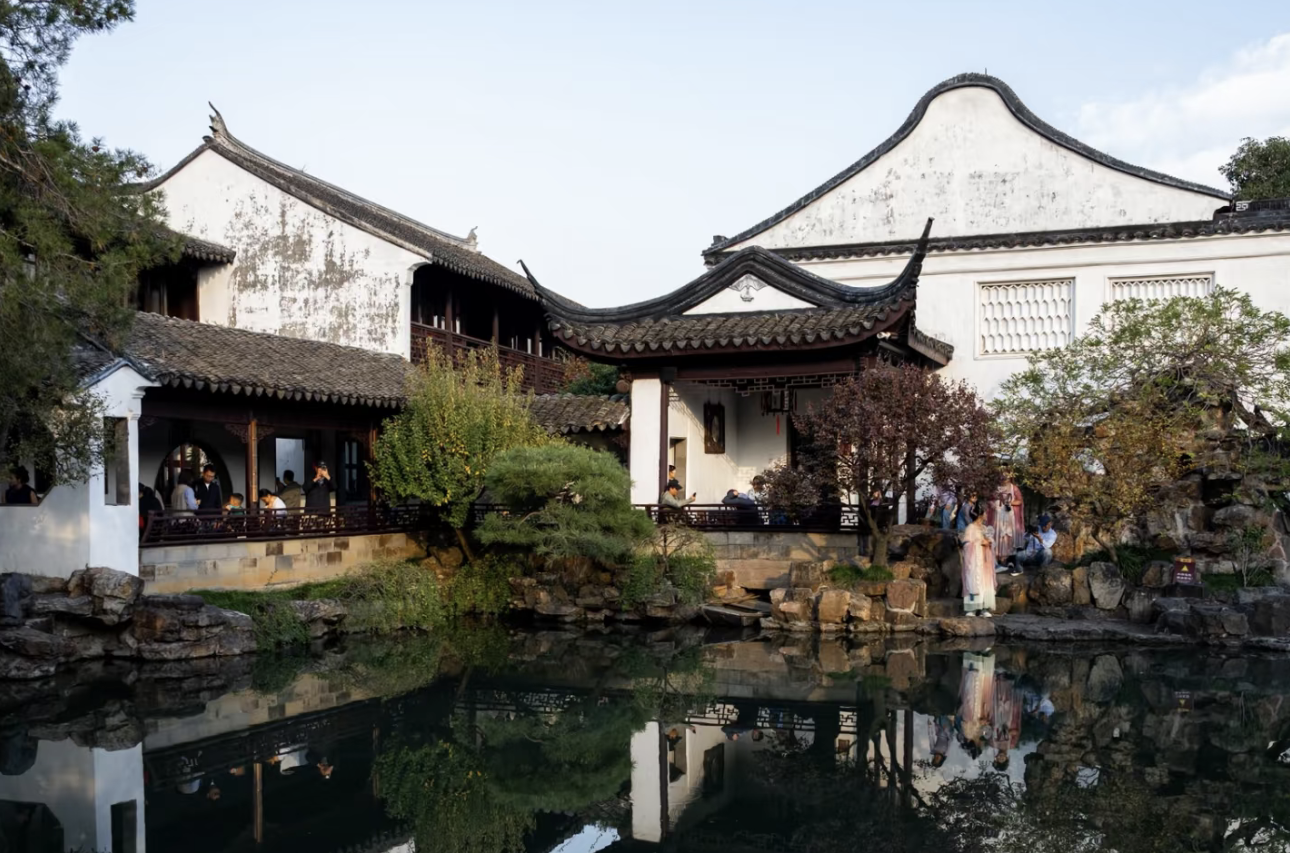
📍 Address No. 11 Kuojiatou Lane, Gusu District, Suzhou, Jiangsu Province, China Map ↗ Inside Master-of-Nets Garden / Wangshi Garden
Entrance Gate · 入口大门
🎧 In app 
The entrance gate of Wangshi Yuan is located at No. 11, Kuojia Tou Lane, nestled among residential alleyways in the southeastern corner of Suzhou's old city. The gatehouse follows traditional Jiangnan residential style, with a grey-brick doorframe, black-lacquered wooden doors, and a plaque reading "Wangshi Yuan" above the lintel. The narrow lane approaching the gate is lined with white walls and grey-tiled eaves, giving no hint that a UNESCO World Heritage garden lies at its end. This "hidden within the city" setting is precisely the garden's defining characteristic—the owner sought not street-facing grandeur, but a tranquil retreat within the bustling city. Pushing open the door reveals the Sedan Chair Hall, offering a glimpse of the garden within, guiding visitors from the mundane alley into a refined garden realm. The interplay of compression and release in spatial design showcases the masterful vision of the garden's creator.
Sedan Chair Hall · 轿厅
🎧 In app 
The Sedan Chair Hall is the first building in the residential section of Wangshi Yuan and the first interior space visitors enter. The hall spans three bays with a simple, open beam-frame structure. It was originally used for parking sedan chairs: guests would dismount here, and after a servant announced them to the master, they would be received into the inner hall. A plaque inscribed by a Qing Dynasty scholar hangs at the center, flanked by couplets whose texts often relate to fishing and reclusion, echoing the garden's name "Master of the Nets." The hall contains a large wall mirror and a marble screen—the mirror reflects the courtyard scene behind, creating an illusion of extended space within the compact hall. This is a classic "borrowed scenery" technique in Suzhou gardens. Though merely a transitional space, the Sedan Chair Hall already reveals the owner's cultural refinement and design philosophy through these carefully curated elements.
Wanjuan Hall (Hall of Ten Thousand Scrolls) · 万卷堂
🎧 In app 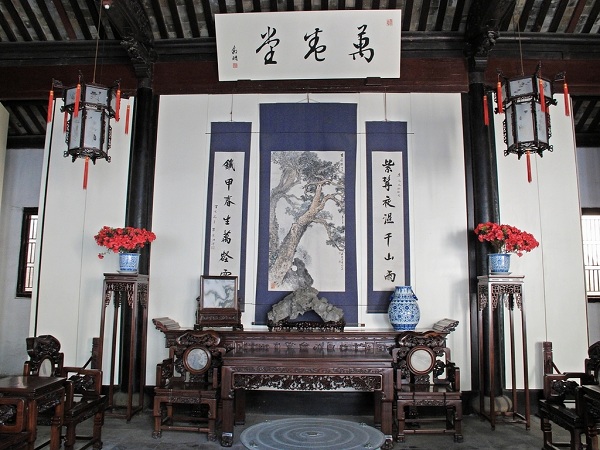
Wanjuan Hall is the main hall of Wangshi Yuan's residential quarter and the garden's most important ceremonial building. The name "Wanjuan Tang" (Hall of Ten Thousand Scrolls) traces back to the Southern Song Dynasty, when Shi Zhengzhi, Vice Minister of Personnel, built a garden here to house his vast book collection—the name embodying the Chinese literati ideal of "reading ten thousand scrolls." When Song Zongyuan rebuilt the garden during the Qianlong reign of the Qing Dynasty, he retained the name in tribute to his predecessor. The hall spans five bays with a lofty, imposing interior, robust timber columns, and blue-stone basin-shaped plinths. A plaque reading "Wanjuan Tang" hangs at the center, featuring calligraphy attributed to Ming Dynasty master Wen Zhengming. The interior follows traditional arrangement: a long narrow table at center, armchairs on either side, and celebrated paintings and calligraphy on the walls. The courtyard before the hall features golden osmanthus and white magnolia, symbolizing "abundance of gold and jade." This was where the owner received distinguished guests, hosted family banquets, and displayed his cultural refinement.
Xiexiu Tower (Gathering Elegance Tower) · 撷秀楼
🎧 In app 
Xiexiu Tower stands directly north of Wanjuan Hall, serving as the inner residence of Wangshi Yuan where the owner and family conducted daily life. "Xiexiu" means "gathering elegance," derived from the poetry of Xie Lingyun of the Southern Dynasties, expressing the owner's aspiration for a refined life. The two-story building has a ground floor for living and dining, with bedrooms and a study upstairs. The upper floor features a corridor and windows that open onto views of Rosy Cloud Pool and the garden's pavilions. The interior once contained rosewood furniture, carved railings, and exquisite latticed windows, all demonstrating superb craftsmanship. A small sky-well connects Xiexiu Tower to Wanjuan Hall, with a planted flower bed featuring camellia and nandina, providing year-round interest. The transition from Wanjuan Hall to Xiexiu Tower marks a shift from public ceremonial space to private domestic space, embodying the traditional residential layout of "front hall, rear tower, inner and outer distinct," while showcasing the refinement of a wealthy Suzhou household's daily life.
Tiyun Room (Cloud-Stepping Room) · 梯云室
🎧 In app 
Tiyun Room is located in the northwest of Wangshi Yuan, serving as the owner's study. "Tiyun" (Cloud-Stepping) derives from a Tang Dynasty tale of Zhou Sheng "climbing clouds to fetch the moon," metaphorically suggesting ascending to lofty heights in pursuit of elevated ideals. The most brilliant feature of this room is its means of access: rather than a conventional wooden staircase, a pathway of Taihu limestone rocks is stacked into a miniature mountain path. One must ascend along the rockery to reach the second-floor study, as if walking on clouds—hence "Tiyun." The rockery serves dual purpose as both staircase and landscape feature, a masterstroke of ingenuity. The interior was once furnished with a writing desk, bookshelves, and the Four Treasures of the Study, in a serene setting. Windows reveal rockeries and verdant bamboo outside, creating the atmosphere of "a study hidden in the mountains." Tiyun Room's design exemplifies the Suzhou garden principle of "adapting to the terrain and borrowing cleverly," perfectly uniting practical function with aesthetic delight—a classic case of "function as art" in garden architecture.
Kansong Duhua Veranda (Pine-Viewing and Painting-Reading Veranda) · 看松读画轩
🎧 In app 
Kansong Duhua Veranda stands on the western shore of Rosy Cloud Pool, one of the most literati-spirited buildings in Wangshi Yuan. The name "Kansong Duhua" (Viewing Pines and Reading Paintings) identifies the two refined pursuits associated with this space: admiring ancient pines and contemplating painted landscapes. The veranda has three bays facing south toward the water, with a seated railing at the front for both sitting and viewing. In the courtyard before the veranda grows a Buddhist pine (Podocarpus) estimated to be several centuries old, its weathered branches and ancient silhouette set against Taihu rocks, forming a natural "pine and rock painting." Seated inside, the owner could appreciate the vigor of the pine and the mood of paintings, with nature and art intermingling seamlessly. The interior once held a writing desk and hanging paintings, with delicately patterned latticed windows framing views like picture frames. Looking out from the veranda, Rosy Cloud Pool, the Moon-Arriving Pavilion, and Zhuoying Water Pavilion layer upon one another like an unrolling landscape scroll. This veranda exemplifies the Suzhou garden aesthetic of "still contemplation"—not wandering through scenery, but sitting peacefully and letting the landscape come to you.
Dianchun Yi (Late Spring Cabin) · 殿春簃
🎧 In app 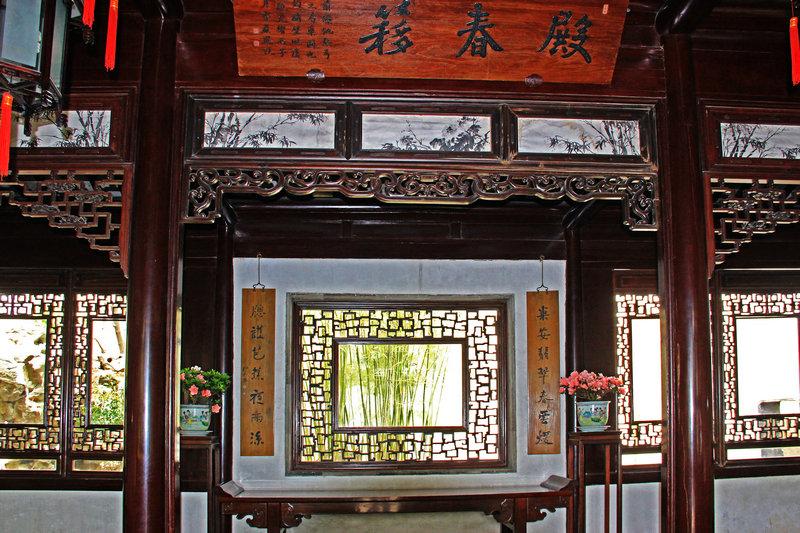
Dianchun Yi is located in the northwest corner of Wangshi Yuan, a self-contained courtyard of its own. "Dianchun" refers to late spring—herbaceous peonies, the last flowers to bloom in spring, were called "dianchun flowers," and since peonies were originally planted here, the name "Dianchun Yi" was chosen. "Yi" means a small chamber beside a main building. Though the courtyard covers barely a quarter-acre, it integrates architecture, rockery, plantings, and a spring—a "garden within a garden." The main room is a three-bay study with refined furnishings including a writing desk, zither table, and antiquities. Before the study stands a half-pavilion named Lengquan Ting (Cold Spring Pavilion), beside Hanbi Spring, whose crystal-clear water never runs dry. Taihu stone peaks in the courtyard are exquisitely perforated, complemented by peonies, plum trees, and bamboo. In 1980, the Metropolitan Museum of Art in New York created the Astor Court (Ming Studio) based on Dianchun Yi, marking a milestone in the global journey of Chinese classical gardens. Dianchun Yi thus became a celebrated chapter in the history of Sino-American cultural exchange.
Yuedao Fenglai Pavilion (Moon-Arriving and Wind-Coming Pavilion) · 月到风来亭
🎧 In app 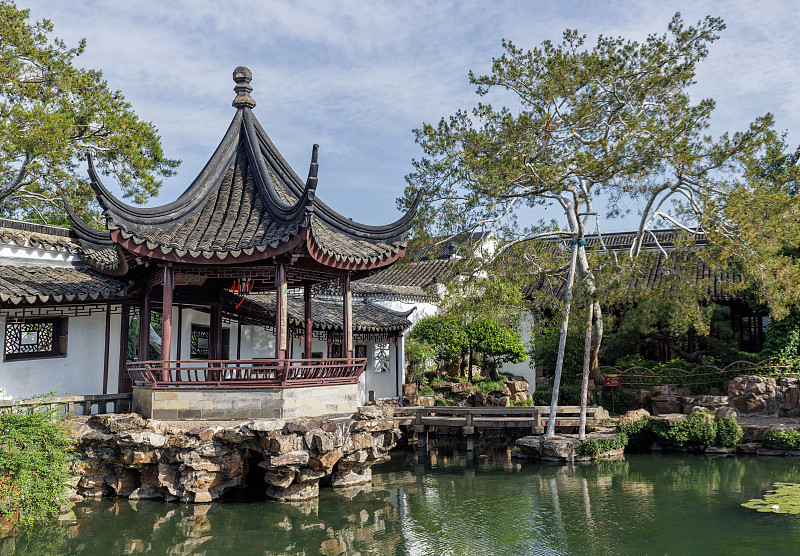
Yuedao Fenglai Pavilion stands at the center of Rosy Cloud Pool's western shore, surrounded by water on three sides—the core structure of Wangshi Yuan's waterscape. The name derives from a line by Song Dynasty poet Shao Yong: "When the moon reaches the heart of heaven, when the wind comes across the water's surface"—a vision of transcendent beauty: moonlight at zenith bathes all in radiance, and wind on water ripples into endless patterns. The square pavilion has a gable-and-hip roof, open on three sides with one wall. A "beauty's resting" railing faces the water; seated here, the pool's surface mirrors the world. This is the garden's premier moon-viewing spot—on Mid-Autumn night, the bright moon rises in the east and reflects into the pool, one moon above and one below shimmering in tandem, the ultimate Suzhou garden moon-viewing experience. A large mirror hangs inside the pavilion, reflecting the pavilions across the water—virtual and real intertwining, giving the compact pool infinite depth. The pavilion masterfully integrates four elements—moon, wind, water, and mirror—exemplifying the highest ideal of Chinese gardens: "though made by human hands, it seems created by nature itself."
Zhuoying Water Pavilion (Tassel-Washing Water Pavilion) · 濯缨水阁
🎧 In app 
Zhuoying Water Pavilion stands on the southern shore of Rosy Cloud Pool, a water pavilion built flush with the surface. "Zhuoying" (washing tassels) derives from the Chu Ci (Songs of Chu) "Yu Fu" chapter: "When the waters of Canglang are clear, I can wash my hat-strings." "Ying" refers to the strings of an official's cap; "washing the tassels" metaphorically means cleansing oneself of official life and retreating to nature. This naming perfectly echoes Wangshi Yuan's theme of "fisherman's reclusion." The pavilion spans three bays with a gable-and-hip roof, open on all sides, supported on stone columns above the water. Inside are stone tables and stools; on summer days, cool breezes sweep through off the pool, dispelling all heat. Looking north from the pavilion, Yuedao Fenglai Pavilion and Kansong Duhua Veranda face each other across the water, reflected in the pool like a symmetrical ink painting. The name plaque was inscribed by a Qing Dynasty scholar, with couplets relating to the themes of fishing and the Canglang River. Zhuoying Water Pavilion uses literary allusion as its inner core and waterscape as its outer expression, seamlessly fusing poetic, pictorial, and garden meaning into one.
Zhuwai Yizhi Veranda (A Single Branch Beyond Bamboo Veranda) · 竹外一枝轩
🎧 In app 
Zhuwai Yizhi Veranda is located at the northeast corner of Rosy Cloud Pool, a narrow, elongated pavilion built along the water. "Zhuwai Yizhi" (A Single Branch Beyond Bamboo) derives from Su Shi's poem "He Qin Taixu Meihua": "A single branch slanting beyond bamboo is all the more lovely," originally describing how a plum branch extending beyond a bamboo thicket embodies elegant restraint. The name identifies both the plantings outside the window—bamboo and plum—and the viewing experience itself, which resembles contemplating a literati painting: spare yet resonant. The veranda has three bays running north-south, facing the water to the west and backed by a wall to the east. The western side features a full run of tall latticed windows, each frame like a picture frame capturing the pool scenery. Outside, a few stalks of bamboo and a single plum tree grow; in winter, when a plum branch extends beyond the bamboo, the poem's imagery comes alive. The narrow interior has a seated railing and small table, ideal for sitting alone with tea and quietly observing the water. Looking out, Yuedao Fenglai Pavilion and Zhuoying Water Pavilion across Rosy Cloud Pool appear like a landscape painting, virtual and real interplaying. This veranda achieves much with little, sees the large within the small—a vivid embodiment of the Suzhou garden philosophy of "a mustard seed holding Mount Sumeru."